. 2005 Jul;15(7):928-35.
doi: 10.1101/gr.3437105. Epub 2005 Jun 17.

Genomic deletion of a long-range bone enhancer misregulates sclerostin in Van Buchem disease

Affiliations

Genomic deletion of a long-range bone enhancer misregulates sclerostin in Van Buchem disease

Gabriela G Loots et al. Genome Res. 2005 Jul.

Abstract

Mutations in distant regulatory elements can have a negative impact on human development and health, yet because of the difficulty of detecting these critical sequences, we predominantly focus on coding sequences for diagnostic purposes. We have undertaken a comparative sequence-based approach to characterize a large noncoding region deleted in patients affected by Van Buchem (VB) disease, a severe sclerosing bone dysplasia. Using BAC recombination and transgenesis, we characterized the expression of human sclerostin (SOST) from normal (SOST(wt)) or Van Buchem (SOST(vbDelta) alleles. Only the SOST(wt) allele faithfully expressed high levels of human SOST in the adult bone and had an impact on bone metabolism, consistent with the model that the VB noncoding deletion removes a SOST-specific regulatory element. By exploiting cross-species sequence comparisons with in vitro and in vivo enhancer assays, we were able to identify a candidate enhancer element that drives human SOST expression in osteoblast-like cell lines in vitro and in the skeletal anlage of the embryonic day 14.5 (E14.5) mouse embryo, and discovered a novel function for sclerostin during limb development. Our approach represents a framework for characterizing distant regulatory elements associated with abnormal human phenotypes.


Figures
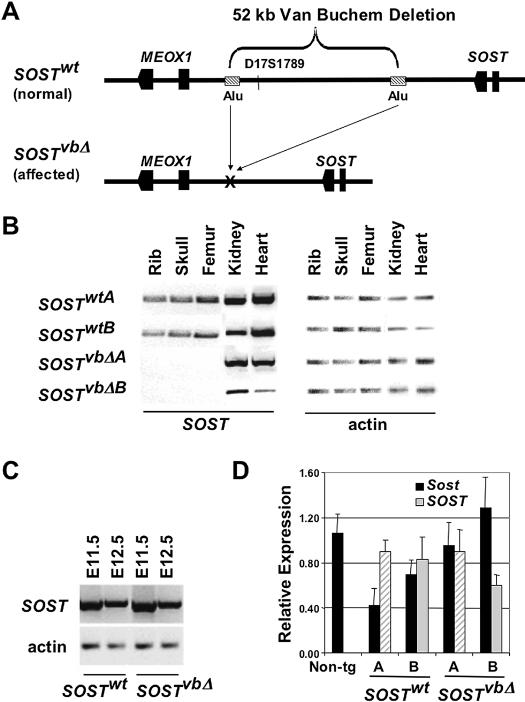
Figure 1.
Figure 1.
Generation and characterization of Van Buchem transgenic mouse models. (A) A 158-kb human BAC (SOSTwt) spanning SOST and MEOX1 was engineered using in vitro BAC recombination in Escherichia coli (Lee et al. 2001) by deleting the 52-kb noncoding region missing in VB patients (SOSTvbΔ). Human SOST expression was analyzed by rtPCR in adult tissues (B), embryos (C), and measured by quantitative rtPCR in E10.5 embryos (D) from two independent lines of each SOSTwt and SOSTvbΔ transgene.
Figure 2.
Figure 2.
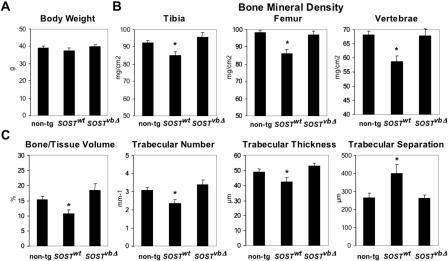
SOST transgenic expression has a negative impact on bone parameters. (A) Body weight measurements of 5-mo-old male mice (non-tg = 13; SOSTwt = 15; SOSTvbΔ = 14; animals were pooled from two lines of SOSTwt and two lines of SOSTvbΔ; Supplemental material). (B) Bone mineral density in the tibia, femur, and lumbar spine as evaluated by DEXA. (C) Bone volume, trabecular number, thickness, and separation as evaluated in the cancellous bone compartment of the proximal tibia metaphysis by microCT. Mean ± SEM; (*) p < 0.05 vs. non-tg.
Figure 3.
Figure 3.
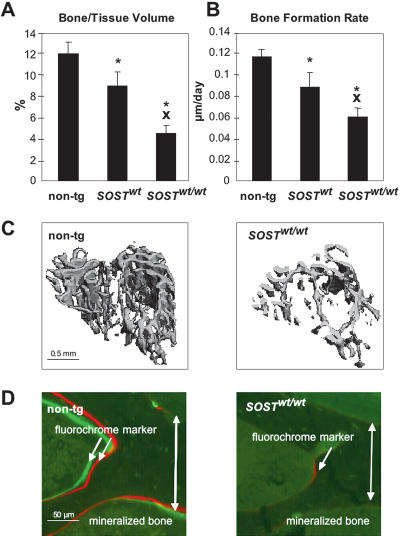
Human SOST dose effect on bone metabolism in the proximal tibia metaphysis of 5-mo-old male mice (non-tg = 5; SOSTwt = 7; SOSTwt/wt = 4). (A) Bone volume and (B) bone formation rates as determined by microCT scans and histomorphometric analysis, respectively. Mean ± SEM; (*) p < 0.05 vs. non-tg; (X) p < 0.05 vs. SOSTwt. (C) Cancellous bone compartment of nontransgenic and SOSTwt/wt mice. (D) Fluorochrome marker uptake at site of active mineralization of bone matrix laid down by osteoblasts in wild-type and transgenic mice at the interface between endocortex and cancellous bone.
Figure 4.
Figure 4.
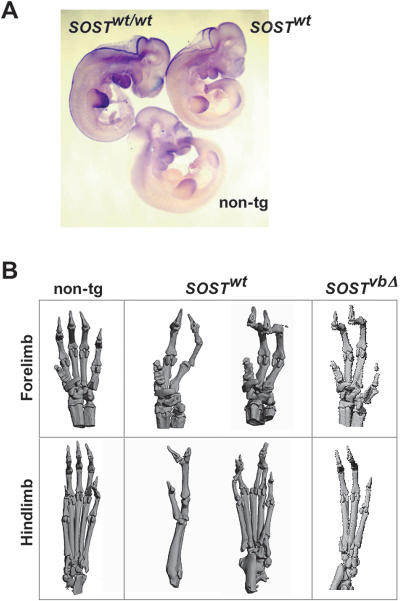
Embryonic sost expression and limb deformity in SOSTwt and SOSTvbΔ transgenic mice. (A) High levels of embryonic SOST expression were predominantly detected in the developing limb bud of E10.5 defective mice, as visualized by whole-mount in situ hybridization using a SOST probe that detects human and mouse transcripts. (B) microCT scans of defective SOSTwt and SOSTvbΔ adult limbs overexpressing human SOST.
Figure 5.
Figure 5.
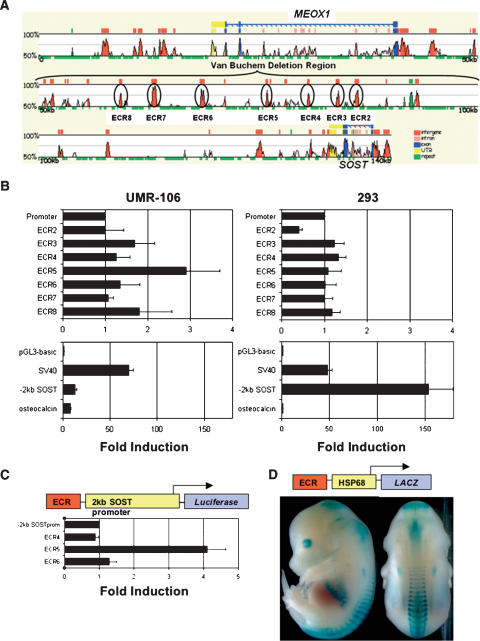
Enhancer activity of evolutionarily conserved noncoding sequences from the Van Buchem deletion region. (A) Human/mouse genomic alignment generated using the zPicture alignment engine (http://zpicture.dcode.org/). Exons are in blue, untranslated regions in yellow, repetitive elements in green, and noncoding sequences in red (intragenic) or pink (intronic). Seven highly conserved elements (≥200 bp; ≥80% ID; ECR2–8) within VBΔ were tested in rat osteosarcoma (UMR-106) and kidney cells (293) for the ability to enhance luciferase expression from the SV40 promoter (B) or human SOST promoter (C). ECR5 activates the human SOST promoter in rat osteosarcoma cells (C), and drives the hsp68 promoter in the skeleton of E14.5 mouse embryos (D).

References

    1. Balemans, W., Van Den Ende, J., Freire Paes-Alves, A., Dikkers, F.G., Willems, P.J., Vanhoenacker, F., de Almeida-Melo, N., Alves, C.F., Stratakis, C.A., Hill, S.C., et al. 1999. Localization of the gene for sclerosteosis to the van Buchem disease-gene region on chromosome 17q12–q21. Am. J. Hum. Genet. 64: 1661-1669. - PMC - PubMed
    1. Balemans, W., Ebeling, M., Patel, N., Van Hul, E., Olson, P., Dioszegi, M., Lacza, C., Wuyts, W., Van Den Ende, J., Willems, P., et al. 2001. Increased bone density in sclerosteosis is due to the deficiency of a novel secreted protein (SOST). Hum. Mol. Genet. 10: 537-543. - PubMed
    1. Balemans, W., Patel, N., Ebeling, M., Van Hul, E., Wuyts, W., Lacza, C., Dioszegi, M., Dikkers, F.G., Hildering, P., Willems, P.J., et al. 2002. Identification of a 52 kb deletion downstream of the SOST gene in patients with van Buchem disease. J. Med. Genet. 39: 91-97. - PMC - PubMed
    1. Beighton, P., Davidson, J., Durr, L., and Hamersma, H. 1977. Sclerosteosis—An autosomal recessive disorder. Clin. Genet. 11: 1-7. - PubMed
    1. Brunet, L.J., McMahon, J.A., McMahon, A.P., and Harland, R.M. 1998. Noggin, cartilage morphogenesis, and joint formation in the mammalian skeleton. Science 280: 1455-1457. - PubMed

Publication types