


Transplantation of spermatogonial stem cells isolated from leukemic mice restores fertility without inducing leukemia
- PMID: 15965502
- PMCID: PMC1150287
- DOI: 10.1172/JCI24189
Transplantation of spermatogonial stem cells isolated from leukemic mice restores fertility without inducing leukemia
Abstract
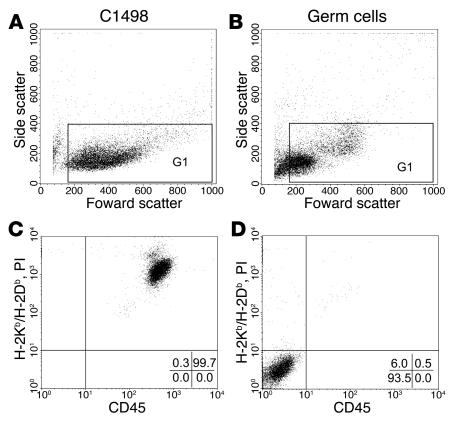
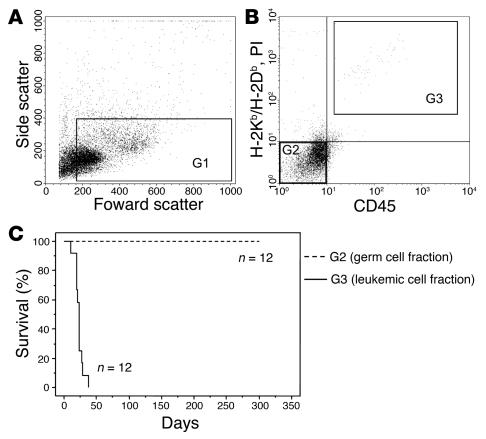
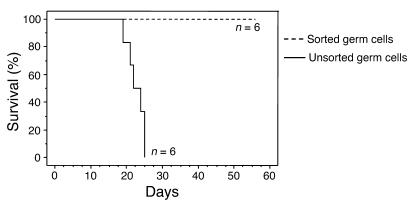
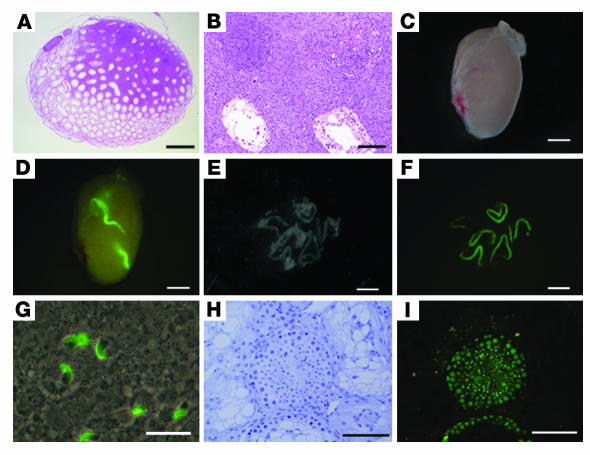
More than 70% of patients survive childhood leukemia, but chemotherapy and radiation therapy cause irreversible impairment of spermatogenesis. Although autotransplantation of germ cells holds promise for restoring fertility, contamination by leukemic cells may induce relapse. In this study, we isolated germ cells from leukemic mice by FACS sorting. The cell population in the high forward-scatter and low side-scatter regions of dissociated testicular cells from leukemic mice were analyzed by staining for MHC class I heavy chain (H-2K/H-2D) and for CD45. Cells that did not stain positively for H-2K/H-2D and CD45 were sorted as the germ cell-enriched fraction. The sorted germ cell-enriched fractions were transplanted into the testes of recipient mice exposed to alkylating agents. Transplanted germ cells colonized, and recipient mice survived. Normal progeny were produced by intracytoplasmic injection of sperm obtained from recipient testes. When unsorted germ cells from leukemic mice were transplanted into recipient testes, all recipient mice developed leukemia. The successful birth of offspring from recipient mice without transmission of leukemia to the recipients indicates the potential of autotransplantation of germ cells sorted by FACS to treat infertility secondary to anticancer treatment for childhood leukemia.
Figures
References
-
- U.S. Cancer Statistics Working Group. 2004. United States cancer statistics: 2000 incidence and mortality — updated and enhanced. Department of Health and Human Services, Centers for Disease Control and Prevention, and National Cancer Institute. Atlanta, Georgia, USA. http://apps.nccd.cdc.gov/uscs/index.asp?Year=2000.
-
- Jemal A, et al. Annual report to the nation on the status of cancer, 1975-2001, with a special feature regarding survival. Cancer. 2004;101:3–27. - PubMed
-
- Humpl T, Schramm P, Gutjahr P. Male fertility in long-term survivors of childhood ALL. Arch. Androl. 1999;43:123–129. - PubMed
-
- Thomson AB, et al. Semen quality and spermatozoal DNA integrity in survivors of childhood cancer: a case-control study. Lancet. 2002;360:361–367. - PubMed
-
- Bauld C, Anderson V, Arnold J. Psychosocial aspects of adolescent cancer survival. J. Paediatr. Child Health. 1998;34:120–126. - PubMed
MeSH terms
Substances
LinkOut - more resources
Full Text Sources
Other Literature Sources
Research Materials
Miscellaneous
