Comparative Study
. 2005 Jul;187(13):4353-61.
doi: 10.1128/JB.187.13.4353-4361.2005.

Synergistic regulation of competence development in Bacillus subtilis by two Rap-Phr systems

Affiliations
Comparative Study

Synergistic regulation of competence development in Bacillus subtilis by two Rap-Phr systems

Cristina Bongiorni et al. J Bacteriol. 2005 Jul.

Abstract

The 11 Rap proteins of Bacillus subtilis comprise a conserved family of tetratricopeptide (TPR)-containing regulatory proteins. Their activity is inhibited by specific Phr pentapeptides produced from the product of phr genes through an export-import maturation process. We found that one of the proteins, namely RapF, is involved in the regulation of competence to DNA transformation. The ComA response regulator and transcription factor for initiation of competence development is the target of RapF. Specific binding of RapF to the carboxy-terminal DNA-binding domain of ComA inhibits the response regulator's ability to bind its target DNA promoters. The PhrF C-terminal pentapeptide, QRGMI, inhibits RapF activity. The activity of RapF and PhrF in regulating competence development is analogous to the previously described activity of RapC and PhrC (L. J. Core and M. Perego, Mol. Microbiol. 49:1509-1522, 2003). In fact, the RapF and PhrF pair of proteins acts synergistically with RapC and PhrC in the overall regulation of the ComA transcription factor. Since the transcription of the RapC- and RapF-encoding genes is positively regulated by their own target ComA, an autoregulatory circuit must exist for the competence transcription factor in order to modulate its activity.


Figures
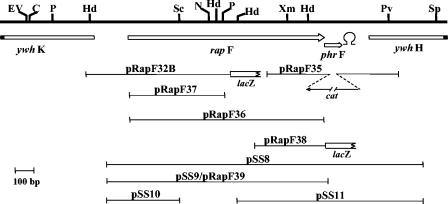
FIG. 1.
FIG. 1.
Restriction map of the chromosomal region containing the rapF-phrF genes. Arrows indicate open reading frames and their direction. The position of a putative transcription terminator downstream of phrF is indicated. Fragments cloned in plasmids used in this study are indicated by lines. Restriction sites relevant to this study are indicated with the following symbols: C, ClaI; EV, EcoRV; Hd, HindIII; N, NdeI; P, PstI; Pv, PvuII; Sc, ScaI; Sp, SphI; Xm, XmnI. The ywhK and ywhH open reading frames are shown truncated.
FIG. 2.
FIG. 2.
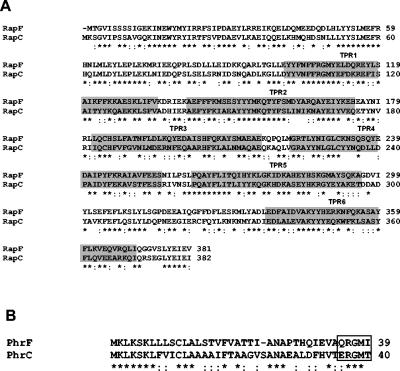
Amino acid sequence alignment of RapF and RapC (A) or PhrF and PhrC (B). Alignments were obtained by the ClustalW program. Shaded areas in panel A identify the TPR domains characterizing Rap proteins. The box in panel B identifies the sequence of the active pentapeptide inhibitors. Asterisks indicate identical residues, while colons denote conserved residues.
FIG. 3.
FIG. 3.
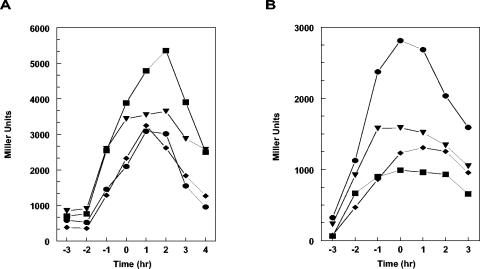
Transcription regulation of rapA in rapF, rapC, phrF, and phrC mutants. Strains carrying rapA-lacZ transcriptional fusion constructs were grown in Schaffer's sporulation medium. Time points were taken at hourly intervals before and after the transition (To) from exponential growth to stationary phase. A. •-, JH12981 wild type; -♦-, JH23059 rapF; -▾-, JH11030 rapC; -▪-, JH23065 rapC rapF. B. •-, JH12981 wild type; -♦-, JH11500 phrF; -▾-, JH11423 phrC; -▪-, JH11508 phrC phrF.
FIG. 4.
FIG. 4.
Transcriptional regulation of rapA in RapF-PhrF overexpressing strains. Cultures for β-galactosidase analysis were grown in Schaeffer's sporulation medium containing erythromycin 5 μg/ml and lincomycin 25 μg/ml. Strains and symbols: -▴-, JH23061 (pSS9); -•-, JH23060 (pSS8); -▾-, JH23061 (pSS11); -▪-, JH23062 (pSS10); -□-, JH23064 (pHT315).
FIG. 5.
FIG. 5.
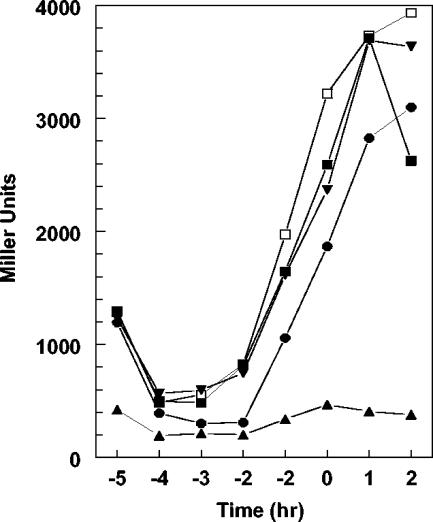
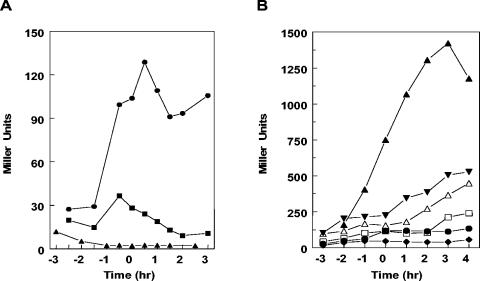
Transcription analysis of the rapF (A) and phrF (B) promoters. Strains carrying the rapF-lacZ fusion construct pRapF32B or the phrF-lacZ plasmid pRapF38 were grown in Schaeffer's sporulation medium and assayed as described in Materials and Methods. A. -•-, JH12981 wild type; -▪-, JH11224 comP; -▴-, JH11223 comA. B. -□-, JH11507 wild type; -♦-, JH23066, spo0A; -•-, JH23069 spo0H; -▵, JH23068 abrB; -▾-, JH23067 spo0A abrB, -▴-, JH19163 (rapFphrF-lacZ).
FIG. 6.
FIG. 6.
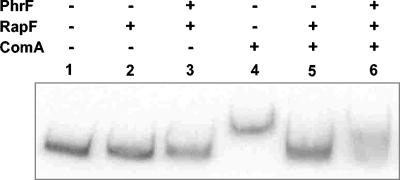
Electrophoresis mobility shift assay of ComA binding to the rapC promoter. The labeled 313-bp rapC promoter fragment was prepared as described in Materials and Methods and used at 1.5 nM final concentration per lane. ComA and RapF were used at 5 μM while the PhrF peptide was added at 50 μM final concentration.
FIG. 7.
FIG. 7.
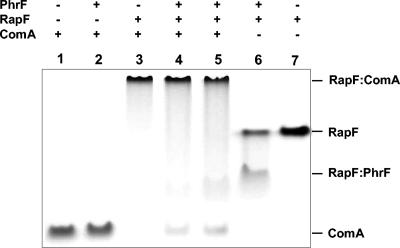
Interaction of RapF with ComA and PhrF. ComA (10 μM), RapF (10 μM), and PhrF (50 μM) were analyzed on a 10% Tris-Tricine-EDTA native gel stained with Coomassie blue. The gel was run at 4°C for 24 h at constant voltage (63 V). In lane 4, RapF was preincubated with ComA for 5 min before the addition of PhrF followed by a further 5-min incubation at room temperature. In lane 5, RapF was preincubated with PhrF and then ComA was added to the reaction mixture for a further 5-min incubation.
FIG. 8.
FIG. 8.
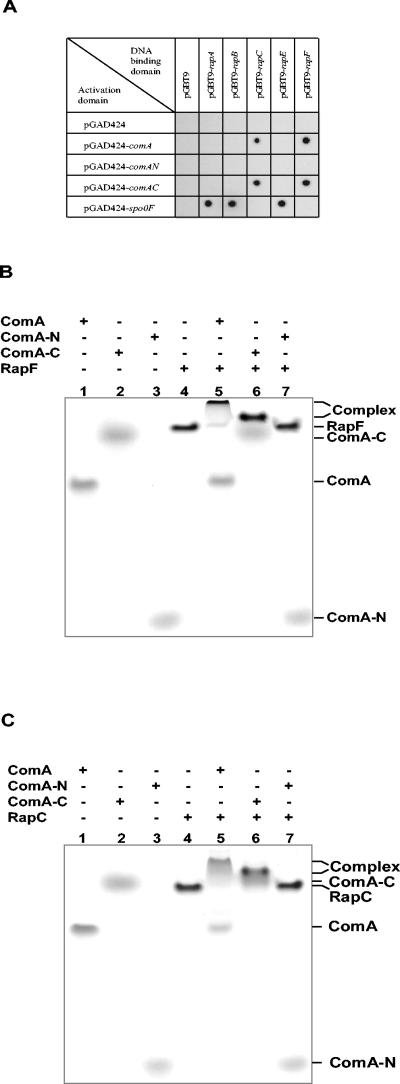
RapC and RapF interaction with ComA. A. Two-hybrid system analysis. Diploid strains were obtained by mating PJ69-4A (containing pGBT9 derivatives) with PJ69-4α (containing pGAD424 derivatives). Interaction between proteins was detected on selection medium (SC-LWH) supplemented with 1mM 3-AT 4 days after inoculation from liquid SC-LW medium. B. Native gel analysis of RapF interaction with ComA. Proteins (40 μM) were run on 10% acrylamide Tris-Tricine native gel for 40 h at constant voltage (63 V) at 4°C. C. Native gel analysis of RapC interaction with ComA. The gel was run as described in B.

References

    1. Anagnostopoulos, C., and J. Spizizen. 1961. Requirements for transformation in Bacillus subtilis. J. Bacteriol. 81:741-746. - PMC - PubMed
    1. Arantes, O., and D. Lereclus. 1991. Construction of cloning vectors for Bacillus thuringiensis. Gene 108:115-119. - PubMed
    1. Blatch, G. L., and M. Lassle. 1999. The tetratricopeptide repeat: a structural motif mediating protein-protein interactions. Bioessays 21:932-939. - PubMed
    1. Brinker, A., C. Scheufler, F. von der Mülbe, B. Bleckenstein, C. Herrmann, G. Jung, I. Moarefi, and F. U. Hartl. 2002. Ligand discrimination by TPR domains. J. Biol. Chem. 277:19265-19275. - PubMed
    1. Burbulys, D., K. A. Trach, and J. A. Hoch. 1991. The initiation of sporulation in Bacillus subtilis is controlled by a multicomponent phosphorelay. Cell 64:545-552. - PubMed

Publication types

MeSH terms

LinkOut - more resources