


Review
doi: 10.1136/adc.2003.034090.
Current treatment and prognosis in children with functionally univentricular hearts
Affiliations
- PMID: 15970622
- PMCID: PMC1720497
- DOI: 10.1136/adc.2003.034090
Item in Clipboard
Review
Current treatment and prognosis in children with functionally univentricular hearts
Arch Dis Child.
2005 Jul.
Abstract
For more than 30 years Fontan-type procedures have been performed for surgical treatment in patients with functionally univentricular hearts. Advances in proper patient selection, staging of the Fontan palliation, and modifications of the surgical technique resulted in continuous improvement of the surgical results during the past two decades. However, increasing experience with medium term and long term follow-up of the Fontan circulation has drawn attention to a number of sequelae and chronic complications affecting a significant number of patients.
Figures

Functional univentricular hearts requiring palliation by Fontan-type procedures as functional correction. DILV, double inlet left ventricle; DIRV, double inlet right ventricle; TA, tricuspid atresie; PA/IVS, pulmonary atresie with intact ventricular septum; MA, mitral atriesia; HLHS, hypoplastic left heart syndrome; AVSD, atrioventricular septal defect; TGA, transposition of the great arteries; DORV, double outlet right ventricle.

(A) The bidirectional Glenn anastomosis is constructed by disconnecting the main pulmonary artery (oversewn at valvular level), dividing the superior vena cava and connecting the distal superior vena cava to the right pulmonary artery. (B) The hemi-Fontan operation consists of a right atrial to right pulmonary artery anastomosis, the right pulmonary artery is augmented anteriorly with a pulmonary allograft patch to create a wide pathway that conducts blood from the superior vena cava to the pulmonary artery; a portion of the allograft gusset is used to close the junction of the right atrium with the superior vena cava. SVC, superior vena cava; RPA, right pulmonary artery; RA, right atrium; LV, left ventricle.

Fontan-type procedures in functionally univentricular hearts. (A) Lateral tunnel procedure with fenestration (arrow). (B) Extracardiac tunnel/conduit procedure. (C) Kawashima-type operation with bilataral cavopulmonary anastomosis leaving the hepatic venous drainge to the pulmonary venous atrium. SVC, superior vena cava; RPA, right pulmonary artery; AO, aorta; LT, lateral tunnel; EC, extracardiac conduit; HV, hepatic vein; PV, pulmonary vein.
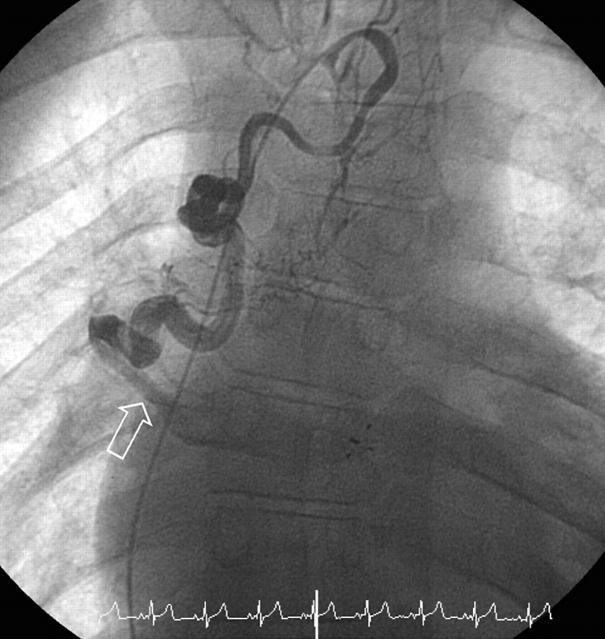
Selective injection of contrast into a tortous systemic venous channel originating from the innominate vein draining into the right upper pulmonary vein (arrow).

Pulmonary arteriovenous malformation in the right lung in a patient after a Kawashima-type operation (selective injection of contrast into the distal left pulmonary artery and simultaneous opacification of the left pulmonary veins (arrow)).
References
Publication types
MeSH terms
LinkOut - more resources
Full Text Sources
Other Literature Sources
Medical
Miscellaneous
