Randomised controlled trial of azathioprine and 5-aminosalicylic acid for treatment of steroid dependent ulcerative colitis
- PMID: 15972298
- PMCID: PMC1856376
- DOI: 10.1136/gut.2005.068809
Randomised controlled trial of azathioprine and 5-aminosalicylic acid for treatment of steroid dependent ulcerative colitis
Abstract
Background and aims: There are limited evidence based data concerning the use of azathioprine in ulcerative colitis. We aimed to compare the efficacy of azathioprine and oral 5-aminosalicylic acid in inducing remission of steroid dependent ulcerative colitis.
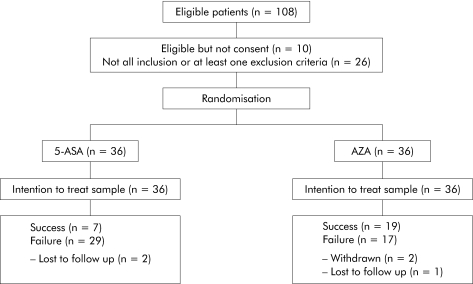
Methods: Seventy two patients with steroid dependent ulcerative colitis were admitted to this investigator-blind study. Steroid dependence was defined as a requirement for steroid therapy > or =10 mg/day during the preceding six months, with at least two attempts to discontinue the medication. The disease had to be clinically and endoscopically active at study entry, and all patients were taking systemic prednisolone (40 mg/day). Patients were randomised to receive azathioprine 2 mg/kg/day or oral 5-aminosalicylic acid 3.2 g/day, for a six month follow up period. The outcome of the treatment was defined as (1) success, indicating induction of clinical and endoscopic remission and steroid discontinuation, or (2) failure, indicating the absence of clinical and endoscopic remission and therefore the need for at least one further cycle of systemic steroids to control symptoms, apart from the initial one, or colectomy.
Results: Significantly more patients in the azathioprine than in the 5-aminosalicylic acid group had clinical and endoscopic remission, and discontinued steroid therapy, both in the intention to treat (azathioprine v 5-aminosalicylic acid: 19/36 patients (53%) v 7/36 (21%); odds ratio (OR) 4.78 (95% confidence interval (CI) 1.57-14.5)) and per protocol (azathioprine v 5-aminosalicylic acid: 19/33 patients (58%) v 7/34 (21%); OR 5.26 (95% CI 1.59-18.1)) analysis.
Conclusions: Azathioprine is significantly more effective than 5-aminosalicylic acid in inducing clinical and endoscopic remission and avoiding steroid requirement in the treatment of steroid dependent ulcerative colitis.
Conflict of interest statement
Conflict of interest: None declared.
Comment in
-
Is thiopurine therapy in ulcerative colitis as effective as in Crohn's disease?Gut. 2006 Jan;55(1):6-8. doi: 10.1136/gut.2005.074401. Gut. 2006. PMID: 16344570 Free PMC article.
-
Adverse events in clinical trials with azathioprine and mesalamine for prevention of postoperative recurrence of Crohn's disease.Gut. 2006 Oct;55(10):1525-6. Gut. 2006. PMID: 16966711 Free PMC article. No abstract available.
References
-
- MacDermott R P, Stenson W F. Alterations of the immune system in ulcerative colitis and Crohhn's disease. Adv Immunol 198842285–328. - PubMed
-
- Farmer R G, Easley K A, Rankin G B. Clinical patterns, natural histpry, and progression of ulcerative colitis. A long‐term follow‐up of 1116 patients. Dig Dis Sci 1993381137–1146. - PubMed
-
- Faubion W A, Jr, Loftus E V, Jr, Harmsen W S.et al The natural history of corticosteroid therapy for inflammatory bowel disease: a population‐based study. Gastroenterology 2001121255–260. - PubMed
Publication types
MeSH terms
Substances
LinkOut - more resources
Full Text Sources
Other Literature Sources
Medical