Comparative Study
. 2005 Jul 5;102(27):9475-80.
doi: 10.1073/pnas.0504089102. Epub 2005 Jun 22.

Hydrophobic hydration from small to large lengthscales: Understanding and manipulating the crossover

Affiliations
Comparative Study

Hydrophobic hydration from small to large lengthscales: Understanding and manipulating the crossover

Sowmianarayanan Rajamani et al. Proc Natl Acad Sci U S A. .

Abstract

Small and large hydrophobic solutes exhibit remarkably different hydration thermodynamics. Small solutes are accommodated in water with minor perturbations to water structure, and their hydration is captured accurately by theories that describe density fluctuations in pure water. In contrast, hydration of large solutes is accompanied by dewetting of their surfaces and requires a macroscopic thermodynamic description. A unified theoretical description of these lengthscale dependencies was presented by Lum, Chandler, and Weeks [(1999) J. Phys. Chem. B 103, 4570-4577]. Here, we use molecular simulations to study lengthscale-dependent hydrophobic hydration under various thermodynamic conditions. We show that the hydration of small and large solutes displays disparate dependencies on thermodynamic variables, including pressure, temperature, and additive concentration. Understanding these dependencies allows manipulation of the small-to-large crossover lengthscale, which is nanoscopic under ambient conditions. Specifically, applying hydrostatic tension or adding ethanol decreases the crossover length to molecular sizes, making it accessible to atomistic simulations. With detailed temperature-dependent studies, we further demonstrate that hydration thermodynamics changes gradually from entropic to enthalpic near the crossover. The nanoscopic lengthscale of the crossover and its sensitivity to thermodynamic variables imply that quantitative modeling of biomolecular self-assembly in aqueous solutions requires elements of both molecular and macroscopic hydration physics. We also show that the small-to-large crossover is directly related to the Egelstaff-Widom lengthscale, the product of surface tension and isothermal compressibility, which is another fundamental lengthscale in liquids.


Figures

Fig. 1.
Fig. 1.
Density fluctuations and hydration free energy. (a and c) The free energy of formation of a cavity of radius R in water at 1 atm (a) and -1,000 atm (c) at 300 K, obtained from MD simulations (triangles) and predicted by using Gaussian theory (lines). (b) A schematic illustration of the Gaussian and non-Gaussian character of density fluctuations. (d) Shown is the ratio, pn/Gauss(n), of probabilities measured in MD simulations of pure water and its Gaussian prediction for R = 4.0 Å as a function of the applied tension at 300 K. (e) The P phase diagram of extended simple point charge water at 300 K in the negative pressure region for three different system sizes containing 128, 300, and 500 water molecules.
Fig. 2.
Fig. 2.
Crossover lengthscale in hydrophobic hydration. (a) The free energy of hydration of a hard-sphere solute per unit surface area, ΔG/4πR2, as a function of the exclusion radius, R, at 300 K was obtained from MD simulations at different tensions. Independent results from Huang et al. (28) at 1 atm are also shown (•). (b) The contact density of water relative to its bulk density as a function of R at five different tensions is shown. The curves are Padé fits to g(R) data calculated from ΔG values (49). (c and d) Shown are ΔG/A curves at 1 atm (c) and -1,000 atm (d) along with linear fits to Gaussian theory prediction in the small-solute region (red) and the γ(1 - 2δ/R) + PR/3 curve in the large-solute limit (blue). We calculated the dependence of γ on tension by using a molecular thermodynamic theory for water (50): γ equals 73.6 dynes/cm at 1 atm and reduces to 68 dynes/cm at -1,000 atm, shown by horizontal dashed lines. δ = 0.76 Å (28) is assumed to be a constant. Arrows indicate the crossover length as the point of intersection of small- and large-solute hydration behavior.
Fig. 3.
Fig. 3.
Prediction of the crossover lengthscale and its connection to the Egelstaff–Widom lengthscale. (a) The microscopic compressibility, χ = σ2/kTρ2V, as a function of the radius of spherical observation volumes calculated from MD simulations at 300 K and 1 atm is shown. The dashed line denotes the bulk water isothermal compressibility, χb = 4.5 × 10⁻⁵ atm-1. (b) A graphical solution of Eq. 3, obtained as a point of intersection of the curve y = 6γχ/(1 - 2Pχ) (solid line) and y = R (dashed line). We used χ(R) from a and γ(R) = γ(1 - 2δ/R). (c) The values of Rc predicted by solving Eq. 3 as a function of the applied tension are shown.
Fig. 4.
Fig. 4.
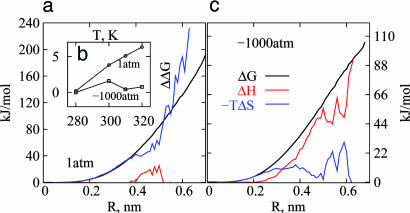
Thermodynamics of small and large solute hydration. (a and c) The hydration free energy of a hard-sphere solute, ΔG, as a function of solute size R, at 1 atm (a) and -1,000 atm (c) at 300 K. (b) The temperature dependence of ΔG is shown with reference to its value at 280 K [ΔΔG = ΔG(T) - ΔG(T = 280K)] for a hard-sphere solute of radius 4.5 Å. (c) The enthalpic (ΔH, red) and entropic (-TΔS, blue) contributions to ΔG obtained from temperature derivatives of the free energy are shown at 300 K. Thermodynamic crossover from entropic to enthalpic hydration is clear at -1,000 atm.
Fig. 5.
Fig. 5.
Effects of salt and additives on hydrophobic hydration. (a) The free energy of hydration of a hard-sphere solute per unit surface area, ΔG/A, as a function of R at 1 atm and 300 K, in pure water, sodium chloride solutions, and ethanol-water mixtures is shown. (b) The enthalpic (red) and entropic (blue) contributions to ΔG in an aqueous solution with 40 mol% ethanol at 300 K are shown.

References

    1. Chandler, D. (2005) Nature, in press.
    1. Kauzmann, W. (1959) Adv. Protein Chem. 14, 1-63. - PubMed
    1. Tanford, C. (1973) The Hydrophobic Effect (Wiley, New York).
    1. Dill, K. A. (1990) Biochemistry 29, 7133-7155. - PubMed
    1. Maibaum, L., Dinner, A. R. & Chandler, D. (2004) J. Phys. Chem. B 108, 6778-6781.

Publication types

LinkOut - more resources