. 2005 Oct;146(10):4312-20.
doi: 10.1210/en.2005-0435. Epub 2005 Jun 23.

Firing pattern and rapid modulation of activity by estrogen in primate luteinizing hormone releasing hormone-1 neurons

Affiliations

Firing pattern and rapid modulation of activity by estrogen in primate luteinizing hormone releasing hormone-1 neurons

Hideki Abe et al. Endocrinology. 2005 Oct.

Abstract

We have shown previously that cultured LHRH-1 neurons, derived from monkey olfactory placode region, exhibit pulsatile LHRH-1 release at hourly intervals and spontaneous intracellular calcium oscillations, which synchronize at a frequency similar to LHRH-1 release. Brief application of estrogen induced a rapid increase in the frequency of intracellular calcium oscillations and the frequency of synchronizations. The estrogen-induced frequency of intracellular calcium oscillations was mediated by estrogen receptors (ER), whereas the frequency of synchronizations was not mediated by ER. In the present study, we further examined the rapid action of estrogen using patch-clamp recording in primate LHRH-1 neurons. Cell-attached patch-clamp recording showed that LHRH-1 neurons exhibited monophasic or biphasic action currents that were sensitive to an increase in extracellular K+ and the sodium channel blocker tetrodotoxin. The majority (90%) of LHRH-1 neurons showed irregular firing patterns composed of bursts and irregular beatings of action currents, which further formed a "cluster" firing pattern. Brief application of 17beta-estradiol (1 nM) increased the firing frequency and burst duration of LHRH-1 neurons with a latency of 60-120 sec for up to 25 min. ICI182,780, an ER antagonist, blocked the 17beta-estradiol-induced increase in the firing activity of LHRH-1 neurons. These results suggest that 1) primate LHRH-1 neurons exhibit complex firing patterns composed of activities with different time domains, 2) estrogen causes rapid stimulatory action of firing activity, and 3) this estrogen action is mediated by ER in primate LHRH-1 neurons.


Figures

Figure 1
Figure 1
Cell-attached recording revealed the firing pattern of primate LHRH-1 neurons in vitro. Action currents recorded from LHRH neurons exhibited either monophasic (Aa) or biphasic patterns (Ab). Bath application of 15 mM K+ for 2 min increased the frequency of action currents (B), whereas TTX (0.5 μM, 2 min) reversibly blocked generation of action currents (C).
Figure 2
Figure 2
Primate LHRH-1 neurons exhibited a random pattern of action currents, which were comprised of a mixture of rapid bursts and irregular beatings (A). The firing pattern of these neurons (A) was composed of a complex rhythmic activity, which was comprised of ‘clusters’ (slower changes of firing activity, B) and rapid ‘bursts’ of action currents (C). B is an enlargement of the bracket in A, C is an enlargement of the bracket in B. Single spike is shown in (D).
Figure 3
Figure 3
Characteristics of cluster and burst activities. An example of detected ‘cluster’ activity from a primate LHRH-1 neuron using Cluster7 algorithm (A). Distribution patterns of the cluster duration (Ba) and cluster interval (Bb) from 97 events in 19 neurons are shown. The interval of clusters was variable, ranging from 10 to 1420 s. Burst firing pattern also showed considerable variability (C), i.e., the number of action currents per burst, burst durations, and burst intervals vary from neuron to neuron, as shown in (Ca) and (Cb). Some LHRH-1 neurons exhibited a stereotypical pattern of rhythmic bursts with short duration (Cc), in which the first action current with the highest amplitude was followed by multiple action currents with gradually decreasing amplitudes (inset in Cc). The distribution pattern of spikes per burst (Da), burst duration (Db), and inter-burst interval (Dc) is shown from 597 events in 20 neurons.
Figure 4
Figure 4
Effects of E2 on firing activity in primate LHRH-1 neurons. An example of vehicle (A) and 2 examples of the E2 effects (B, D) are shown. A: Bath application of vehicle for 10 min caused no significant effects on firing activity. B and D: Bath application of E2 (1 nM) for 10 min facilitated firing activity (Ba and Da). The time course of the E2- induced increase in firing activity is clearly seen in an integrated plot with the spike number per 10 s (Bb and Db). C and E: Detailed profiles of the E2 effects on action currents. Firing activities 10 min before (Ca and Ea) and during E2 application (Cb and Eb) from B and D, respectively, are shown. Further detailed profiles during a 1 min period “before” (Ca and Ea) and “during” E2 application (Cb and Eb), corresponding period indicated by dotted lines, are shown below. Note that the latency of the E2-induced facilitation of firing activity was 60–120 s and this effect lasted up to 25 min.
Figure 5
Figure 5
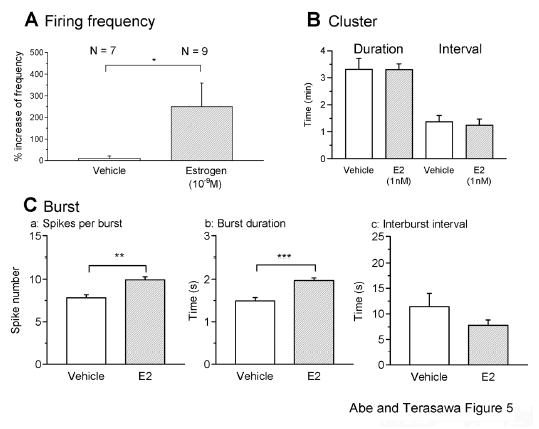
The quantitative analysis of the effects of estrogen on firing activity in LHRH-1 neurons. Changes in the firing frequency (A), cluster (B), and burst activity (C) by vehicle and E2 (1 nM) are shown. A: The firing frequency (normalized value) was significantly increased by bath application of E2 (* P < 0.05, one-tailed alternate Welch t-test) when compared with vehicle controls. B: E2 application had no effect on cluster activity (P > 0.05). C: E2 significantly increased the spike number per burst (Ca, ** P < 0.01) and burst duration (Cb, *** P < 0.001), but not interburst interval (Cc, P > 0.05) in LHRH-1 neurons.
Figure 6
Figure 6
An example of the effect of the estrogen receptor antagonist, ICI on the E2- induced facilitation of firing activity in LHRH-1 neurons. A: ICI (0.1 μM) was applied to bath starting 10 min before E2 and continued for the entire recording period. ICI blocked the facilitatory action of E2 on firing activity, as seen in a raw trace (Aa) and an integrated plot (Ab). B: Detailed profiles of the ICI effects on action currents. Firing activity in the control period (Ba), during ICI alone (Bb), and during E2 application with ICI (Bc) are shown. Further detailed profiles during the 1 min period, indicated by dotted lines, are also shown in the bottom panel. Note that there were no significant changes in firing activity during these periods.
Fig. 7
Fig. 7
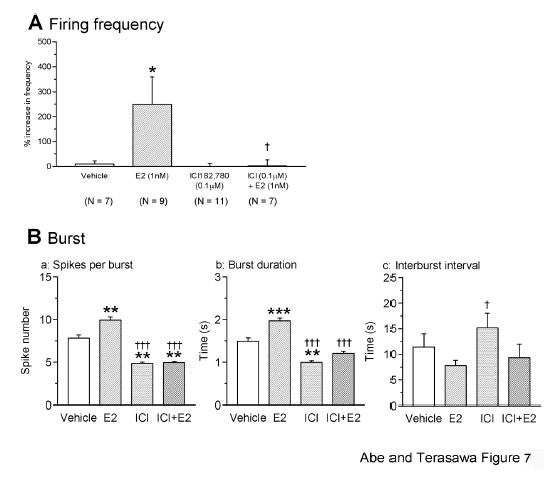
ICI blocks the estrogen-induced firing increase in LHRH-1 neurons. Changes in the firing frequency (A) and burst activity (B) by treatments with ICI (0.1 μM) alone or ICI + E2 (1 nM) are shown. ICI completely blocked the E2-induced increase in firing activity, as seen bath application of E2 under the presence of ICI did not increase the frequency (A), spike number per burst (Ba), or burst duration (Bb). The spike number per burst (Ba) and burst duration (Bb) in the ICI group were also lower than vehicle control. Interburst interval with ICI alone was significantly different from E2 (Bc). *: P<0.05 vs. vehicle; †: P<0.05 vs E2; **: P<0.01 vs. vehicle; : P<0.001 vs vehicle; †††: P<0.001 vs. E2.

References

    1. Wilson RC, Kesner JS, Kaufman JM, Uemura T, Akema T, Knobil E. Central electrophysiologic correlates of pulsatile luteinizing hormone secretion in the rhesus monkey. Neuroendocrinology. 1984;39:256–260. - PubMed
    1. Tanaka T, Ozawa T, Hoshino K, Mori Y. Changes in the gonadotropin-releasing hormone pulse generator activity during the estrous cycle in the goat. Neuroendocrinology. 1995;62:553–561. - PubMed
    1. Nishihara M, Takeuchi Y, Tanaka T, Mori Y. Electrophysiological correlates of pulsatile and surge gonadotrophin secretion. Rev Reprod. 1999;4:110–116. - PubMed
    1. Terasawa E 2003 Pulse generation in LHRH neurons. In: Handa R, Hayashi S, Terasawa E, Kawata M (eds) Neuroplasticity, Development, and Steroid Hormone Action. CRC Press, Boca Raton, pp 153–168
    1. Terasawa E. Luteinizing hormone-releasing hormone (LHRH) neurons: Mechanism of pulsatile LHRH release. Vitam Horm. 2001;63:91–129. - PubMed

Publication types

MeSH terms