


The presence of benign prostatic glandular tissue at surgical margins does not predict PSA recurrence
- PMID: 15976340
- PMCID: PMC1770707
- DOI: 10.1136/jcp.2004.024182
The presence of benign prostatic glandular tissue at surgical margins does not predict PSA recurrence
Abstract
Background: Serum prostate specific antigen (PSA) increases after radical prostatectomy are thought to indicate recurrent disease, although some suggest they result from benign prostatic epithelial tissue left at surgical margins.
Aims: To investigate whether presence, location, and extent of benign prostatic tissue at radical prostatectomy surgical margins influence patient outcome.
Methods: One hundred and ninety nine patients with prostate cancer and negative surgical margins were studied. The prostectomy specimens were totally embedded using the whole mount technique. The apex and bladder neck, dissected as a cone from the specimen, were serially sectioned. The total length of benign prostatic tissue at the margins, measured for each location using an ocular micrometer, was obtained by summing the length of all positive sites. The presence, anatomical location, and extent of benign prostatic tissue at the margin were correlated with clinicopathological characteristics and postoperative PSA increases.
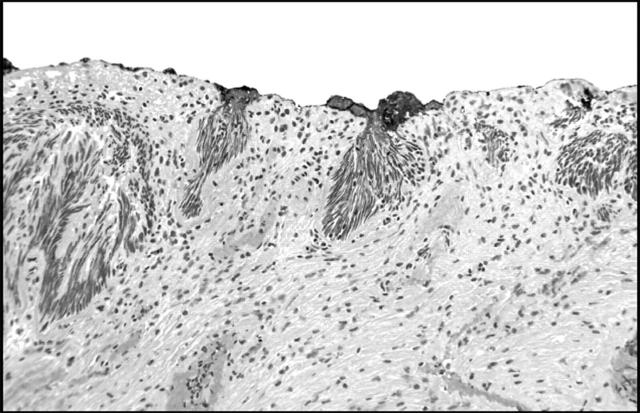
Results: Fifty five cases had benign prostatic glandular tissue at the surgical margin. The mean length was 2.19 mm (0.1-14.7). The most frequent location of benign prostatic tissue was the apex (40 patients). Presence, anatomical location, and length of benign prostatic tissue at the margin were not significantly associated with age, preoperative PSA, prostate weight, pathological stage, tumour volume, largest tumour dimension, Gleason score, extraprostatic extension, seminal vesical invasion, tumour multifocality, perineural invasion, or PSA recurrence.
Conclusions: Benign prostatic tissue was frequently found in margins of apex and bladder base, but uncommon in the anterior or posterior prostate. The presence of benign prostatic tissue at surgical margins had no prognostic relevance.
Figures
References
-
- Pound CR, Partin AW, Eisenberger MA, et al. Natural history of progression after PSA elevation following radical prostatectomy. JAMA 1999;281:1591–7. - PubMed
-
- Frazier HA, Robertson JE, Humphrey PA, et al. Is prostate specific antigen of clinical importance in evaluating outcome after radical prostatectomy? J Urol 1993;149:516–18. - PubMed
-
- Cheng L, Darson MF, Bergstralh EJ, et al. Correlation of margin status and extraprostatic extension with progression of prostate carcinoma. Cancer 1999;86:1775–82. - PubMed
-
- Cheng L, Slezak J, Bergstralh EJ, et al. Preoperative prediction of surgical margin status in prostate cancer patients treated by radical prostatectomy. J Clin Oncol 2000;18:2862–8. - PubMed
-
- Emerson RE, Koch MO, Daggy J, et al. Closest distance between tumor and resection margin in radical prostatectomy specimens: lack of prognostic significance. Am J Surg Pathol 2005;29:225–9. - PubMed
MeSH terms
Substances
LinkOut - more resources
Full Text Sources
Medical
Research Materials
Miscellaneous
