


Antifolate activity of epigallocatechin gallate against Stenotrophomonas maltophilia
- PMID: 15980368
- PMCID: PMC1168674
- DOI: 10.1128/AAC.49.7.2914-2920.2005
Antifolate activity of epigallocatechin gallate against Stenotrophomonas maltophilia
Abstract
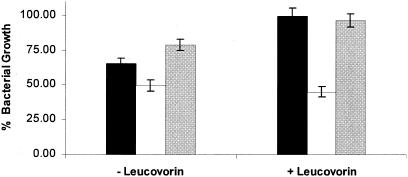
The catechin epigallocatechin gallate, one of the main constituents of green tea, showed strong antibiotic activity against 18 isolates of Stenotrophomonas maltophilia (MIC range, 4 to 256 microg/ml). In elucidating its mechanism of action, we have shown that epigallocatechin gallate is an efficient inhibitor of S. maltophilia dihydrofolate reductase, a strategic enzyme that is considered an attractive target for the development of antibacterial agents. The inhibition of S. maltophilia dihydrofolate reductase by this tea compound was studied and compared with the mechanism of a nonclassical antifolate compound, trimethoprim. Investigation of dihydrofolate reductase was undertaken with both a trimethoprim-susceptible S. maltophilia isolate and an isolate with a high level of resistance. The enzymes were purified using ammonium sulfate precipitation, gel filtration, and methotrexate affinity chromatography. The two isolates showed similar levels of dihydrofolate reductase expression and similar substrate kinetics. However, the dihydrofolate reductase from the trimethoprim-resistant isolate demonstrated decreased susceptibility to inhibition by trimethoprim and epigallocatechin gallate. As with other antifolates, the action of epigallocatechin gallate was synergistic with that of sulfamethoxazole, a drug that blocks folic acid metabolism in bacteria, and the inhibition of bacterial growth was attenuated by including leucovorin in the growth medium. We conclude that the mechanism of action of epigallocatechin gallate on S. maltophilia is related to its antifolate activity.
Figures
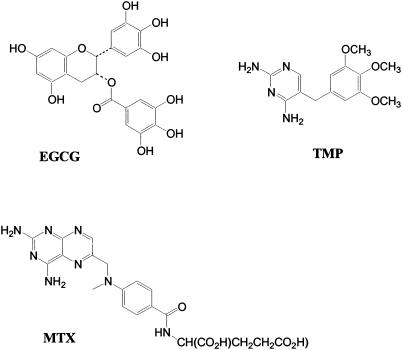
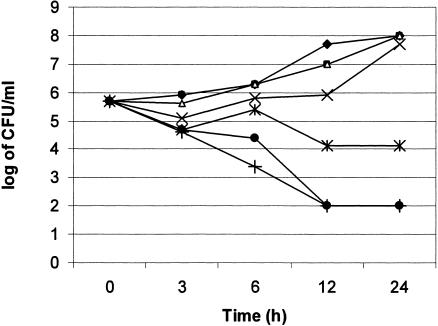
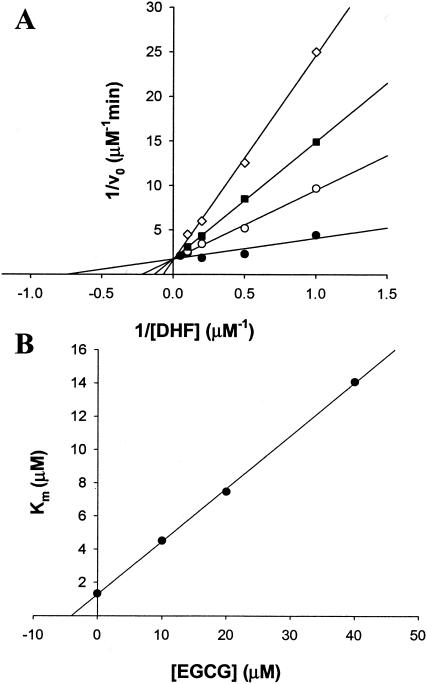
 , 64 (×), 32 (▵), 16 (□), and 0 (⧫) μg/ml. Culture samples (100 μl) were taken at the times indicated, and viability was measured by the plate colony count technique.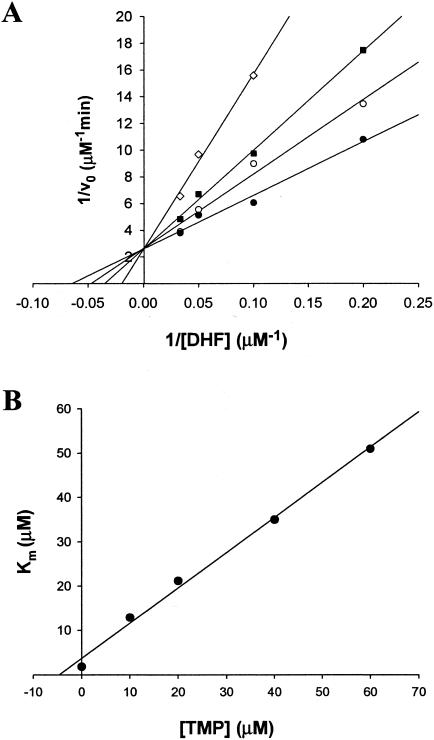
References
-
- Backus, H. H., H. M. Pinedo, D. Wouters, J. M. Padron, N. Molders, C. L. van Der Wilt, C. J. van Groeningen, G. Jansen, and G. J. Peters. 2000. Folate depletion increases sensitivity of solid tumor cell lines to 5-fluorouracil and antifolates. Int. J. Cancer 15:771-778. - PubMed
-
- Barbolla, R., M. Catalano, B. E. Orman, A. Famiglietti, C. Vay, J. Smayevsky, D. Centrón, and S. A. Piñeiro. 2004. Class I integrons increase trimethoprim-sulfamethoxazole MICs against epidemiologically unrelated Stenotrophomonas maltophilia isolates. Antimicrob. Agents Chemother. 48:666-669. - PMC - PubMed
-
- Burns, R. L., and L. Lowe. 1997. Xanthomonas maltophilia infection presenting as erythematous nodules. J. Am. Acad. Dermatol. 37:836-838. - PubMed
-
- Clark, N. M., J. Patterson, and J. P. Lynch III. 2003. Antimicrobial resistance among gram-negative organisms in the intensive care unit. Curr. Opin. Crit. Care 9:413-423. - PubMed
Publication types
MeSH terms
Substances
LinkOut - more resources
Full Text Sources
Medical
Research Materials
