


Antimalarial activity of human immunodeficiency virus type 1 protease inhibitors
- PMID: 15980379
- PMCID: PMC1168637
- DOI: 10.1128/AAC.49.7.2983-2985.2005
Antimalarial activity of human immunodeficiency virus type 1 protease inhibitors
Abstract
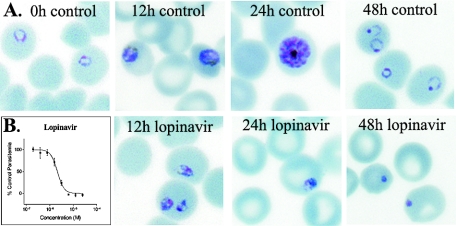
Aspartic proteases play key roles in the biology of malaria parasites and human immunodeficiency virus type 1 (HIV-1). We tested the activity of seven HIV-1 protease inhibitors against cultured Plasmodium falciparum. All compounds inhibited the development of parasites at pharmacologically relevant concentrations. The most potent compound, lopinavir, was active against parasites (50% inhibitory concentration [IC50], 0.9 to 2.1 microM) at concentrations well below those achieved by ritonavir-boosted lopinavir therapy. Lopinavir also inhibited the P. falciparum aspartic protease plasmepsin II at a similar concentration (IC50, 2.7 microM). These findings suggest that use of HIV-1 protease inhibitors may offer clinically relevant antimalarial activity.
Figures
References
-
- Bailly, E., R. Jambou, J. Savel, and G. Jaureguiberry. 1992. Plasmodium falciparum: differential sensitivity in vitro to E-64 (cysteine protease inhibitor) and pepstatin A (aspartyl protease inhibitor). J. Protozool. 39:593-599. - PubMed
-
- Boffito, M., S. Bonora, R. Raiteri, H. E. Reynolds, P. G. Hoggard, A. Sinicco, D. J. Back, and G. Di Perri. 2002. Pharmacokinetic evaluation of indinavir and indinavir/ritonavir-containing antiretroviral regimens in a clinical setting. Ther. Drug Monit. 24:574-576. - PubMed
-
- Cooper, C. L., R. P. van Heeswijk, K. Gallicano, and D. W. Cameron. 2003. A review of low-dose ritonavir in protease inhibitor combination therapy. Clin. Infect. Dis. 36:1585-1592. - PubMed
-
- Corbett, E. L., R. W. Steketee, F. O. ter Kuile, A. S. Latif, A. Kamali, and R. J. Hayes. 2002. HIV-1/AIDS and the control of other infectious diseases in Africa. Lancet 359:2177-2187. - PubMed
Publication types
MeSH terms
Substances
LinkOut - more resources
Full Text Sources
Other Literature Sources
