


KinasePhos: a web tool for identifying protein kinase-specific phosphorylation sites
- PMID: 15980458
- PMCID: PMC1160232
- DOI: 10.1093/nar/gki471
KinasePhos: a web tool for identifying protein kinase-specific phosphorylation sites
Abstract
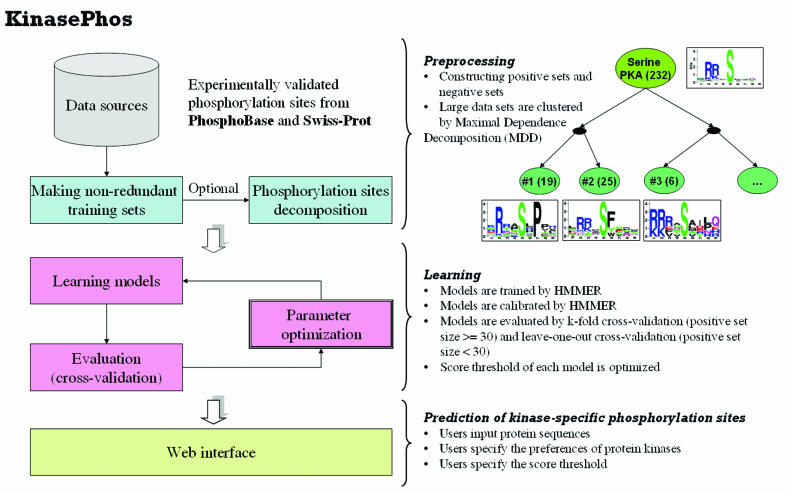
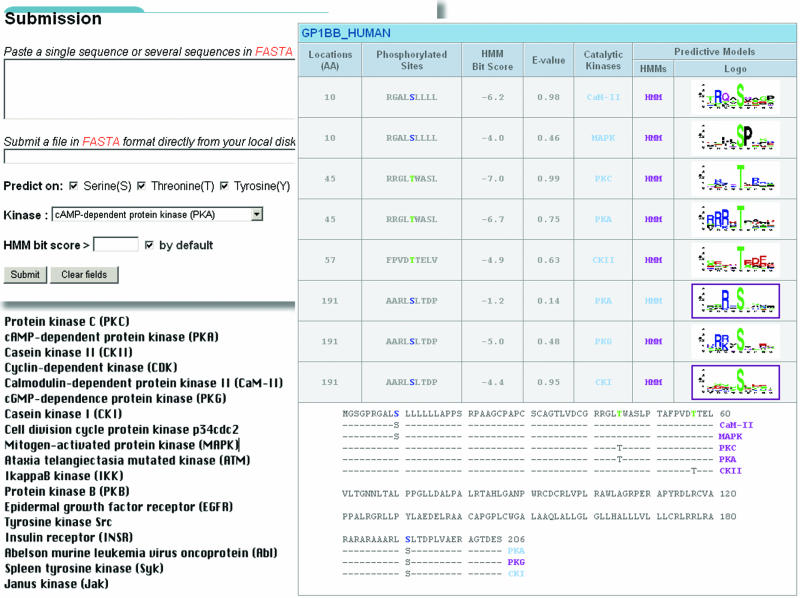
KinasePhos is a novel web server for computationally identifying catalytic kinase-specific phosphorylation sites. The known phosphorylation sites from public domain data sources are categorized by their annotated protein kinases. Based on the profile hidden Markov model, computational models are learned from the kinase-specific groups of the phosphorylation sites. After evaluating the learned models, the model with highest accuracy was selected from each kinase-specific group, for use in a web-based prediction tool for identifying protein phosphorylation sites. Therefore, this work developed a kinase-specific phosphorylation site prediction tool with both high sensitivity and specificity. The prediction tool is freely available at http://KinasePhos.mbc.nctu.edu.tw/.
Figures
References
-
- Berry E.A., Dalby A.R., Yang Z.R. Reduced bio basis function neural network for identification of protein phosphorylation sites: comparison with pattern recognition algorithms. Comput. Biol. Chem. 2004;28:75–85. - PubMed
-
- Blom N., Gammeltoft S., Brunak S. Sequence and structure-based prediction of eukaryotic protein phosphorylation sites. J. Mol. Biol. 1999;294:1351–1362. - PubMed
-
- Hjerrild M., Stensballe A., Rasmussen T.E., Kofoed C.B., Blom N., Sicheritz-Ponten T., Larsen M.R., Brunak S., Jensen O.N., Gammeltoft S. Identification of phosphorylation sites in protein kinase A substrates using artificial neural networks and mass spectrometry. J. Proteome Res. 2004;3:426–433. - PubMed
Publication types
MeSH terms
Substances
LinkOut - more resources
Full Text Sources
Other Literature Sources
