


. 2005 Jul 1;33(Web Server issue):W393-6.
doi: 10.1093/nar/gki354.
TOUCAN 2: the all-inclusive open source workbench for regulatory sequence analysis
Affiliations
- PMID: 15980497
- PMCID: PMC1160115
- DOI: 10.1093/nar/gki354
Item in Clipboard
TOUCAN 2: the all-inclusive open source workbench for regulatory sequence analysis
Nucleic Acids Res.
.
Abstract
We present the second and improved release of the TOUCAN workbench for cis-regulatory sequence analysis. TOUCAN implements and integrates fast state-of-the-art methods and strategies in gene regulation bioinformatics, including algorithms for comparative genomics and for the detection of cis-regulatory modules. This second release of TOUCAN has become open source and thereby carries the potential to evolve rapidly. The main goal of TOUCAN is to allow a user to come to testable hypotheses regarding the regulation of a gene or of a set of co-regulated genes. TOUCAN can be launched from this location: http://www.esat.kuleuven.ac.be/~saerts/software/toucan.php.
Figures
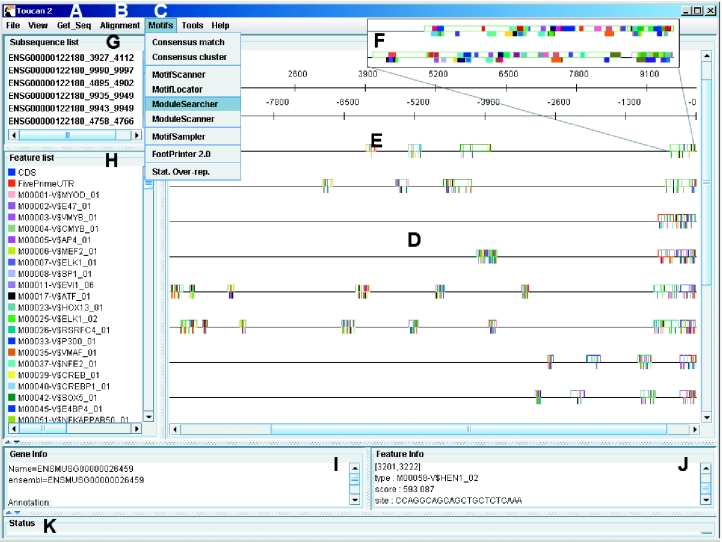
Screenshot of the TOUCAN software. (A) The Get_Seq menu allows for automated sequence retrieval from the EMBL nucleotide database or from the Ensembl genomic databases. Whole gene sequences or upstream sequences can be retrieved from the latter, together with the corresponding sequences of orthologous genes. (B) All pairs of orthologous sequences of a set of genes can be aligned automatically using AVID, LAGAN or Blastz. (C) Motifs and CRMs can be predicted by various algorithms (see text). (D) The sequence-feature map is sensitive to mouse clicks and allows manipulations, such as cutting, reverse complementing, etc. (E) Features are annotated as colored boxes. The large rectangle shown under (E) is a region that is conserved with the region in the mouse sequence that has the same color, right below it (i.e. a CNS). The small vertical lines within the CNSs are predicted TFBSs. (F) By zooming in, the individual binding site predictions become visible. (G) Sequence sublist where regions like CNSs are collected so that certain analyses can be focused only on the sublist. The sublist can also be saved or be opened in a new window. (H) Feature list where features can be removed, or given another visualization characteristics (color, fill, etc), or where certain combinations of features can be selected to be visualized. (I) Information about a sequence. (J) Information about a feature that is left-clicked on. (K) Status window.
References
-
- Davidson E.H. Genomic Regulatory Systems. San Diego, CA: Academic Press; 2001.
-
- Wasserman W.W., Palumbo M., Thompson W., Fickett J.W., Lawrence C.E. Human–mouse genome comparisons to locate regulatory sites. Nature Genet. 2000;26:225–228. - PubMed
-
- Ahituv N., Rubin E., Nobrega M. Exploiting human–fish genome comparisons for deciphering gene regulation. Hum. Mol. Genet. 2004;13(Suppl. 2):R261–R266. - PubMed
Publication types
MeSH terms
LinkOut - more resources
Full Text Sources
Other Literature Sources
