


Projector 2: contig mapping for efficient gap-closure of prokaryotic genome sequence assemblies
- PMID: 15980536
- PMCID: PMC1160117
- DOI: 10.1093/nar/gki356
Projector 2: contig mapping for efficient gap-closure of prokaryotic genome sequence assemblies
Abstract
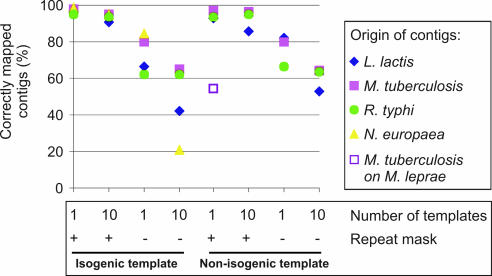
With genome sequencing efforts increasing exponentially, valuable information accumulates on genomic content of the various organisms sequenced. Projector 2 uses (un)finished genomic sequences of an organism as a template to infer linkage information for a genome sequence assembly of a related organism being sequenced. The remaining gaps between contigs for which no linkage information is present can subsequently be closed with direct PCR strategies. Compared with other implementations, Projector 2 has several distinctive features: a user-friendly web interface, automatic removal of repetitive elements (repeat-masking) and automated primer design for gap-closure purposes. Moreover, when using multiple fragments of a template genome, primers for multiplex PCR strategies can also be designed. Primer design takes into account that, in many cases, contig ends contain unreliable DNA sequences and repetitive sequences. Closing the remaining gaps in prokaryotic genome sequence assemblies is thereby made very efficient and virtually effortless. We demonstrate that the use of single or multiple fragments of a template genome (i.e. unfinished genome sequences) in combination with repeat-masking results in mapping success rates close to 100%. The web interface is freely accessible at http://molgen.biol.rug.nl/websoftware/projector2.
Figures
References
-
- Fraser C.M., Fleischmann R.D. Strategies for whole microbial genome sequencing and analysis. Electrophoresis. 1997;18:1207–1216. - PubMed
-
- Stjepandic D., Weinel C., Hilbert H., Koo H.L., Diehl F., Nelson K.E., Tummler B., Hoheisel J.D. The genome structure of Pseudomonas putida: high-resolution mapping and microarray analysis. Environ. Microbiol. 2002;4:819–823. - PubMed
-
- Tettelin H., Radune D., Kasif S., Khouri H., Salzberg S.L. Optimized multiplex PCR: efficiently closing a whole-genome shotgun sequencing project. Genomics. 1999;62:500–507. - PubMed
Publication types
MeSH terms
Substances
LinkOut - more resources
Full Text Sources
Miscellaneous
