


doi: 10.1002/ana.20515.
Brain activation in offspring of AD cases corresponds to 10q linkage
Affiliations
- PMID: 15984011
- PMCID: PMC2672820
- DOI: 10.1002/ana.20515
Item in Clipboard
Brain activation in offspring of AD cases corresponds to 10q linkage
Ann Neurol.
2005 Jul.
Abstract
Previously, we reported evidence of genetic heterogeneity in late-onset familial Alzheimer's disease, based on sex of affected parent, demonstrating linkage to chromosome 10q, a region identified by other groups and implicated as a quantitative trait loci for Abeta levels, in families with an affected mother. Using functional magnetic resonance imaging and a memory encoding task, we now show differential brain activation patterns among asymptomatic offspring which correspond to the previous linkage finding. These results suggest the possibility that activation patterns may prove useful as a preclinical quantitative trait related to the putative familial late-onset AD gene in this chromosome 10 region.
Figures
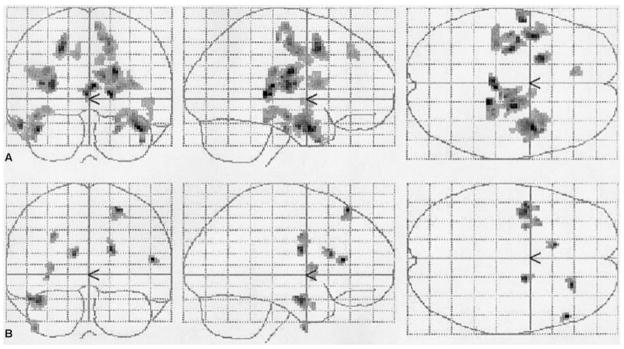
Group activation maps for verbal encoding. The three images on top (A) represent the pattern of activation during verbal encoding in offspring from linked families, whereas the three images on the bottom (B) represent the activation in offspring from unlinked families.
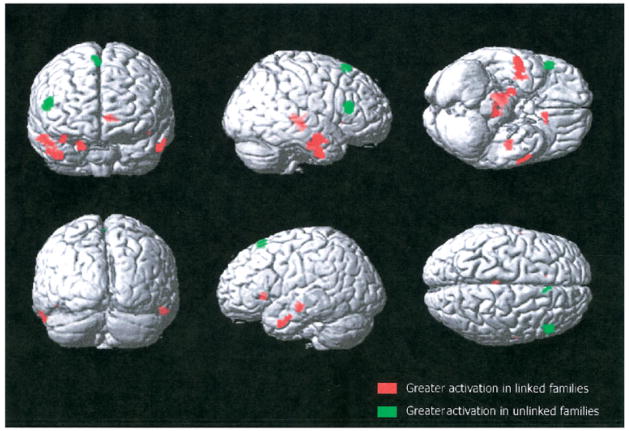
This is a representation of two contrasts of the functional magnetic resonance imaging activation during verbal encoding. There is increased activation in linked families in temporal areas (shown in red), whereas unlinked families show a very different pattern of activation, mainly localized in the frontal lobes (shown in green).
References
-
- Myers A, Wavrant De-Vrieze F, Holmans P, et al. Full genome screen for Alzheimer disease: stage II analysis. Am J Med Genet. 2002;114:235–244. - PubMed
-
- Kehoe P, Wavrant-De Vrieze F, Crook R, et al. A full genome scan for late onset Alzheimer’s disease. Hum Mol Genet. 1999;8:237–245. - PubMed
-
- Pericak-Vance MA, Bass MP, Yamaoka LH, et al. Complete genomic screen in late-onset familial Alzheimer disease. Evidence for a new locus on chromosome 12. JAMA. 1997;278:1237–1241. - PubMed
-
- Pericak-Vance MA, Bass ML, Yamaoka LH, et al. Complete genomic screen in late-onset familial Alzheimer’s disease. Neurobiol Aging. 1998;19:S39–S42. - PubMed
-
- Blacker D, Bertram L, Saunders AJ, et al. Results of a high-resolution genome screen of 437 Alzheimer’s disease families. Hum Mol Genet. 2003;12:23–32. - PubMed
Publication types
MeSH terms
Grants and funding
LinkOut - more resources
Full Text Sources
Medical
Molecular Biology Databases
