


Distribution of fertility-restorer genes for wild-abortive and Honglian CMS lines of rice in the AA genome species of genus Oryza
- PMID: 15987696
- PMCID: PMC4246779
- DOI: 10.1093/aob/mci197
Distribution of fertility-restorer genes for wild-abortive and Honglian CMS lines of rice in the AA genome species of genus Oryza
Abstract
Background and aims: Rice (Oryza sativa) is one of the most important cereal plants in the world. Wild-abortive (WA) and Honglian (HL) cytoplasmic male sterility (CMS) have been used extensively in the production of hybrid seeds. Although a variable number of fertility-restorer genes (Rf) for WA and HL-CMS have been identified in various cultivars, information on Rf in Oryza species with the AA-genome is sparse. Therefore the distribution and heredity of Rf for WA and HL-CMS in wild rice species of Oryza with the AA-genome were investigated.
Methods: Fertility-restorer genes for WA and HL-CMS in wild rice species with the AA-genome were investigated by following the fertility of microspores identified by I2-KI staining and by following the seed-setting rate of spikelets. A genetic model of Rf in some selected restorer accessions was analysed based on the fertility segregation of BC1F1 populations.
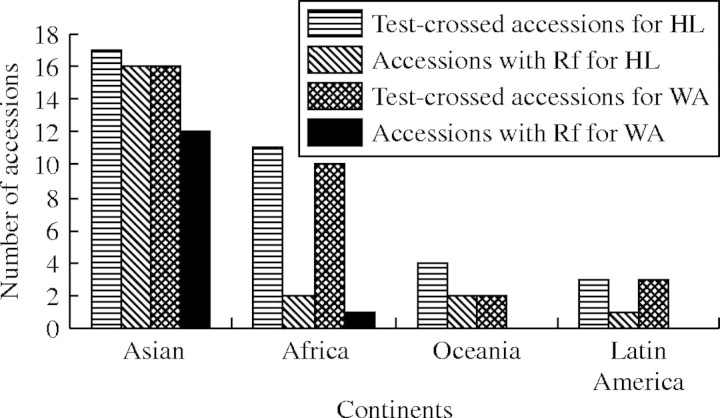
Key results: Fertility analysis showed that 21 out of 35 HL-type F1s, and 13 out of 31 WA-type F1s were scored as fertile. The frequency of Rf in wild rice was 60% for HL-CMS and 41.9% for WA-CMS, respectively. The fertility-restorer accessions, especially those with complete restoring ability, aggregated mainly in two species of O. rufipogon and O. nivara. The wild rice accessions with Rf for HL-CMS were distributed in Asia, Oceania, Latin American and Africa, but were centered mainly in Asia, whilst the wild restorer accessions for WA-CMS were limited only to Asia and Africa. Apart from one restorer accession that possessed two pairs of Rf for WA-CMS, all of the other nine tested wild restorer accessions each contained only a single Rf for WA-CMS or HL-CMS. Allele analysis indicated that there existed at least three Rf loci for the WA and HL-CMS systems.
Conclusions: These data support the hypothesis that fertility-restorer genes exist widely in Oryza species with the AA-genome, and that Rf in Oryza sativa originated from the Oryza rufipogon/Oryza nivara complex, the ancestor of cultivated rice in Asia. The origin and evolution of Rf is tightly linked to that of CMS in wild rice, and fertility of a given CMS type is controlled by several Rf alleles in various wild restorer accessions.
Figures
References
-
- Budar F, Pelletier G. 2001. Male sterility in plants: occurrence, determinism, significance and use. Life Science 324: 543–550. - PubMed
-
- Chen DZ, Xiao YQ, Zhao SX, Xiao HJ. 1995. Study on the restoring resource for CMS lines with the cytoplasm of Jiangxi Dongxiang wild rice. Hybrid Rice 6: 4–6.
-
- Dalmacio R, Brar DS, Sitch LA, Virmani SS, Khush GS. 1992.Oryza perennis: a new source of cytoplasmic male sterility in rice. Rice Genetics Newsletter 9: 108–110.
-
- De Haan AA, Luyten RMJM, Bakx-schotman TJMT, van Damme JMM. 1997. The dynamics of gynodioecy in Plantago lanceolata L. I. Frequency of male-steriles and their cytoplasmic male sterility types. Heredity 79: 453–462.
