A surprisingly large RNase P RNA in Candida glabrata
- PMID: 15987816
- PMCID: PMC1370791
- DOI: 10.1261/rna.2130705
A surprisingly large RNase P RNA in Candida glabrata
Abstract
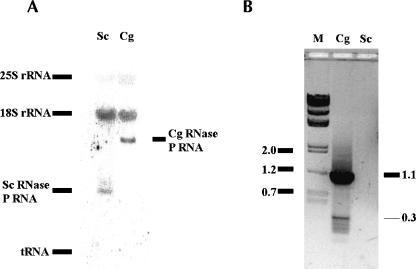
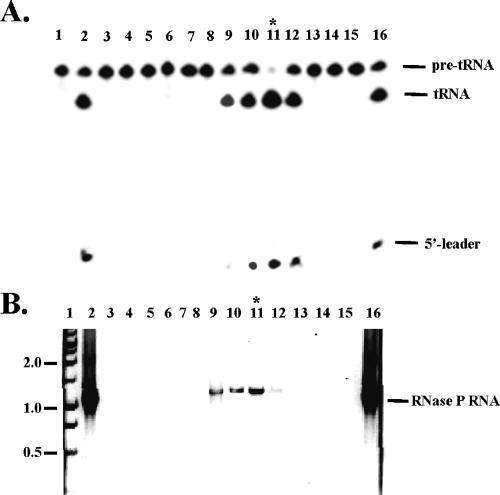
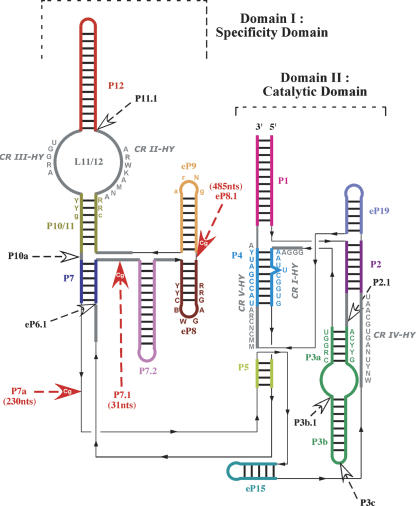
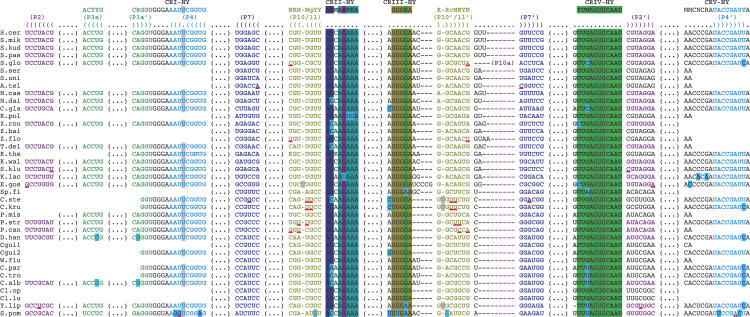
We have found an extremely large ribonuclease P (RNase P) RNA (RPR1) in the human pathogen Candida glabrata and verified that this molecule is expressed and present in the active enzyme complex of this hemiascomycete yeast. A structural alignment of the C. glabrata sequence with 36 other hemiascomycete RNase P RNAs (abbreviated as P RNAs) allows us to characterize the types of insertions. In addition, 15 P RNA sequences were newly characterized by searching in the recently sequenced genomes Candida albicans, C. glabrata, Debaryomyces hansenii, Eremothecium gossypii, Kluyveromyces lactis, Kluyveromyces waltii, Naumovia castellii, Saccharomyces kudriavzevii, Saccharomyces mikatae, and Yarrowia lipolytica; and by PCR amplification for other Candida species (Candida guilliermondii, Candida krusei, Candida parapsilosis, Candida stellatoidea, and Candida tropicalis). The phylogenetic comparative analysis identifies a hemiascomycete secondary structure consensus that presents a conserved core in all species with variable insertions or deletions. The most significant variability is found in C. glabrata P RNA in which three insertions exceeding in total 700 nt are present in the Specificity domain. This P RNA is more than twice the length of any other homologous P RNAs known in the three domains of life and is eight times the size of the smallest. RNase P RNA, therefore, represents one of the most diversified noncoding RNAs in terms of size variation and structural diversity.
Figures
References
-
- Altman, S. and Kirsebom, L. 1999. Ribonuclease P. In The RNA world (eds. R.F. Gesteland et al.), pp. 351–380. Cold Spring Harbor Laboratory Press, Cold Spring Harbor, NY.
-
- Cliften, P., Sudarsanam, P., Desikan, A., Fulton, L., Fulton, B., Majors, J., Waterston, R., Cohen, B.A., and Johnston, M. 2003. Finding functional features in Saccharomyces genomes by phylogenetic footprinting. Science 301: 71–76. - PubMed
Publication types
MeSH terms
Substances
LinkOut - more resources
Full Text Sources
Other Literature Sources
Molecular Biology Databases
Research Materials