. 2005 Jul;187(14):4992-9.
doi: 10.1128/JB.187.14.4992-4999.2005.

The genome of Sulfolobus acidocaldarius, a model organism of the Crenarchaeota

Affiliations

The genome of Sulfolobus acidocaldarius, a model organism of the Crenarchaeota

Lanming Chen et al. J Bacteriol. 2005 Jul.

Abstract

Sulfolobus acidocaldarius is an aerobic thermoacidophilic crenarchaeon which grows optimally at 80 degrees C and pH 2 in terrestrial solfataric springs. Here, we describe the genome sequence of strain DSM639, which has been used for many seminal studies on archaeal and crenarchaeal biology. The circular genome carries 2,225,959 bp (37% G+C) with 2,292 predicted protein-encoding genes. Many of the smaller genes were identified for the first time on the basis of comparison of three Sulfolobus genome sequences. Of the protein-coding genes, 305 are exclusive to S. acidocaldarius and 866 are specific to the Sulfolobus genus. Moreover, 82 genes for untranslated RNAs were identified and annotated. Owing to the probable absence of active autonomous and nonautonomous mobile elements, the genome stability and organization of S. acidocaldarius differ radically from those of Sulfolobus solfataricus and Sulfolobus tokodaii. The S. acidocaldarius genome contains an integrated, and probably encaptured, pARN-type conjugative plasmid which may facilitate intercellular chromosomal gene exchange in S. acidocaldarius. Moreover, it contains genes for a characteristic restriction modification system, a UV damage excision repair system, thermopsin, and an aromatic ring dioxygenase, all of which are absent from genomes of other Sulfolobus species. However, it lacks genes for some of their sugar transporters, consistent with it growing on a more limited range of carbon sources. These results, together with the many newly identified protein-coding genes for Sulfolobus, are incorporated into a public Sulfolobus database which can be accessed at http://dac.molbio.ku.dk/dbs/Sulfolobus.


Figures

FIG. 1.
FIG. 1.
Conservation of protein genes. The overlapping circle plot shows the number of genes shared between two or three Sulfolobus genomes. Blue, red, and green numbers represent genes shared with S. acidocaldarius, S. solfataricus, and S. tokodaii, respectively. The black number in the center denotes the total number of different genes in the three genomes.
FIG. 2.
FIG. 2.
Origins of replication and other major structural features of the S. acidocaldarius genome. Replication origins were predicted using the Z-curve method (64), where only the Y component, calculated for each nucleotide, is plotted. Arrows indicate putative replication origins which are consistent with those predicted experimentally from marker frequency analyses (39). On the genome map, the following are indicated: three cdc6 genes, integrated elements SA1 to SA4, large rRNA genes, and SRSR clusters. The two different classes of repeat sequences (A,B and C,D) which are present in the four SRSR clusters are shown.
FIG. 3.
FIG. 3.
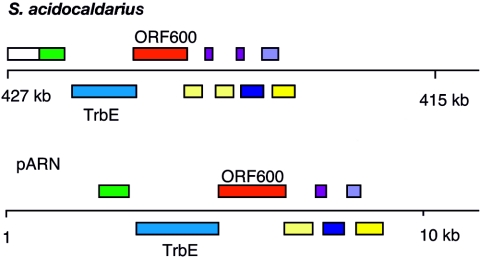
Gene map of the region of the integrated element SA3 which resembles a pARN self-transmissible plasmid. The chromosomal region is aligned with the corresponding region of a pARN plasmid (23). Genes with identical colors are homologs. All proteins in this region have been implicated in the archaeal conjugative apparatus. They include the partial homolog of TrbE and ORF600 (23).
FIG. 4.
FIG. 4.
Putative Cdc6 binding sites in S. acidocaldarius. (A) The three ORB sequences in S. acidocaldarius (S.a. ORB1 to -3) compared to the consensus ORB sequences in S. solfataricus and S. tokodaii (S.s. and S.t. ORB) (48), where dots indicate nonconserved bases. The genome map shows the position of the sequences relative to cdc6-1. (B) S. acidocaldarius sequences which are similar to Cdc6-2 and Cdc6-3 binding sites (48). The genome map indicates the positions of the sequences relative to cdc6-3.
FIG. 5.
FIG. 5.
Analysis of leader sequences of all putative protein-coding genes of the S. acidocaldarius genome. Results are presented for single genes and the first, middle, and terminal ORFs of predicted operons. The vertical bars represent the presence of (a) TATA-like motifs located 24 to 30 bp upstream from the start codon, (b) Shine-Dalgarno motifs, (c) neither motif, and (d) TATA-like and Shine-Dalgarno motifs.

References

    1. Aagaard, C., H. Phan, S. Trevisanato, and R. A. Garrett. 1994. A spontaneous point mutation in the single 23S rRNA gene of the thermophilic archaeon Sulfolobus acidocaldarius confers multiple drug resistance. J. Bacteriol. 176:7744-7747. - PMC - PubMed
    1. Aagaard, C., J. Z. Dalgaard, and R. A. Garrett. 1995. Inter-cellular mobility and homing of an archaeal rDNA intron confers selective advantage over intron− cells of Sulfolobus acidocaldarius. Proc. Natl. Acad. Sci. USA 92:12285-12289. - PMC - PubMed
    1. Aagaard, C., I. Leviev, R. N. Aravalli, P. Forterre, D. Prieur, and R. A. Garrett. 1996. General vectors for archaeal hyperthermophiles: strategies based on a mobile intron and a plasmid. FEMS Microbiol. Rev. 18:93-104. - PubMed
    1. Baliga, N. S., R. Bonneau, M. T. Faccioti, M. Pan, G. Glusman, E. W. Deutsch, P. Shannon, Y. Chiu, R. S. Weng, R. R. Gan, P. Hung, S. V. Date, E. Marcotte, L. Hood, and W. V. Ng. 2004. Complete sequence of Haloarcula marismortui: a halophilic archaeon from the Dead Sea. Genome Res. 14:2221-2234. - PMC - PubMed
    1. Bateman, A., E. Birney, L. Cerruti, R. Durbin, L. Etwiller, S. Eddy, S. Griffiths-Jones, K. Howe, M. Marshall, and E. Sonnhammer. 2002. The Pfam protein families database. Nucleic Acids Res. 30:276-280. - PMC - PubMed

Publication types

Associated data