Review
doi: 10.1038/sj.embor.7400460.
Light and oxygenic photosynthesis: energy dissipation as a protection mechanism against photo-oxidation
Affiliations
- PMID: 15995679
- PMCID: PMC1369118
- DOI: 10.1038/sj.embor.7400460
Item in Clipboard
Review
Light and oxygenic photosynthesis: energy dissipation as a protection mechanism against photo-oxidation
EMBO Rep.
2005 Jul.
Abstract
Efficient photosynthesis is of fundamental importance for plant survival and fitness. However, in oxygenic photosynthesis, the complex apparatus responsible for the conversion of light into chemical energy is susceptible to photodamage. Oxygenic photosynthetic organisms have therefore evolved several protective mechanisms to deal with light energy. Rapidly inducible non-photochemical quenching (NPQ) is a short-term response by which plants and eukaryotic algae dissipate excitation energy as heat. This review focuses on recent advances in the elucidation of the molecular mechanisms underlying this protective quenching pathway in higher plants.
Figures

Organization of photosystem II and light-harvesting complex II in the thylakoid membrane. Cp43, Cp47: internal antenna chlorophyll–protein complexes. D1, D2: main components of reaction centres (RCs) with binding sites for electron acceptor quinones (QB, QA). P680: chlorophyll special pair. Other cofactors associated with D1/D2: pheophytin (Phe), non-haem iron (Fe), Mn-cluster. Accessory chlorophylls and β-carotene are not shown. Chl, chlorophyll; PQH2, plastoquinone pool; cytb6f, cytochrome b6f complex; YZ, D1-Tyr161. For a more detailed description, see Ferreira et al (2004). Scheme adapted from J. Nield (Imperial College London, UK) with permission. See downloads section of www.bio.ic.ac.uk/research/nield/ .
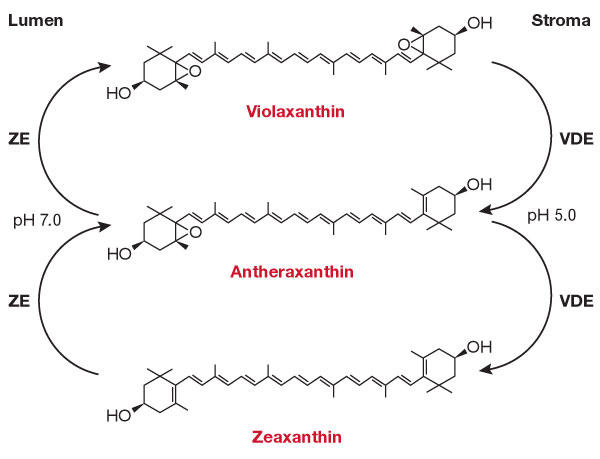
The xanthophyll cycle. VDE, violaxanthin de-epoxidase; ZE, zeaxanthin epoxidase.

Possible mechanism for PsbS-dependent non-photochemical quenching. See text for a detailed description. Green circles: either major or minor antenna proteins. For the sake of clarity, only one chlorophyll (Chl) and one zeaxanthin (Zea, red zigzag) per protein are indicated. Yellow circles: quenching sites. Chl: antenna Chl interacting with Zea.

Ildikò Szabò, Giorgio Mario Giacometti & Elisabetta Bergantino. I.S. is the recipient of an EMBO Young Investigator Award.
References
-
- Allen JF, Forsberg J (2001) Molecular recognition in thylakoid structure and function. Trends Plant Sci 6: 317–326 - PubMed
-
- Andersson J, Wentworth M, Walters RG, Howard CA, Ruban AV, Horton P, Jansson S (2003) Absence of Lhcb1 and Lhcb2 proteins of the light-harvesting complex of photosystem II—effects on photosynthesis, grana stacking and fitness. Plant J 35: 350–361 - PubMed
-
- Aro EM, Ohad I (2003) Redox regulation of thylakoid protein phosphorylation. Antioxid Redox Signal 5: 55–67 - PubMed
Publication types
MeSH terms
Substances
LinkOut - more resources
Full Text Sources