


Evaluation of PCR for diagnosis of Indian kala-azar and assessment of cure
- PMID: 16000412
- PMCID: PMC1169152
- DOI: 10.1128/JCM.43.7.3038-3041.2005
Evaluation of PCR for diagnosis of Indian kala-azar and assessment of cure
Abstract
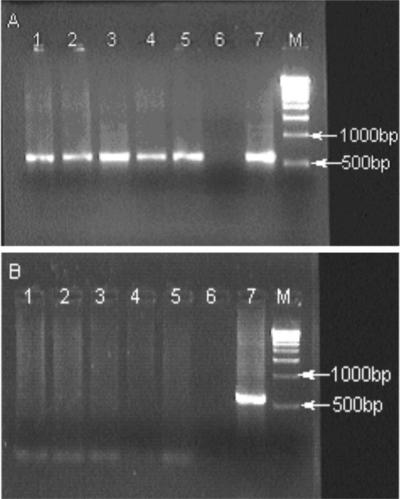
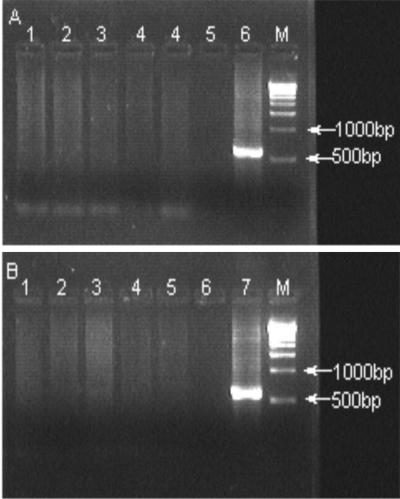
This study was done to evaluate PCR with Ld1 primers for the diagnosis of Indian visceral leishmaniasis (VL) and to assess its role in prediction of the disease outcome. The PCR assay was performed with DNA isolated from the peripheral blood of parasitologically confirmed cases of VL before the initiation of treatment, just after the end of treatment, and at 3 and 6 months of follow-up. The pretreatment PCR result was positive for 100 of 101 patients (sensitivity, 99%; confidence interval [CI], 94 to 100%). None of the 150 negative controls tested were PCR positive (specificity, 100%; CI, 96.8 to 100%). Of 60 patients who were treated at our center, 51 (85%; CI, 73 to 93%) became negative immediately after treatment and continued to be negative at 3 and 6 months of follow-up. At the 3-month follow-up, two of the remaining nine patients were PCR positive, making 58 (96.7%; CI, 87 to 100%) patients PCR negative. At the 6-month follow-up, all patients became PCR negative. One patient who was PCR negative immediately after the end of treatment relapsed 11 months later. This limited prospective study with VL patients suggests that the PCR assay is a highly sensitive and specific (99% and 100%, respectively) tool for the diagnosis of VL. In the majority of patients, it can identify a successful disease outcome; however, its translation into the field setting remains a major challenge.
Figures
References
-
- Adhya, S., M. Chatterjee, M. Q. Hassan, S. Mukherjee, and S. Sen. 1995. Detection of Leishmania in the blood of early kala-azar patients with the aid of the polymerase chain reaction. Trans. R. Soc. Trop. Med. Hyg. 89:622-624. - PubMed
-
- Cascio, A., S. Calattini, C. Colomba, C. Scalamogna, M. Galazzi, M. Pizzuto, R. Camilli, M. Gramiccia, L. Titone, M. Corbellino, and S. Antinori. 2002. Polymerase chain reaction in the diagnosis and prognosis of Mediterranean visceral leishmaniasis in immunocompetent children. Pediatrics 109:E27. - PubMed
-
- Fisa, R., C. Riera, E. Ribera, M. Gallego, and M. Portus. 2002. A nested polymerase chain reaction for diagnosis and follow-up of human visceral leishmaniasis patients using blood samples. Trans. R. Soc. Trop. Med. Hyg. 96(Suppl. 1):S191-S194. - PubMed
-
- Hailu, A. 1990. Pre- and post-treatment antibody levels in visceral leishmaniasis. Trans. R. Soc. Trop. Med. Hyg. 84:673-675. - PubMed
-
- Jha, T. K., S. Sundar, C. P. Thakur, P. Bachmann, J. Karbwang, C. Fischer, A. Voss, and J. Berman. 1999. Miltefosine, an oral agent, for the treatment of Indian visceral leishmaniasis. N. Engl. J. Med. 341:1795-1800. - PubMed
Publication types
MeSH terms
Substances
LinkOut - more resources
Full Text Sources
