. 2005 Jul;43(7):3074-82.
doi: 10.1128/JCM.43.7.3074-3082.2005.

Detection and typing of integrons in epidemic strains of Acinetobacter baumannii found in the United Kingdom

Affiliations

Detection and typing of integrons in epidemic strains of Acinetobacter baumannii found in the United Kingdom

Jane F Turton et al. J Clin Microbiol. 2005 Jul.

Abstract

Integrons were sought in Acinetobacter isolates from hospitals in the United Kingdom by integrase gene PCR. Isolates were compared by pulsed-field gel electrophoresis, and most belonged to a small number of outbreak strains or clones of A. baumannii, which are highly successful in the United Kingdom. Class 1 integrons were found in all of the outbreak isolates but in none of the sporadic isolates. No class 2 integrons were found. Three integrons were identified among the main outbreak strains and clones. While a particular integron was usually associated with a strain or clone, some members carried a different integron. Some integrons were associated with more than one strain. The cassette arrays of two of the integrons were very similar, both containing gene aacC1, which confers resistance to gentamicin, two open reading frames coding for unknown products (orfX, orfX'), and gene aadA1a, which confers resistance to spectinomycin and streptomycin. The larger of these integrons had two copies of the first (orfX) of the gene cassettes coding for unknown products. The third integron, with a cassette array containing gene aacA4, which codes for amikacin, netilmicin, and tobramycin resistance; a chloramphenicol acetyltransferase, catB8; and gene aadA1, conferring resistance to spectinomycin and streptomycin, was associated with an OXA-23 carbapenemase-producing clone, which has spread rapidly in hospitals in the United Kingdom during 2003 and 2004. These integron cassette arrays have been found in other outbreak strains of A. baumannii from other countries. We conclude that integrons are useful markers for epidemic strains of A. baumannii and that integron typing provides valuable information for epidemiological studies.


Figures
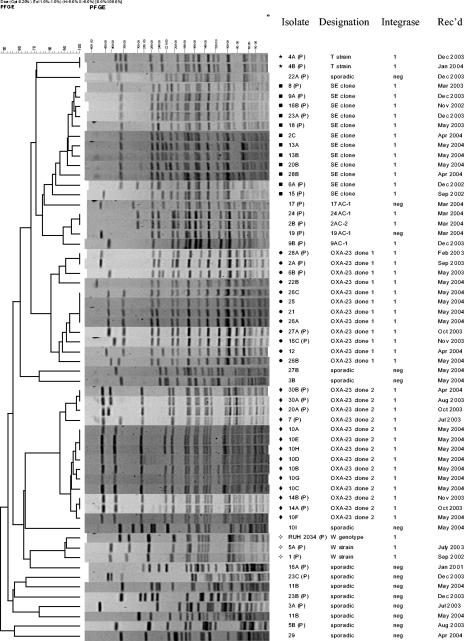
FIG. 1.
FIG. 1.
PFGE profiles of ApaI-digested genomic DNA from Acinetobacter isolates. Isolates were labeled according to hospital (hospitals 1 to 29); isolates from the same hospital were differentiated by letters following the hospital number. Panel isolates are designated by the letter “P” in brackets. Results of integrase PCR (for class 1 and class 2 integrases) for each isolate are given in the third column. Symbols indicate the various outbreak strains, detailed in the figure. Isolates described as belonging to the W strain or to the W genotype are representatives of European clone 1 (8). neg, negative.
FIG. 2.
FIG. 2.
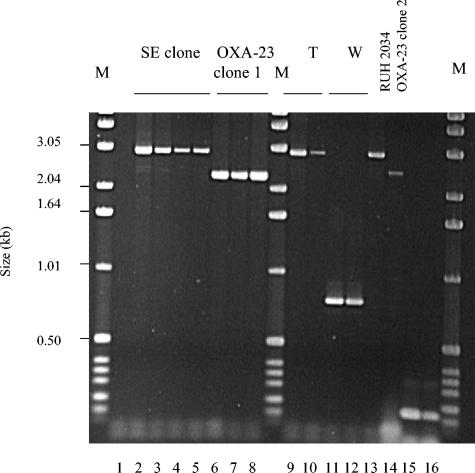
Integron gene cassette PCR products from various isolates of the outbreak strains and clones and isolate RUH 2034 (which has the W genotype). Size standards (1-kb ladder) were run in the lanes labeled M. A negative (water) control was run in lane 1. Isolates were as follows: lane 2, 15(P); lane 3, 8(P); lane 4, 13A; lane 5, 18(P); lane 6, 28A(P); lane 7, 27A(P); lane 8, 22B; lane 9, 4A(P); lane 10, 4B(P); lane 11, 1(P); lane 12, 5A(P); lane 13, RUH 2034; lane 14, 7(P). Integrase gene PCR products from isolates 26A and 7A(P) are shown in lanes 15 and 16, respectively.
FIG. 3.
FIG. 3.
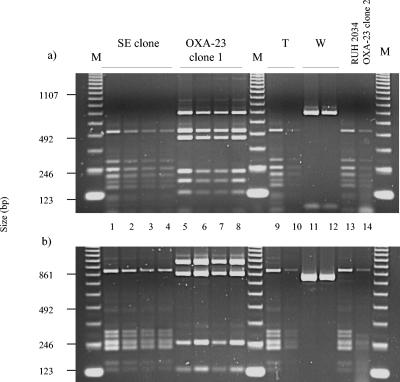
Restriction patterns obtained following digestion of integron gene cassette amplicons with (a) HaeIII and (b) MspI. Size standards (123-bp ladder) were run in the lanes labeled M. Isolates used were as follows: lane 1, 15(P); lane 2, 8(P); lane 3, 13A; lane 4, 18(P), lane 5, 28A(P); lane 6, 26A; lane 7, 27A(P); lane 8, 22B; lane 9, 4A(P); lane 10, 4B(P); lane 11, 1(P); lane 12, 5A(P); lane 13, RUH 2034; lane 14, 7(P).
FIG. 4.
FIG. 4.
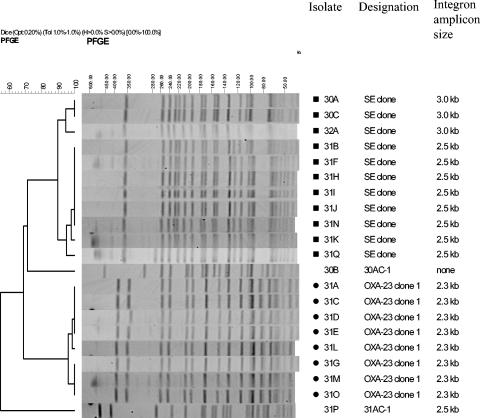
PFGE profiles of ApaI-digested genomic DNA and integron types of a set of isolates received from a hospital group (hospitals 30 to 32). As in Fig. 1, isolates of the South East clone are indicated with a square symbol, and those of OXA-23 clone 1 are indicated with a circle.
FIG. 5.
FIG. 5.
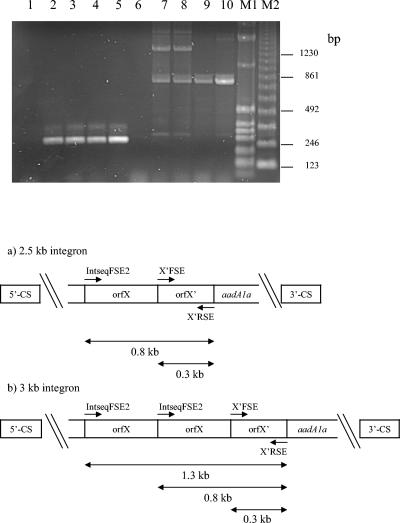
Demonstration by PCR of the presence of two copies of the orfX gene cassette in the 3-kb integron. Primers used were X′FSE and X′RSE (lanes 1 to 5) and IntseqFSE2 and X′RSE (lanes 6 to 10). Negative (water) controls were included in lanes 1 and 6. Isolates were as follows: lanes 2 and 7, 16B(P); lanes 3 and 8, RUH 2034; lanes 4 and 9, 7(P); lanes 5 and 10, 31H. Molecular weight markers were run in lanes M1 (1-kb ladder) and M2 (123-bp ladder). Isolates 16B(P) and RUH 2034 both contain the 3-kb integron, while isolates 7(P) and 31H contain the 2.5-kb integron. These integrons are the same except that the 3-kb integron contains two copies of the orfX gene cassette (Table 2), and the fragments obtained from the PCRs are shown schematically under the gel image.

References

    1. Afzal-Shah, M., N. Woodford, and D. M. Livermore. 2001. Characterization of OXA-25, OXA-26, and OXA-27, molecular class D β-lactamases associated with carbapenem resistance in clinical isolates of Acinetobacter baumannii. Antimicrob. Agents Chemother. 45:583-588. - PMC - PubMed
    1. Altschul, S. F., T. L. Madden, A. A. Schäffer, J. Zhang, Z. Zhang, W. Miller, and D. J. Lipman. 1997. Gapped BLAST and PSI-BLAST: a new generation of protein database search programs. Nucleic Acids Res. 25:3389-3402. - PMC - PubMed
    1. Andrews, J. M., et al. 2001. BSAC standardized disc susceptibility testing method. J. Antimicrob. Chemother. 48(Suppl. S1):43-57. - PubMed
    1. Clark, N. M., J. Patterson, and J. P. Lynch III. 2003. Antimicrobial resistance among gram-negative organisms in an intensive care unit. Curr. Opin. Crit. Care 9:413-423. - PubMed
    1. Corbella, X., A. Montero, M. Pujol, M. A. Dominguez, J. Ayats, M. J. Argerich, F. Garrigosa, J. Ariza, and F. Gudiol. 2000. Emergence and rapid spread of carbapenem resistance during a large and sustained hospital outbreak of multiresistant Acinetobacter baumannii. J. Clin. Microbiol. 38:4086-4095. - PMC - PubMed

MeSH terms

Associated data

LinkOut - more resources