


Rapid method for enumeration of viable Legionella pneumophila and other Legionella spp. in water
- PMID: 16000824
- PMCID: PMC1169006
- DOI: 10.1128/AEM.71.7.4086-4096.2005
Rapid method for enumeration of viable Legionella pneumophila and other Legionella spp. in water
Abstract
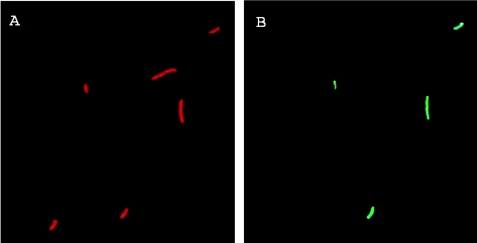
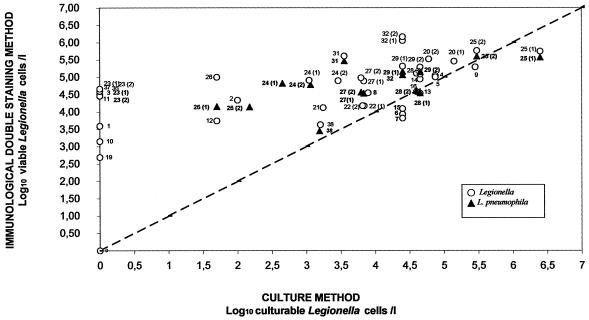
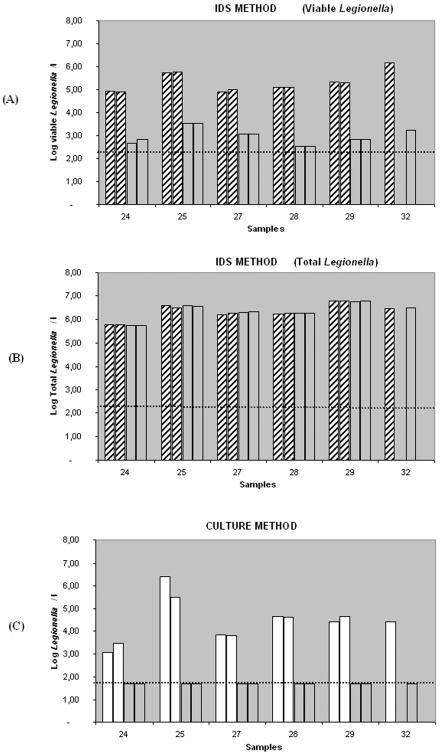
A sensitive and specific method has been developed to enumerate viable L. pneumophila and other Legionella spp. in water by epifluorescence microscopy in a short period of time (a few hours). This method allows the quantification of L. pneumophila or other Legionella spp. as well as the discrimination between viable and nonviable Legionella. It simultaneously combines the specific detection of Legionella cells using antibodies and a bacterial viability marker (ChemChrome V6), the enumeration being achieved by epifluorescence microscopy. The performance of this immunological double-staining (IDS) method was investigated in 38 natural filterable water samples from different aquatic sources, and the viable Legionella counts were compared with those obtained by the standard culture method. The recovery rate of the IDS method is similar to, or higher than, that of the conventional culture method. Under our experimental conditions, the limit of detection of the IDS method was <176 Legionella cells per liter. The examination of several samples in duplicates for the presence of L. pneumophila and other Legionella spp. indicated that the IDS method exhibits an excellent intralaboratory reproducibility, better than that of the standard culture method. This immunological approach allows rapid measurements in emergency situations, such as monitoring the efficacy of disinfection shock treatments. Although its field of application is as yet limited to filterable waters, the double-staining method may be an interesting alternative (not equivalent) to the conventional standard culture methods for enumerating viable Legionella when rapid detection is required.
Figures
Comment in
-
Deja vu all over again: rapid enumeration of Legionella pneumophila in water.Appl Environ Microbiol. 2006 Jan;72(1):980. doi: 10.1128/AEM.72.1.980.2006. Appl Environ Microbiol. 2006. PMID: 16391150 Free PMC article. No abstract available.
References
-
- Addiss, D. G., J. P. Davis, M. La Venture, P. J. Wand, M. A. Hutchinson, and R. M. McKinney. 1989. Community-acquired Legionnaires' disease associated with a cooling tower: evidence for longer-distance transport of Legionella. Am. J. Epidemiol. 130:557-568. - PubMed
-
- Association Française de Normalisation. 1993. Testing water—detection and enumeration of Legionella et de Legionella pneumophila—general method by direct culture and membrane filtration. French standard AFNOR NF T90-431. Association Française de Normalisation, Paris, France.
-
- Atlas, R. M. 1999. Legionella: from environmental habitats to disease pathology, detection and control. Environ. Microbiol. 1:283-293. - PubMed
Publication types
MeSH terms
Substances
LinkOut - more resources
Full Text Sources
Other Literature Sources
Molecular Biology Databases
Miscellaneous
