


doi: 10.1128/AEM.71.7.4108-4111.2005.
Prevalence and antimicrobial resistance of Campylobacter spp. and Salmonella serovars in organic chickens from Maryland retail stores
Affiliations
- PMID: 16000828
- PMCID: PMC1169031
- DOI: 10.1128/AEM.71.7.4108-4111.2005
Item in Clipboard
Prevalence and antimicrobial resistance of Campylobacter spp. and Salmonella serovars in organic chickens from Maryland retail stores
Appl Environ Microbiol.
2005 Jul.
Abstract
Retail organic (n = 198) and conventional (n = 61) chickens were analyzed. Most organic (76%) and conventional (74%) chickens were contaminated with campylobacters. Salmonellae were recovered from 61% of organic and 44% of conventional chickens. All Salmonella enterica serovar Typhimurium isolates from conventional chickens were resistant to five or more antimicrobials, whereas most S. enterica serovar Typhimurium isolates (79%) from organic chickens were susceptible to 17 antimicrobials tested.
Figures
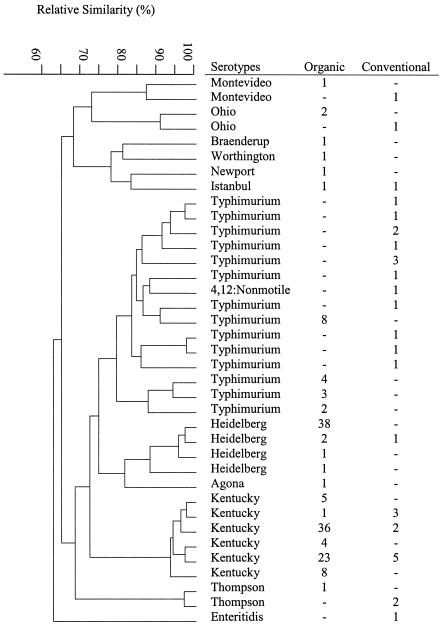
Dendrogram of PFGE of Salmonella isolates recovered from organically and conventionally produced chicken samples. The tree of relative genetic similarity was constructed based on the neighbor-joining method; scale at 100 means identical. The numbers under columns organic and conventional are the numbers of chicken samples from which each serotype was recovered.
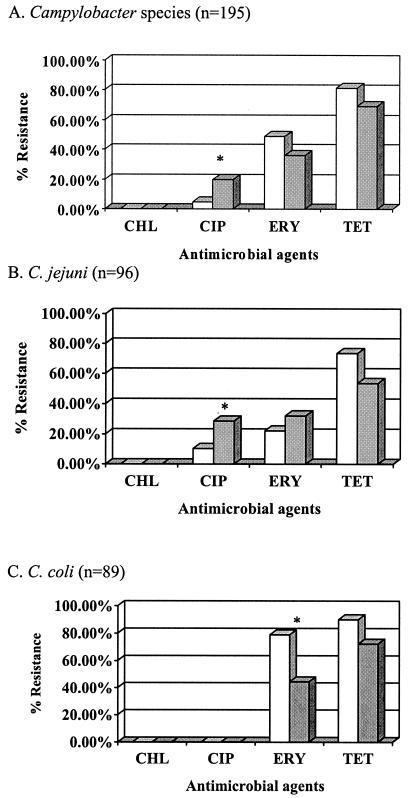
Antimicrobial resistance of campylobacters isolated from 150 organic (cross-hatch bars) and 45 conventional (solid bars) chickens. Abbreviations: CHL, chloramphenicol; CIP, ciprofloxacin; ERY, erythromycin; TET, tetracycline. An asterisk indicates a significant difference.
References
-
- Angulo, F. J., K. R. Johnson, R. V. Tauxe, and M. L. Cohen. 2000. Origins and consequences of antimicrobial-resistant nontyphoidal Salmonella: implications for the use of fluoroquinolones in food animals. Microb. Drug Resist. 6:77-83. - PubMed
-
- Besser, T. E., C. C. Gay, J. M. Gay, D. D. Hancock, D. Rice, L. C. Pritchett, and E. D. Erickson. 1997. Salmonellosis associated with S typhimurium DT104 in the USA. Vet. Rec. 140:75. - PubMed
-
- Engvall, A. 2001. May organically farmed animals pose a risk for Campylobacter infections in humans? Acta Vet. Scand. Suppl. 95:85-87. - PubMed
-
- Fey, P. D., T. J. Safranek, M. E. Rupp, E. F. Dunne, E. Ribot, P. C. Iwen, P. A. Bradford, F. J. Angulo, and S. H. Hinrichs. 2000. Ceftriaxone-resistant Salmonella infection acquired by a child from cattle. N. Engl. J. Med. 342:1242-1249. - PubMed
-
- Ge, B., S. Bodeis, R. D. Walker, D. G. White, S. Zhao, P. F. McDermott, and J. Meng. 2002. Comparison of the Etest and agar dilution for in vitro antimicrobial susceptibility testing of Campylobacter. J. Antimicrob. Chemother. 50:487-494. - PubMed
MeSH terms
Substances
LinkOut - more resources
Full Text Sources
Medical
Molecular Biology Databases
Miscellaneous
