Review
. 2005 Jun;2(2):113-25.
doi: 10.1186/1479-7364-2-2-113.

Genome-wide scans for loci under selection in humans

Affiliations
Review

Genome-wide scans for loci under selection in humans

James Ronald et al. Hum Genomics. 2005 Jun.

Abstract

Natural selection, which can be defined as the differential contribution of genetic variants to future generations, is the driving force of Darwinian evolution. Identifying regions of the human genome that have been targets of natural selection is an important step in clarifying human evolutionary history and understanding how genetic variation results in phenotypic diversity, it may also facilitate the search for complex disease genes. Technological advances in high-throughput DNA sequencing and single nucleotide polymorphism genotyping have enabled several genome-wide scans of natural selection to be undertaken. Here, some of the observations that are beginning to emerge from these studies will be reviewed, including evidence for geographically restricted selective pressures (ie local adaptation) and a relationship between genes subject to natural selection and human disease. In addition, the paper will highlight several important problems that need to be addressed in future genome-wide studies of natural selection.


Figures
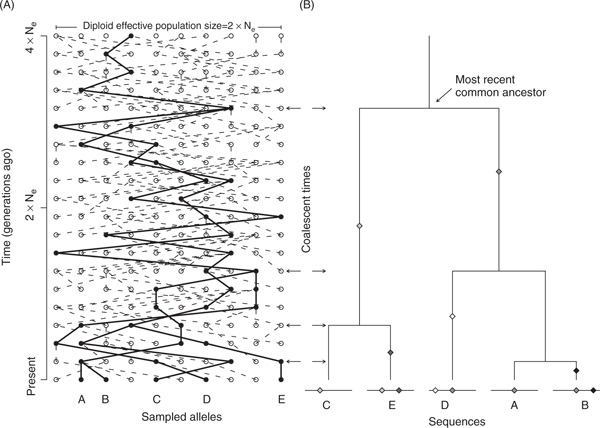
Figure 1
Figure 1
Coalescent representation of a neutrally evolving sequence. (A) Explicitly tracing the history of a sample of alleles from the population, each progenitor allele is derived from a randomly chosen parental allele. Occasionally, two progenitor alleles are derived from the same parent, causing the lineages of these two alleles to unite or coalesce when they are followed backward in time from the present. Note that if progeny are derived from parents at random, the probability that two lineages coalesce increases as the number of distinct lineages increases and as the effective population size decreases. Thus, for a constant-sized population, a characteristic distribution of waiting times between coalescent events is expected. (B) The untangled, coalescent representation of (A) is created by treating lineages as branches, ignoring the intermediate ancestors between coalescent events. Under neutrality, mutational events (represented by shaded diamonds) are uniformly distributed throughout time, hence the number of mutations that occur on a branch is proportional to the length of the branch. Note that mutations occurring on external branches are rare, appearing on only a single allele, whereas mutations occurring on internal branches are common.
Figure 2
Figure 2
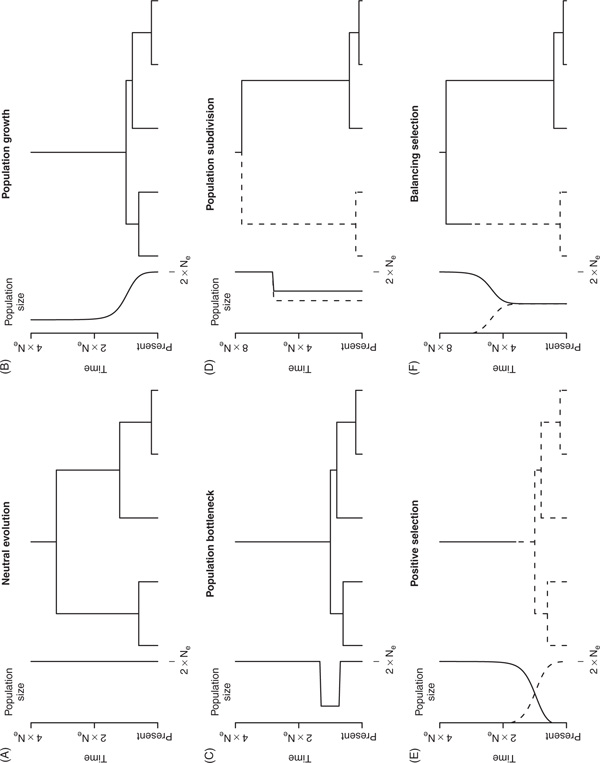
Effects of deviations from neutrality on gene genealogies. (A) Neutral evolution. (B) Population growth. (C) Population bottleneck. Here, only one ancestral lineage passes through the bottleneck, leading to a short tree with relatively long external branches. (D) Population subdivision. An initial population (represented by solid lines) separates into two subpopulations, which are denoted by dashed and solid lines. (E) Positive selection. An advantageous allele (represented by the dashed lines) sweeps through the population to fixation. Note that the genealogy of a selective sweep is similar to that produced by a population growth or bottleneck. (F) Balancing selection. An allele that is advantageous only in the heterozygous state (dashed line) appears in the population and is maintained at an intermediate frequency. Note that the genealogy under balancing selection is similar to population subdivision. Ne, effective population size.
Figure 3
Figure 3
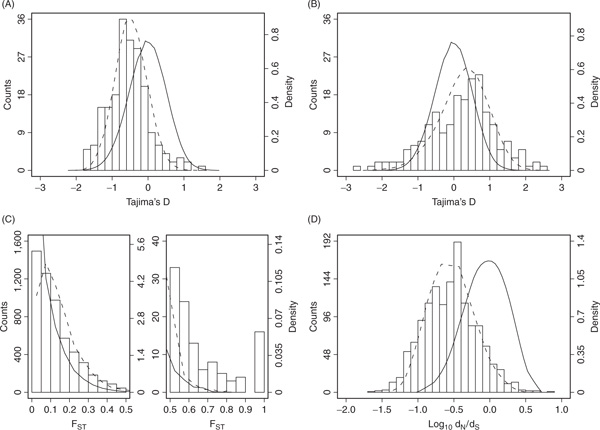
Empirical distributions of some commonly used test statistics and their theoretical distributions. (A) Distribution of Tajima's D in 201 genes in an African-American sample. The empirical distribution is denoted with bars. The solid line indicates the distribution of Tajima's D simulated under a standard neutral model with recombination using the ms program [59]. The dashed line indicates the distribution of Tajima's D simulated under the best fitting population demographic model from Akey et al. [60] (exponential expansion starting 50,000 years ago with a growth rate of 10-3 per generation). (B) Distribution of Tajima's D from the same 201 genes in a European-American sample. The best-fitting population demographic model is a bottleneck beginning 40,000 years ago with an inbreeding coefficient of 0.175 [60]. Data used to calculate Tajima's D in panels (A) and (B) was obtained from the SeattleSNPs project (http://pga.gs.washington.edu/). (C) The empirical distribution of FST for 5,590 chromosome 7 single nucleotide polymorphisms (SNPs) obtained from the HapMap project.61 The theoretical distributions of FST were simulated using ms [59]. An island migration model was assumed, with a constant migration parameter between each pair of populations. The solid line shows the expected distribution of FST under neutrality, whereas the dashed line shows the expected distribution under neutrality with an ascertainment bias favouring common SNPs. To approximate the ascertainment bias in the HapMap data, a 'double-hit' SNP discovery strategy was modelled [61] by randomly selecting four simulated chromosomes and only analysing SNPs where each allele was observed twice. The migration parameter was the same for both distributions and was chosen such that the mean of the biased FST distribution (0.138) closely matched the mean observed FST. (D) The empirical distribution of dn/ds from Clark et al. [62] Only those genes with dn > 0.001 and ds > 0.001 are shown. The solid line shows the distribution of dn/ds estimated using the method of Yang and Nielsen [63] for neutrally evolving coding sequences simulated with the PAML program [64]. The dashed line shows the distribution of dn/ds for sequences under negative selection, with the magnitude of the selective force chosen such that the mean log10 dn/ds (21.25) matched the mean of the Clark et al. [62] distribution. The length of the simulated sequences (450 codons) was chosen to match the mean length of sequences from Clark et al. [62].
Figure 4
Figure 4
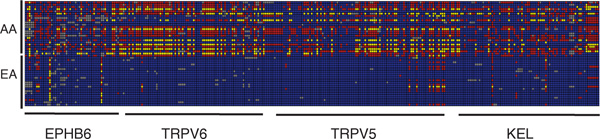
Signature of local adaptation on chromosome 7q33. A graphical representation of genotypes is shown for 23 European-American (EA) and 24 African-Americans (AA) across a 115 kilobase region on chromosome 7q33, which encompasses four genes. Rows correspond to individuals and columns denote a particular single nucleotide polymorphism (SNP). For each SNP, blue, red and yellow boxes indicate whether the individual is homozygous for the common allele, heterozygous or homozygous for the rare allele, respectively. Grey boxes indicate missing data. Notice the significant reduction in polymorphism in the European-American sample, which is consistent with the hypothesis that variation in one or more of these four genes conferred a selective advantage to European- Americans but not African-Americans. See Akey et al. [60] for more details. This figure was produced using genotype data from SeattleSNPs project (http://pga.gs.washington.edu/).

References

    1. Valle D. Genetics, individuality, and medicine in the 21st century. Am J Hum Genet. 2004;74:374–381. doi: 10.1086/382790. - DOI - PMC - PubMed
    1. Bamshad M, Wooding SP. Signatures of natural selection in the human genome. Nat Rev Genet. 2003;4:99–111. doi: 10.1038/nrg999. - DOI - PubMed
    1. Harr B, Kauer M, Schlotterer C. Hitchhiking mapping: A population-based fine mapping strategy for adaptive mutations in Drosophila melanogaster. Proc Natl Acad Sci USA. 2002;99:12949–12954. doi: 10.1073/pnas.202336899. - DOI - PMC - PubMed
    1. Kauer MO, Dieringer D, Schlotterer C. A microsatellite variability screen for positive selection associated with the "Out of Africa" habitat expansion of Drosophila melanogaster. Genetics. 2003;165:1137–1148. - PMC - PubMed
    1. Schofl G, Schlotterer C. Patterns of microsatellite variability among X chromosomes and autosomes indicate a high frequency of beneficial mutations in non-African D. simulans. Mol Biol Evol. 2004;21:1384–1390. doi: 10.1093/molbev/msh132. - DOI - PubMed

Publication types

LinkOut - more resources