Comparative Study
. 2005;49 Suppl 1(0 1):135-45.
doi: 10.1016/j.neuropharm.2005.05.005.

NMDA-induced potentiation of mGluR5 is mediated by activation of protein phosphatase 2B/calcineurin

Affiliations
Comparative Study

NMDA-induced potentiation of mGluR5 is mediated by activation of protein phosphatase 2B/calcineurin

Sudar Alagarsamy et al. Neuropharmacology. 2005.

Abstract

Previous reports have shown that activation of N-methyl-D-aspartate (NMDA) receptors potentiates responses to activation of the group I metabotropic glutamate receptor mGluR5 by reversing PKC-mediated desensitization of this receptor. NMDA-induced reversal of mGluR5 desensitization is dependent on activation of protein phosphatases. However, the specific protein phosphatase involved and the precise mechanism by which NMDA receptor activation reduces mGluR desensitization are not known. We have performed a series of molecular, biochemical, and genetic studies to show that NMDA-induced regulation of mGluR5 is dependent on activation of calcium-dependent protein phosphatase 2B/calcineurin (PP2B/CaN). Furthermore, we report that purified calcineurin directly dephosphorylates the C-terminal tail of mGluR5 at sites that are phosphorylated by PKC. Finally, immunoprecipitation and GST fusion protein pull-down experiments reveal that calcineurin interacts with mGluR5, suggesting that these proteins could be colocalized in a signaling complex. Taken together with previous studies, these data suggest that activation of NMDA receptors leads to activation of calcineurin and that calcineurin modulates mGluR5 function by directly dephosphorylating mGluR5 at PKC sites that are involved in desensitization of this receptor.


Figures
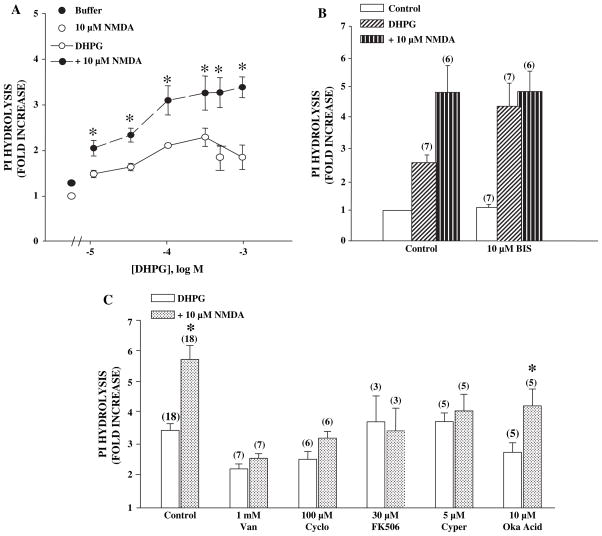
Fig. 1
Fig. 1
(A) DHPG dose-dependently increases phosphoinositide hydrolysis and NMDA increases this response in slices from adult rat cortex. Data are represented as fold of no drug control and are means ± S.E.M. of 3 experiments done in triplicate. An asterisk (*) indicates statistical difference ( p < 0.05, Student’s t-test) from DHPG response without 10 μM NMDA. (B) PKC inhibitor bisindolylmaleimide (BIS) potentiates the DHPG-induced phosphoinositide hydrolysis and prevents NMDA from causing further potentiation. Data are represented as described for panel A and are the means ± S.E.M. of (n) independent experiments done in triplicate. NMDA-induced a significant potentiation of the response to DHPG in control conditions ( p < 0.05, Student’s t-test) but not in the presence of BIS ( p > 0.05, Student’s t-test). Also BIS induced a significant potentiation of the DHPG response ( p < 0.05 of DHPG control, Student’s t-test). All groups, except BIS control, are statistically different from untreated control, p < 0.01). (C) Phosphatase inhibitors block the NMDA-induced potentiation of DHPG-induced phosphoinositide hydrolysis. The non-specific and calcineurin/PP2B-specific phosphatase inhibitors block the NMDA-induced potentiation of the DHPG response while okadaic acid had no effect. Data represent (n) experiments done in triplicate and are calculated as described above. An asterisk (*) indicates significant difference from each DHPG control, p < 0.05 or less.
Fig. 2
Fig. 2
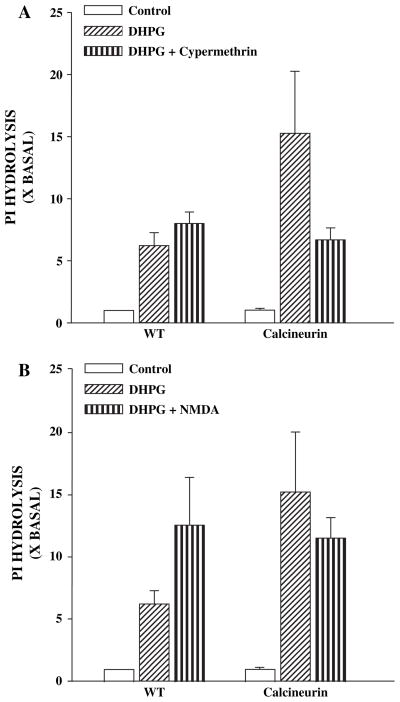
(A) Phosphoinositide hydrolysis in hippocampal slices made from wild-type (WT) mice that overexpress a constitutively active mutant of calcineurin (CAL). The agonist-induced responses are higher in tissue obtained from the mutant mice and this increase in response is reduced to WT levels in the presence of the calcineurin inhibitor, cypermethrin (cyper). (B) In contrast to slices made from WT mice, NMDA does not further potentiate the agonist response in the mutant mice. Data represented are pooled data from 12 mice and are expressed as percent of no drug control and are means ± S.E.M. of experiments done in triplicate.
Fig. 3
Fig. 3
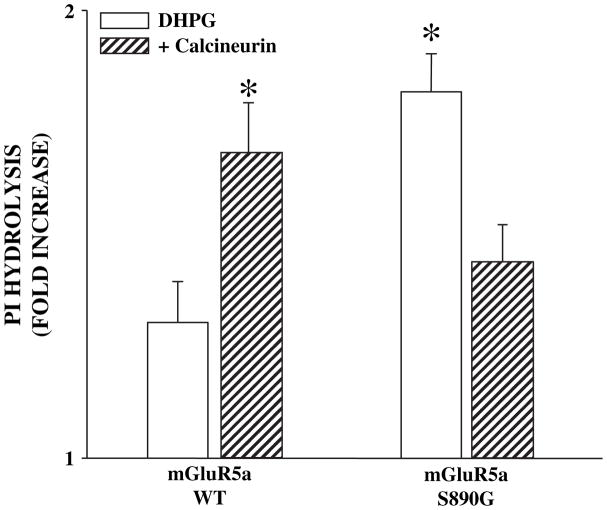
DHPG-induced phosphoinositide hydrolysis in Chinese hamster ovary (CHO) cells transiently transfected with mGluR5a wild-type (mGluR5a-WT) or mGluR5a-S890G DNA in the presence or absence of a calcineurin construct that is constitutively active (CaNa). There is a significant increase in response of cells transfected with mGluR5a-WT and CaNa and mGluR5a-S890G alone. As predicted, there is no further potentiation of responses in cells transfected with mGluR5a-S890G and CaNa. Data are represented as fold increase of no drug control measured 45 min after addition of 500 μM DHPG and are means ± S.E.M. of 5 experiments done in triplicate. An asterisk (*) indicates significant difference from response of cells transfected with mGluR5a-WT alone, p < 0.05 or less.
Fig. 4
Fig. 4
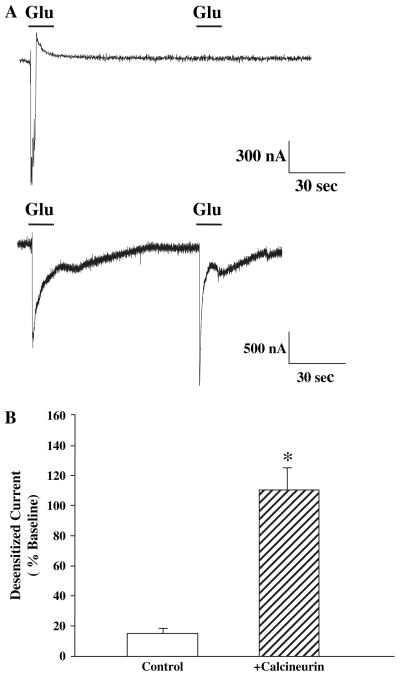
Dual-electrode voltage clamp recordings from Xenopus oocytes injected with mRNA made from cDNA of mGluR5a alone (top trace) or mGluR5a plus constitutively active calcineurin (CaNa) (bottom trace). Those oocytes expressing both mGluR5 and CaNa show less mGluR5 desensitization. Bar graph shows mean data expressed as percentage of second current from nine oocytes in each group and an asterisk (*) indicates statistical significance from oocytes not expressing CaNa, p < 0.01.
Fig. 5
Fig. 5
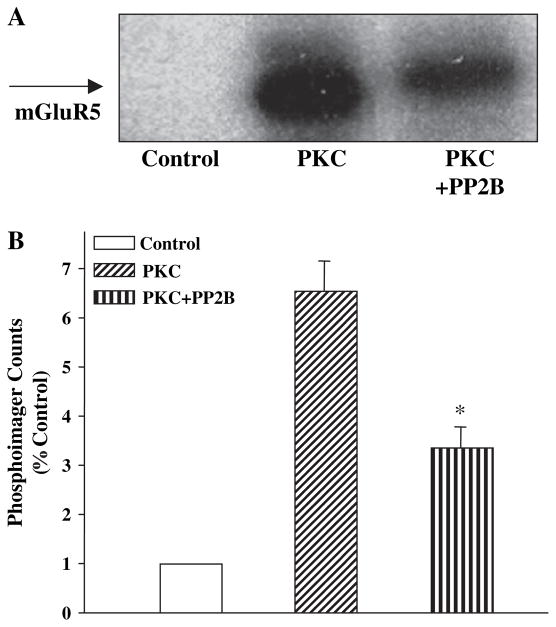
(A) Representative autoradiograph of mGluR5aCTX-GST fusion protein phosphorylated in vitro with purified protein kinase C (PKC) and appropriate activators in the presence and absence of purified calcineurin/PP2B (PP2B). PKC causes a significant increase in 32P incorporation into mGluR5aCTX-GST fusion proteins over samples without PKC while addition of PP2B decreases the amount. (B) The bands from three independent experiments were quantitated using a phosphoimager and are represented in the bar graph as fold increase over samples containing no PKC. An asterisk (*) indicates significant difference from the PKC effect, p < 0.05.
Fig. 6
Fig. 6
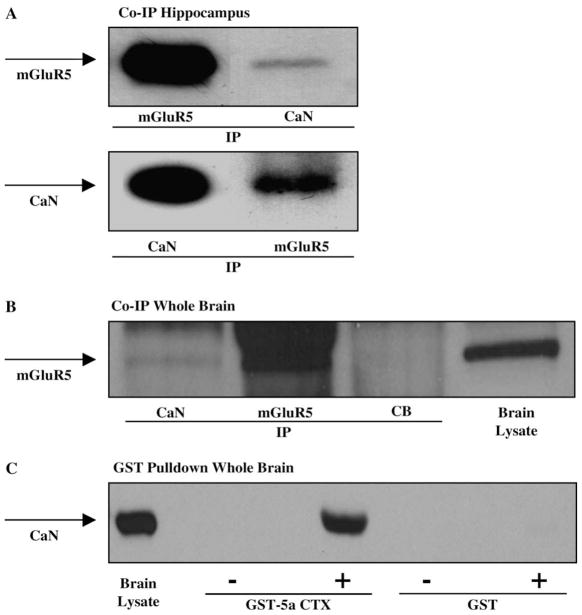
(A) Coimmunoprecipitation of mGluR5 and calcineurin. Immunoblots of rat hippocampal homogenates were immunoprecipitated with either mGluR5 or calcineurin (CaN) antibodies, and probed with mGluR5 and CaN antibodies. The blots show that mGluR5 and CaN are immunoprecipitated from hippocampal lysates, and that CaN coimmunoprecipitates with mGluR5, and mGluR5 coimmunoprecipitates with CaN. (B) Immunoblot of rat whole brain lysates immunoprecipitated with CaN, mGluR5, or a negative control cascade blue antibody, and probed for mGluR5. The blot shows that mGluR5 is detected in total brain lysate and in the mGluR5 immunoprecipitate, and that CaN is also detected as a coimmunoprecipitate of mGluR5, however, there is no mGluR5 detected in the negative control (CB). (C) Pull-down assay of mGluR5a and CaN. Rat whole brain homogenates were incubated with GST fusion protein or GST-mGluR5a carboxy terminal domain (GST-5aCTX) and probed with CaN antibody. The results show no CaN detected in GST alone, GST incubated with rat brain lysate, or GST-5aCTX alone, but CaN is detected in total brain lysate and GST-5aCTX incubated with rat brain lysate.

References

    1. Alagarsamy S, Marino MJ, Rouse ST, Gereau RW, Heinemann SF, Conn PJ. Activation of NMDA receptors reverses desensitization of mGluR5 in native and recombinant systems. Nat Neurosci. 1999a;2:234–240. - PubMed
    1. Alagarsamy S, Rouse ST, Gereau RW, Heinemann SF, Smith Y, Conn PJ. Activation of N-methyl-D-aspartate receptors reverses desensitization of metabotropic glutamate receptor, mGluR5, in native and recombinant systems. Ann N Y Acad Sci. 1999b;868:526–530. - PubMed
    1. Aniksztejn L, Bregestovski P, Ben Ari Y. Selective activation of quisqualate metabotropic receptor potentiates NMDA but not AMPA responses. Eur J Pharmacol. 1991;205:327–328. - PubMed
    1. Awad H, Hubert GW, Smith Y, Levey AI, Conn PJ. Activation of metabotropic glutamate receptor 5 has direct excitatory effects and potentiates NMDA receptor currents in neurons of the subthalamic nucleus. J Neurosci. 2000;20:7871–7879. - PMC - PubMed
    1. Bleakman D, Rusin KI, Chard PS, Glaum SR, Miller RJ. Metabotropic glutamate receptors potentiate ionotropic glutamate responses in the rat dorsal horn. Mol Pharmacol. 1992;42:192–196. - PubMed

Publication types

MeSH terms