. 2006 Apr;46(8-9):1210-20.
doi: 10.1016/j.visres.2005.05.008. Epub 2005 Jul 11.

Sustained and transient covert attention enhance the signal via different contrast response functions

Affiliations

Sustained and transient covert attention enhance the signal via different contrast response functions

Sam Ling et al. Vision Res. 2006 Apr.

Abstract

We investigated the mechanisms underlying the effects of sustained and transient covert attention on contrast sensitivity. The aim of this study was twofold: (1) Using a zero-noise display, we assessed whether sustained (endogenous) attention enhances contrast sensitivity via signal enhancement, and compared the magnitude of the effect with that of transient (exogenous) attention. (2) We compared the contrast psychometric functions for both sustained and transient attention and evaluated them in terms of contrast gain and response gain models. Observers performed a 2AFC orientation discrimination task on a tilted target Gabor, presented alone at 1 of 8 iso-eccentric locations. Either a neutral (baseline), peripheral (to manipulate transient attention), or a central cue (to manipulate sustained attention) preceded the target. Even in the absence of external noise, and using suprathreshold stimuli, observers showed an attentional effect, evidence in support of signal enhancement underlying both sustained and transient attention. Moreover, sustained attention caused a strictly leftward threshold shift in the psychometric function, supporting a contrast gain model. Interestingly, with transient attention we observed a change in asymptote in addition to a threshold shift. These findings suggest that whereas sustained attention operates strictly via contrast gain, transient attention may be better described by a mixture of response gain and contrast gain.


Figures
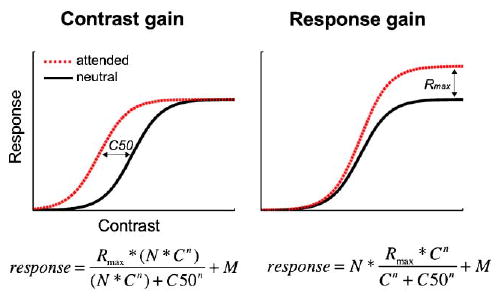
Fig. 1
Fig. 1
Possible effects of attention on the contrast response function. The left panel depicts a contrast gain model for attention. Contrast gain predicts an increase in sensitivity that is a function of stimulus intensity, and is characterized by a leftward threshold (C50) shift in the contrast response function. The dashed curve represents the signature curve shift brought about by attentional contrast gain; the shape of the function does not change, but rather shifts leftward—boosting the effective contrast of the stimulus. In the right panel, the dashed curve (attended) represents the effects of attention according to response gain models. Response gain predicts an increase in firing rate, which is characterized by a change in the shape of the curve—in slope and asymptote (Rmax). C50, threshold; Rmax, asymptote; n, slope; C, contrast level; N, attentional modulation; and M, response at lowest stimulus intensity.
Fig. 2
Fig. 2
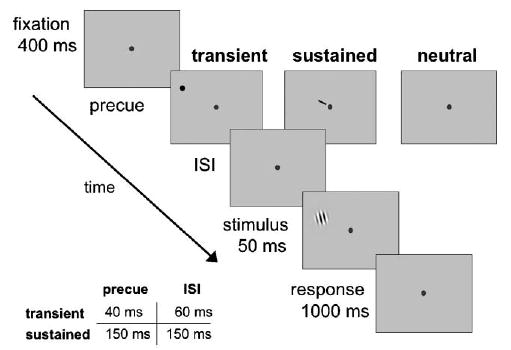
Sequence of events in a given trial. Observers performed a 2AFC orientation discrimination task on a tilted target Gabor patch, which appeared at one of eight iso-eccentric locations. The target was preceded by either a sustained cue (instructing observers to deploy their attention to the upcoming target location), a transient cue (reflexively capturing attention to the upcoming target location), or a neutral cue (baseline). The timings (precue and ISI) for sustained and transient conditions differed (along with their respective neutral conditions), to maximize the effectiveness of the cues. We used the method of constant stimuli to obtain psychometric functions, varying the contrast of the Gabor stimuli from trial-to-trial.
Fig. 3
Fig. 3
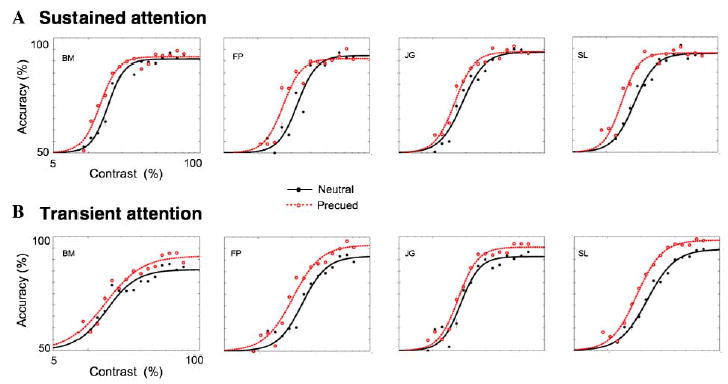
Psychometric functions for sustained and transient attention. The solid line represents the fits for the neutral condition, and the dashed line represents the fits for the precued. (A) Sustained attention consistently shifted the function to the left, having little impact on its shape, but increasing contrast sensitivity. (B) Transient attention consistently led to an elevation in asymptote, and the fits suggest a decrease in contrast threshold as well. Error bars correspond to mean ± 1 standard error.
Fig. 4
Fig. 4
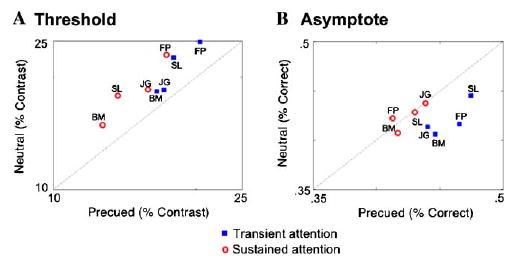
The effect of sustained and transient attention on threshold (C50) and asymptote (Rmax) for individual observers. The blue squares represent an observer’s parameter estimates in the transient condition vs. neutral, and the red circles represent estimates for sustained condition vs. neutral. Points falling on the dashed line represent unity, where there is no difference between precued and neutral conditions. (A) Threshold (C50) decreased for both sustained and transient covert attention. (B) Asymptote (Rmax) did not change with sustained attention, but increased for all observers with transient attention. (For interpretation of the references to colors in this figure legend, the reader is referred to the web version of this paper.)
Fig. 5
Fig. 5
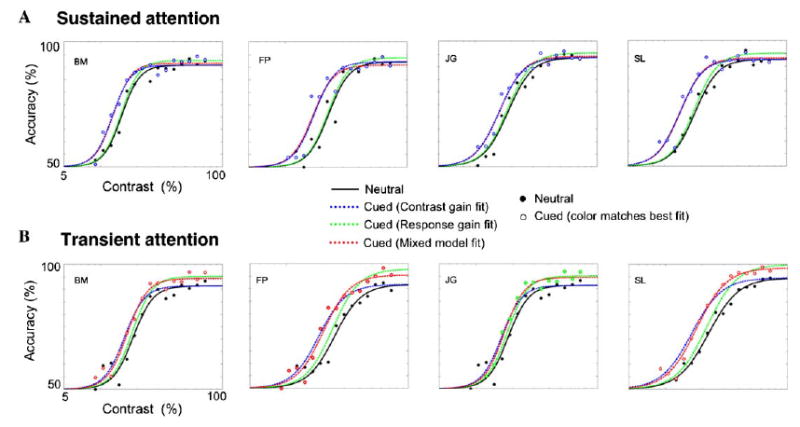
Contrast gain, response gain and mixed model fits to the data for sustained (A) and transient (B) covert attention. Filled circles correspond to the neutral data, and the hollow circles represent the precued data. The color of the hollow circles corresponds to the fit that best describes the attentional data. The solid black line is the fit to the neutral condition, the dashed green line corresponds to the attentional response gain model fit Eq. (2), the dashed blue line is the fit to the attentional contrast gain model Eq. (3), and the dashed red line corresponds to the mixed model Eq. (4).

References

    1. Albrecht DG, Hamilton DB. Striate cortex of monkey and cat: Contrast response function. Journal of Neurophysiology. 1982;48(1):217–237. - PubMed
    1. Baldassi S, Burr DC. Feature-based integration of orientation signals in visual search. Vision Research. 2000;40:1293–1300. - PubMed
    1. Brainard DH. The psychophysics toolbox. Spatial Vision. 1997;10:433–436. - PubMed
    1. Britten K, Shadlen MN, Newsome WT, Movshon JA. The analysis of visual motion: A comparison of neuronal and psychophysical performance. Journal of Neuroscience. 1992;12:4745–4767. - PMC - PubMed
    1. Cameron EL, Tai JC, Carrasco M. Covert attention affects the psychometric function of contrast sensitivity. Vision Research. 2002;42:949–967. - PubMed

Publication types