


Predictors and prognosis of paroxysmal atrial fibrillation in general practice in the UK
- PMID: 16008832
- PMCID: PMC1185525
- DOI: 10.1186/1471-2261-5-20
Predictors and prognosis of paroxysmal atrial fibrillation in general practice in the UK
Abstract
Background: Natural history of paroxysmal atrial fibrillation (AF) is not very well documented. Clinical experience suggests that paroxysmal AF could progress to chronic AF with estimates ranging between 15 and 30% over a period of 1-3 years. We performed an epidemiologic study to elucidate the natural history of paroxysmal AF, this study estimated its incidence in a general practice setting, identified associated factors and analyzed the progression into chronic AF as well as the mortality rate.
Methods: Using the UK General Practice Research Database (GPRD), we identified patients aged 40-89 years with a first-recorded episode of paroxysmal AF during 1996. Risk factors were assessed using 525 incident paroxysmal AF cases confirmed by the general practitioner (GP) and a random sample of controls. We follow-up paroxysmal AF patients and estimated their mortality rate and progression to chronic AF.
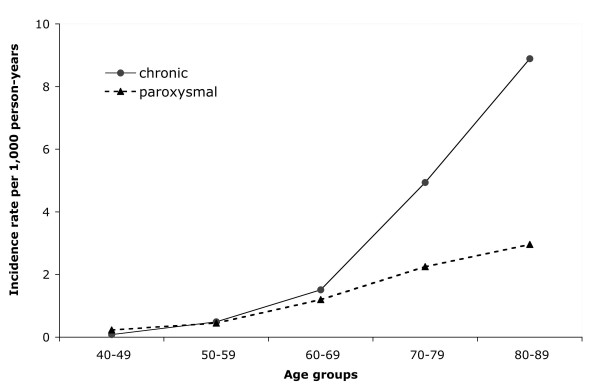
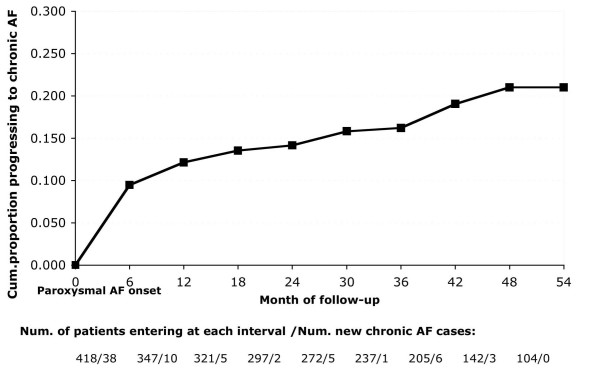
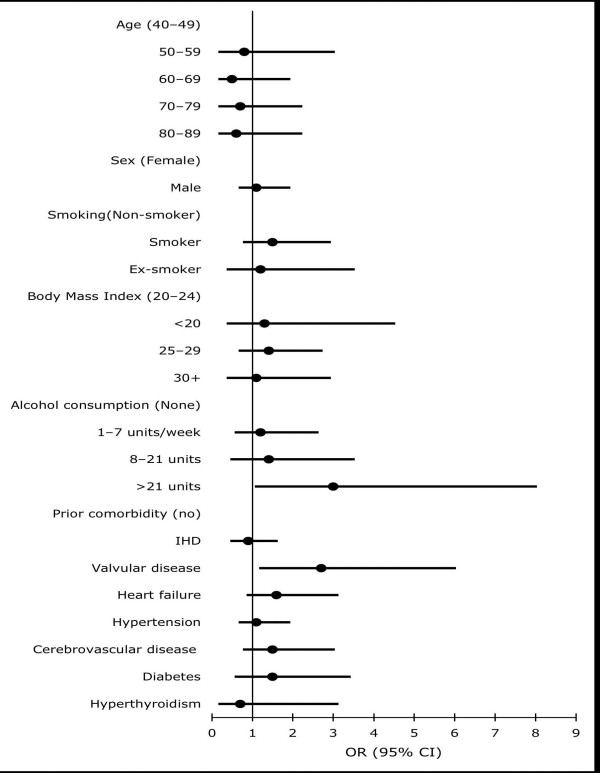
Results: The incidence of paroxysmal AF was 1.0 per 1,000 person-years. Major risk factors for paroxysmal AF were age and prior valvular heart disease, ischaemic heart disease, heart failure and hyperthyroidism. During a mean follow-up of 2.7 years, 70 of 418 paroxysmal AF patients with complete information progressed to chronic AF. Risk factors associated with progression were valvular heart disease (OR 2.7, 95% CI 1.2-6.0) and moderate to high alcohol consumption (OR 3.0, 95% CI 1.1-8.0). Paroxysmal AF patients did not carry an increased risk of mortality, compared to an age and sex matched sample of the general population. There was a suggestion of a small increased risk among patients progressing to chronic AF (RR 1.5, 96% CI 0.8-2.9).
Conclusion: Paroxysmal AF is a common arrhythmia in the general practice setting, increasing with age and commonly associated with other heart diseases. It sometimes is the initial presentation and then progress to chronic AF. A history of valvular heart disease and alcohol consumption are associated with this progression.
Figures
References
-
- Fuster V, Rydén LE, Asinger RW, Cannom DS, Crijns HJ, Frye RL, Halperin JL, Kay GN, Klein WW, Levy S, McNamara RL, Prystowsky EN, Wann LS, Wyse DG, Gibbons RJ, Antman EM, Alpert JS, Faxon DP, Fuster V, Gregoratos G, Hiratzka LF, Jacobs AK, Russell RO, Smith SC, Klein WW, Alonso-Garcia A, Blomstrom-Lundqvist C, De Backer G, Flather M, Hradec J, Oto A, Parkhomenko A, Silber S, Torbicki A. American College of Cardiology/American Heart Association/European Society of Cardiology Board. ACC/AHA/ESC guidelines for the management of patients with atrial fibrillation: a report of the American College of Cardiology/American Heart Association Task Force on Practice Guidelines and the European Society of Cardiology Committee for Practice Guidelines and Policy Conferences (Committee to Develop Guidelines for the Management of Patients With Atrial Fibrillation) J Am Coll Cardiol. 2001;38:1231–66. doi: 10.1016/S0735-1097(01)01587-X. - DOI - PubMed
-
- Page RL, Wilkinson WE, Clair WK, McCarthy EA, Pritchett EL. Asymptomatic arrhythmias in patients with symptomatic paroxysmal atrial fibrillation and paroxysmal supraventricular tachycardia. Circulation. 1994;89:224–7. - PubMed
Publication types
MeSH terms
LinkOut - more resources
Full Text Sources
Medical
