


Reduced prevalence of Epstein-Barr virus-related lymphocryptovirus infection in sera from a new world primate
- PMID: 16014968
- PMCID: PMC1181547
- DOI: 10.1128/JVI.79.15.10069-10072.2005
Reduced prevalence of Epstein-Barr virus-related lymphocryptovirus infection in sera from a new world primate
Abstract
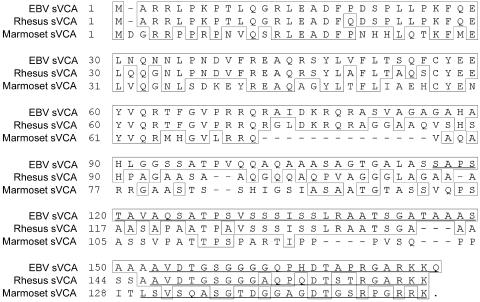
The recent discovery of an Epstein-Barr virus (EBV)-related lymphocryptovirus (LCV) naturally infecting common marmosets demonstrated that gamma-1 herpesviruses are not limited to human and Old World nonhuman primate hosts. We developed serologic assays to detect serum antibodies against lytic- and latent-infection marmoset LCV antigens in order to perform the first seroepidemiologic study of LCV infection in New World primates. In three different domestic colonies and in animals recently captured from the wild, we found that the seroprevalence of marmoset LCV infection was not as ubiquitous as with EBV or Old World LCV. These biologic differences in LCV infection of New World versus human and Old World primate hosts correlate with the evolution of the LCV viral gene repertoire.
Figures

References
-
- Frank, A., W. A. Andiman, and G. Miller. 1976. Epstein-Barr virus and nonhuman primates: natural and experimental infection. Adv. Cancer Res. 23:171-201. - PubMed
-
- Jenson, H. B., Y. Ench, S. J. Gao, K. Rice, D. Carey, R. C. Kennedy, J. R. Arrand, and M. Mackett. 2000. Epidemiology of herpesvirus papio infection in a large captive baboon colony: similarities to Epstein-Barr virus infection in humans. J. Infect. Dis. 181:1462-1466. - PubMed
Publication types
MeSH terms
Substances
Grants and funding
LinkOut - more resources
Full Text Sources
Other Literature Sources
