


Variants of CCR5, which are permissive for HIV-1 infection, show distinct functional responses to CCL3, CCL4 and CCL5
- PMID: 16015368
- PMCID: PMC1369982
- DOI: 10.1038/sj.gene.6364247
Variants of CCR5, which are permissive for HIV-1 infection, show distinct functional responses to CCL3, CCL4 and CCL5
Abstract
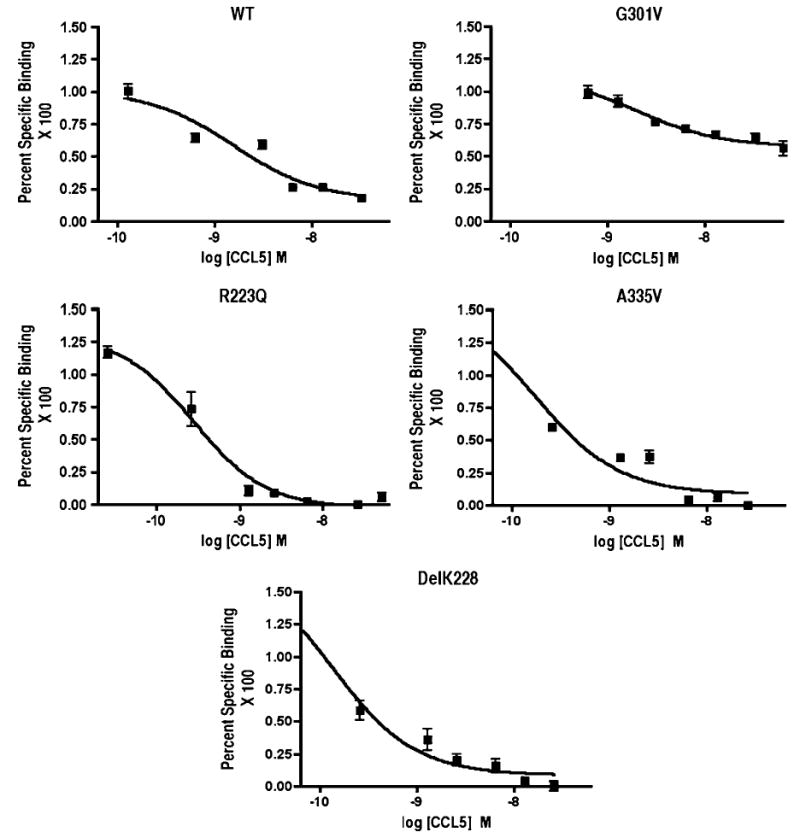
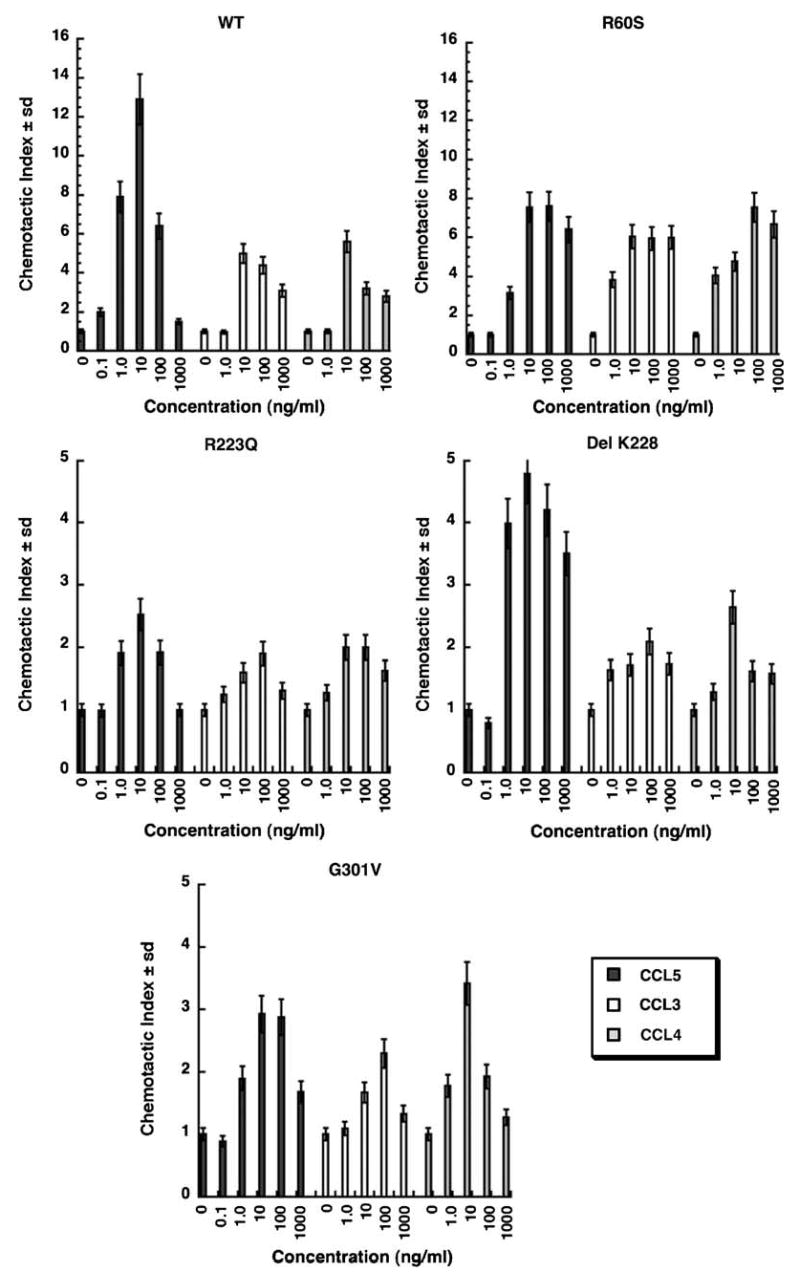
CCR5 is one of the primary coreceptors for Env-mediated fusion between cells and human immunodeficiency virus type 1 (HIV-1). Analyses of CCR5 variants in cohorts of HIV-1 high-risk individuals led to the identification of multiple single amino-acid substitutions, which may have functional consequences. This study focused on eight naturally occurring allelic variants located between amino-acid residues 60 and 334 of CCR5. All studied allelic variants were highly expressed on the cell surface of HEK-293 cells and permissive for HIV-1 infection. Variant G301V showed 3.5-fold increase in 50% effective concentration (EC(50)) for CCL4 (MIP 1beta) in a competitive binding assay. There was also a significant reduction in CCL5 (RANTES) EC(50) for the R223Q, A335V and Y339F variants. The most unexpected functional abnormality was exhibited by the R60S variant that exhibited a loss of ligand-induced desensitization in chemotaxis assays, but showed normal CCL4 and CCL5 binding avidity. This mutation is located in the first intracellular loop, a domain that has not previously been shown to be involved in receptor desensitization. In conclusion, our results support earlier studies showing that these naturally occurring point mutations do not limit HIV-1 infection, and indicated that single amino-acid changes can have unexpected functional consequences.
Genes and Immunity (2005) 6, 609-619. doi:10.1038/sj.gene.6364247; published online 14 July 2005.
Figures




References
-
- Feng Y, Broder CC, Kennedy PE, Berger EA. HIV-1 entry cofactor: functional cDNA cloning of a seven-transmembrane, G protein-coupled receptor [see comments] Science. 1996;272:872–877. - PubMed
-
- Moore JP, Trkola A, Dragic T. Co-receptors for HIV-1 entry. Curr Opin Immunol. 1997;9:551–562. - PubMed
-
- Littman DR. Chemokine receptors: keys to AIDS pathogenesis? Cell. 1998;93:677–680. - PubMed
-
- Raport CJ, Gosling J, Schweickart VL, Gray PW, Charo IF. Molecular cloning and functional characterization of a novel human CC chemokine receptor (CCR5) for RANTES, MIP-1beta, and MIP-1alpha. J Biol Chem. 1996;271:17161–17166. - PubMed
-
- Zlotnik A, Yoshie O. Chemokines: a new classification system and their role in immunity. Immunity. 2000;12:121–127. - PubMed
Publication types
MeSH terms
Substances
Grants and funding
LinkOut - more resources
Full Text Sources
Other Literature Sources
Miscellaneous
