. 2005 Sep 15;340(1):46-63.
doi: 10.1016/j.virol.2005.05.030.

Virulence differences between monkeypox virus isolates from West Africa and the Congo basin

Affiliations

Virulence differences between monkeypox virus isolates from West Africa and the Congo basin

Nanhai Chen et al. Virology. .

Abstract

Studies indicate that West African and Congo basin isolates of monkeypox virus (MPXV) are genetically distinct. Here, we show Congo basin MPXV-ZAI-V79 is more virulent for cynomolgus monkeys as compared to presumed West African MPXV-COP-58. This finding may explain the lack of case-fatalities in the U.S. 2003 monkeypox outbreak, which was caused by a West African virus. Virulence differences between West African and Congo basin MPXV are further supported by epidemiological analyses that observed a similar prevalence of antibodies in non-vaccinated humans in both regions, while >90% of reported cases occurred in the Congo basin, and no fatal cases were observed outside of this region. To determine the basis for this difference in virulence, we sequenced the genomes of one human West African isolate, and two presumed West African isolates and compared the sequences to Congo basin MPXV-ZAI-96-I-16. The analysis identified D10L, D14L, B10R, B14R, and B19R as possible virulence genes, with D14L (ortholog of vaccinia complement protein) as a leading candidate.


Figures
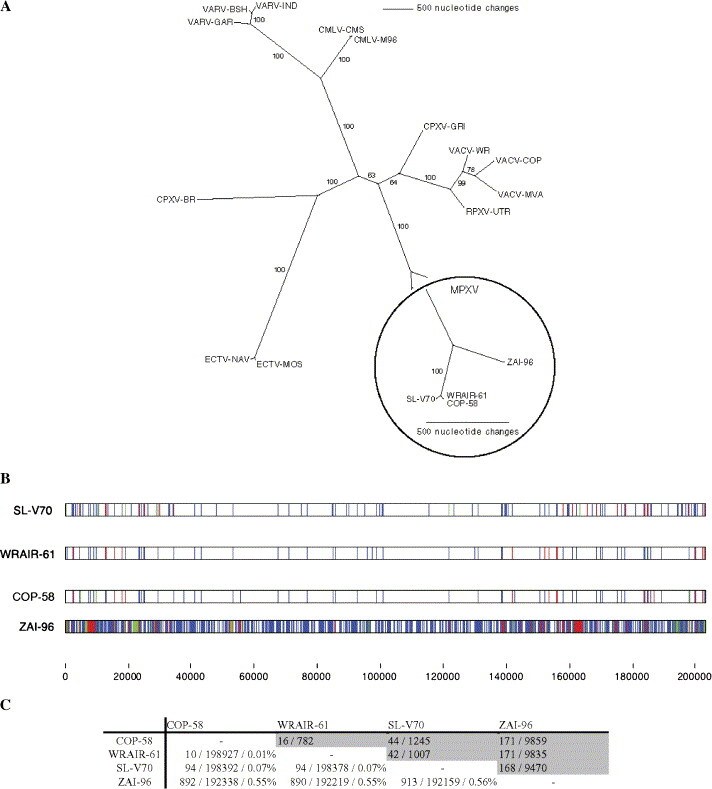
Fig. 1
Fig. 1
Genomic comparison of West African and Congo basin isolates of MPXV. (A) OPV phylogenetic predictions based upon the multiple nucleic acid sequence alignments of the core genomic region of each representative orthopoxvirus species, strain, or isolate. Bootstrap resampling confidence percentage based on 1000 replicates are displayed at each branch point. Branch lengths are proportional to the number of nucleotide changes. (B) CLUSTALW software was used to align the genomes of SL-V70, COP-58, WRAIR-61, and ZAI-96 and the alignment was manually optimized using Base-By-Base (Brodie et al., 2004). Each mismatched base was identified as a substitution (blue bar), deletion (red bar), or insertion (green bar) relative to a consensus; blue bars in all genomes indicate no consensus. InDels were counted as one mismatch regardless of size. The scale is such that several substitutions in close proximity may generate a single blue bar. (C) Summary of nucleotide difference comparisons: upper (grey) = gap number (segments) / total gap length; lower = number substitutions / number identical (non-gap) residues / percent difference (includes number of gaps).
Fig. 2
Fig. 2
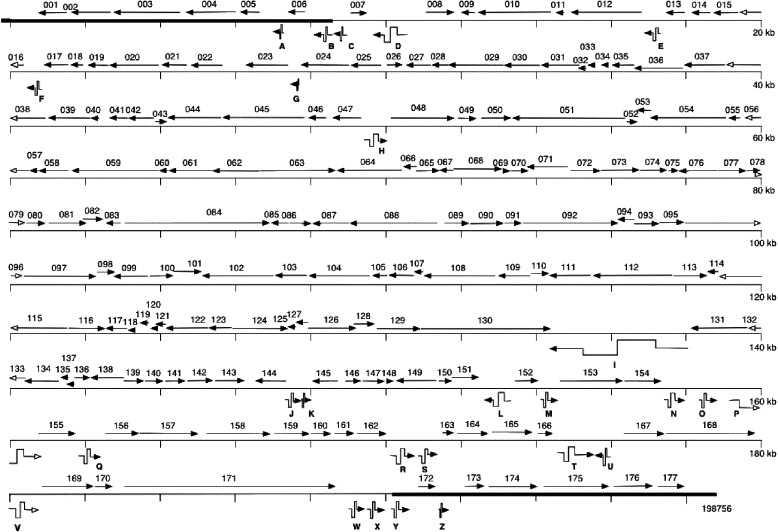
Physical map of SL-V70. Predicted genes are numbered and shown as straight arrows; regions containing fragments of larger genes in other OPVs are shown with staggered arrows to represent frame changes and are labeled A–Z. Open arrowheads indicate an ORF split over 2 lines of the diagram. Scale is shown in kilobases. The thick line represents the ITR.
Fig. 3
Fig. 3
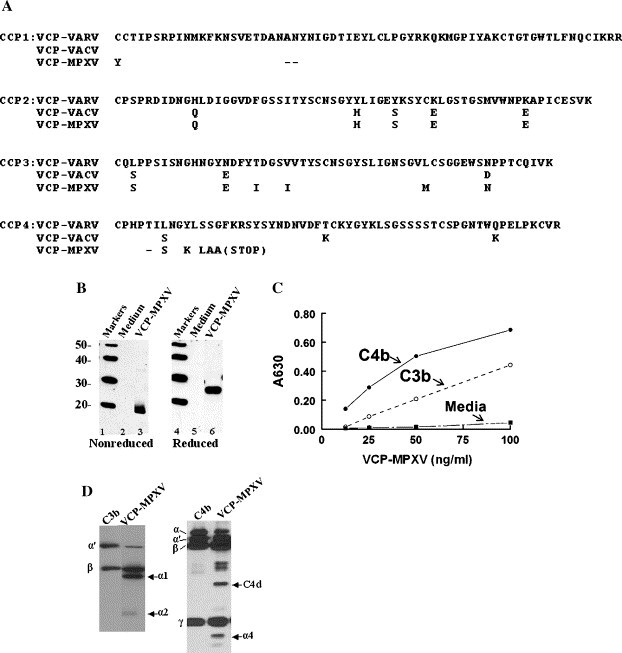
VCP-MPXV structure and function. (A) Amino acid alignment of VCP-VARV and VCP-MPXV without signal peptides illustrating amino acid differences and the premature termination of VCP-MPXV. (B) Western blot of non-reduced and reduced VCP-MPXV. Concentrated CHO supernatants containing VCP-MPXV were electrophoresed in a 10% SDS-PAGE, transferred to nitrocellulose and developed with 1:5000 rabbit anti-VCP-VACV antibody. (C) VCP-MPXV binds human C4b and C3b. A representative binding curve is shown. Ligands were coated onto microtiter plates followed by incubations with media or VCP-MPXV. Binding was detected with rabbit anti-VCP-VACV antibody (1:5000). VCP-MPXV was quantified in an ELISA (Materials and methods). (D) VCP-MPXV possesses cofactor activity for human C3b and C4b. Chemiluminescent cofactor assays were performed (with or without 10 ng VCP-MPXV), biotinylated human C3b and C4b and 100 ng of human factor I followed by Western blot analysis. Arrows denote some of the major cleavage fragments. Controls of VCP-MPXV without factor I did not show cleavage fragments (data not shown).
Fig. S1
Fig. S1
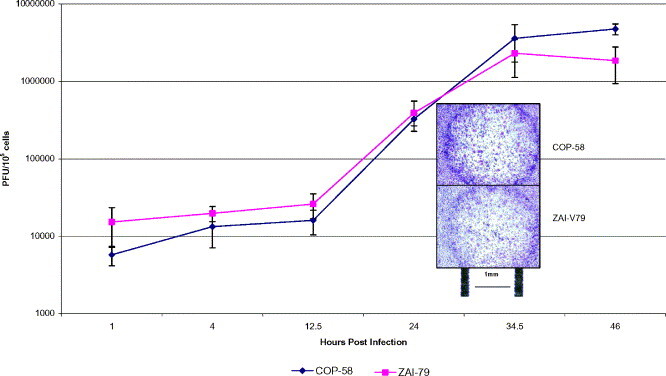
Comparison of single-cycle replication yields of COP-58 and ZAI-V79. Monolayer cultures of BSC-1 cells were infected with COP-58 or ZAI-V79 at approximately 1 PFU/cell. At 1, 4, 12.5, 24, 34.5, and 46 h post-infection, 4 cultures were harvested for each virus. Cells were scrapped into the cultures supernatant, frozen and thawed 3 times, and infectivity was measured by plaque assay on BSC-1 monolayers. Plaque titers are presented as means with error bars indicating 1 standard deviation of the mean. The inset shows a typical COP-58 and ZAI-V79 plaque stained at 4 days post-infection.

References

    1. Alcami A., Smith G.L. A soluble receptor for interleukin-1 beta encoded by vaccinia virus: a novel mechanism of virus modulation of the host response to infection. Cell. 1992;71:153–167. - PubMed
    1. Altschul S.F., Madden T.L., Schaffer A.A., Zhang J., Zhang Z., Miller W., Lipman D.J. Gapped BLAST and PSI-BLAST: a new generation of protein database search programs. Nucleic Acids Res. 1997;25:3389–3402. - PMC - PubMed
    1. Arita I., Gispen R., Kalter S.S., Wah L.T., Marennikova S.S., Netter R., Tagaya I. Outbreaks of monkeypox and serological surveys in nonhuman primates. Bull. World Health Organ. 1972;46:625–631. - PMC - PubMed
    1. Barry M., Hnatiuk S., Mossman K., Lee S.F., Boshkov L., McFadden G. The myxoma virus M-T4 gene encodes a novel RDEL-containing protein that is retained within the endoplasmic reticulum and is important for the productive infection of lymphocytes. Virology. 1997;239:360–377. - PubMed
    1. Bonfield J.K., Staden R. Experiment files and their application during large-scale sequencing projects. DNA Seq. 1996;6:109–117. - PubMed

Further reading

    1. Davison A.J., Moss B. Structure of vaccinia virus late promoters. J. Mol. Biol. 1989;210:771–784. - PubMed
    1. Payne L.G. Significance of extracellular enveloped virus in the in vitro and in vivo dissemination of vaccinia. J. Gen. Virol. 1980;50:89–100. - PubMed

Publication types

MeSH terms

Associated data