


Viral load quantitation of SARS-coronavirus RNA using a one-step real-time RT-PCR
- PMID: 16023880
- PMCID: PMC7110610
- DOI: 10.1016/j.ijid.2005.02.003
Viral load quantitation of SARS-coronavirus RNA using a one-step real-time RT-PCR
Abstract
Introduction: Severe acute respiratory syndrome (SARS) is an emerging infectious disease that first occurred in humans in the People's Republic of China in November 2002 and has subsequently spread worldwide. A novel virus belonging to the Coronaviridae family has been identified as the cause of this pulmonary disease. The severity of the disease combined with its rapid spread requires the development of fast and sensitive diagnostic assays.
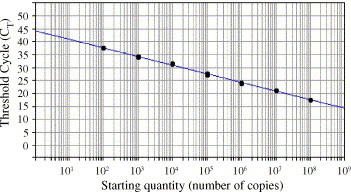
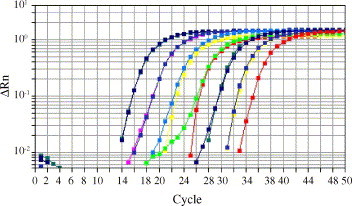
Results: A real-time quantitative RT-PCR was designed in the nsp11 region of the replicase 1B domain of the SARS-coronavirus (SARS-CoV) genome. To evaluate this quantitative RT-PCR, cRNA standards were constructed by in vitro transcription of SARS-CoV Frankfurt 1 RNA using T7 RNA polymerase, followed by real-time RT-PCR. The assay allowed quantitation over a range of 10(2) to 10(8) RNA copies per reaction.
Conclusions: Extrapolated to clinical samples, this novel assay has a detection range of 10(4) to 10(10) copies of viral genome equivalents per millilitre. In comparison to the current de facto cRNA Artus Biotech standard, the in-house cRNA standard gives a 100-fold higher absolute quantity, suggesting a possible underestimation of the viral load when using the Artus Biotech standard.
Figures
References
-
- Drosten C., Gunther S., Preiser W., van der Werf S., Brodt H.R., Becker S. Identification of a novel coronavirus in patients with severe acute respiratory syndrome. N Engl J Med. 2003;348:1967–1976. - PubMed
-
- Ksiazek T.G., Erdman D., Goldsmith C.S., Zaki S.R., Peret T., Emery S., SARS Working Group A novel coronavirus associated with severe acute respiratory syndrome. N Engl J Med. 2003;348:1953–1966. - PubMed
Publication types
MeSH terms
Substances
LinkOut - more resources
Full Text Sources
Miscellaneous
