


Barnacle reproductive hotspots linked to nearshore ocean conditions
- PMID: 16027356
- PMCID: PMC1180783
- DOI: 10.1073/pnas.0503874102
Barnacle reproductive hotspots linked to nearshore ocean conditions
Abstract
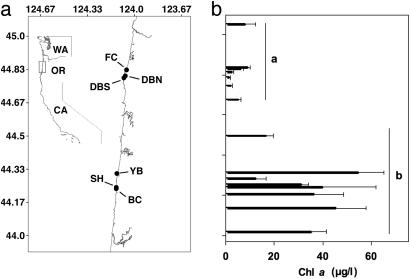
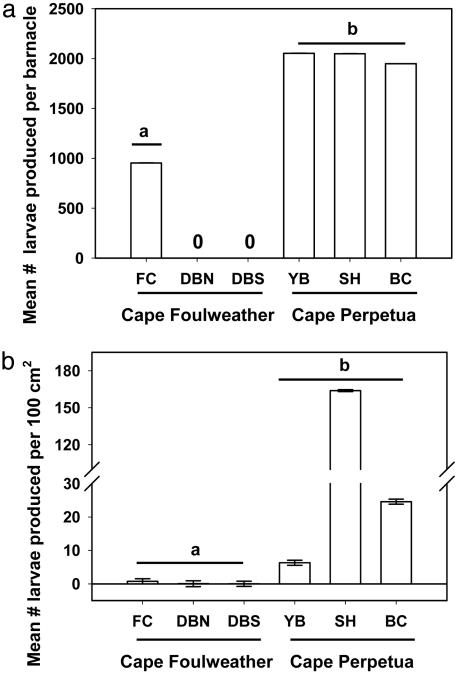
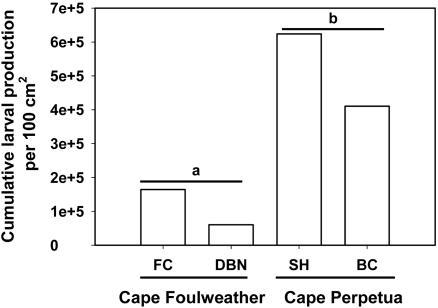
Coastal marine ecosystems provide important ecosystem services to human populations worldwide. Understanding the contexts in which a species has markedly higher reproductive output is vital for effective management and conservation of these valuable and highly impacted systems. We documented reproductive hotspots along the Oregon coast for an ecologically significant marine invertebrate, the intertidal barnacle Balanus glandula. Greater larval production in both natural and experimental populations was associated with higher primary productivity in the adjacent nearshore ocean, providing strong evidence for bottom-up forcing. Mean cumulative larval production per 100 cm2 in natural barnacle populations in the region of higher primary productivity was almost 5x that of populations in the less productive region. Mean estimated larval production per individual in experimental populations in the region of higher primary productivity was >2x that of populations in the region of lower productivity, and mean larval production per 100 cm2 was >120x greater in the region of higher productivity. Our results highlight the importance of spatial heterogeneity in reproduction and other ecological processes in the marine environment and provide a mechanistic basis for evaluating the relative contributions of different sites when designing marine reserves and other protected areas. Our findings also advance the understanding of the role of bottom-up influences on population and community dynamics and contribute data for the next generation of models of marine community dynamics.
Figures
References
-
- Pulliam, H. R. (1988) Am. Nat. 132, 652-661.
-
- National Research Council (2001) Marine Protected Areas: Tools for Sustaining Ocean Ecosystems (Natl. Academy Press, Washington, DC).
-
- Bertness, M. D., Gaines, S. D., Bermudez, D. & Sanford, E. (1991) Mar. Ecol. Prog. Ser. 75, 91-100.
-
- Barnes, H. & Barnes, M. (1968) J. Exp. Mar. Biol. Ecol. 2, 135-153.
-
- Best, P. B. (2001) Mar. Ecol. Prog. Ser. 220, 277-289.
Publication types
MeSH terms
LinkOut - more resources
Full Text Sources
