Comparative Study
. 2005 Aug;187(15):5406-18.
doi: 10.1128/JB.187.15.5406-5418.2005.

Mosaic nature of the wolbachia surface protein

Affiliations
Comparative Study

Mosaic nature of the wolbachia surface protein

Laura Baldo et al. J Bacteriol. 2005 Aug.

Abstract

Lateral gene transfer and recombination play important roles in the evolution of many parasitic bacteria. Here we investigate intragenic recombination in Wolbachia bacteria, considered among the most abundant intracellular bacteria on earth. We conduct a detailed analysis of the patterns of variation and recombination within the Wolbachia surface protein, utilizing an extensive set of published and new sequences from five main supergroups of Wolbachia. Analysis of nucleotide and amino acid sequence variations confirms four hypervariable regions (HVRs), separated by regions under strong conservation. Comparison of shared polymorphisms reveals a complex mosaic structure of the gene, characterized by a clear intragenic recombining of segments among several distinct strains, whose major recombination effect is shuffling of a relatively conserved set of amino acid motifs within each of the four HVRs. Exchanges occurred both within and between the arthropod supergroups. Analyses based on phylogenetic methods and a specific recombination detection program (MAXCHI) significantly support this complex partitioning of the gene, indicating a chimeric origin of wsp. Although wsp has been widely used to define macro- and microtaxonomy among Wolbachia strains, these results clearly show that it is not suitable for this purpose. The role of wsp in bacterium-host interactions is currently unknown, but results presented here indicate that exchanges of HVR motifs are favored by natural selection. Identifying host proteins that interact with wsp variants should help reveal how these widespread bacterial parasites affect and evolve in response to the cellular environments of their invertebrate hosts.


Figures
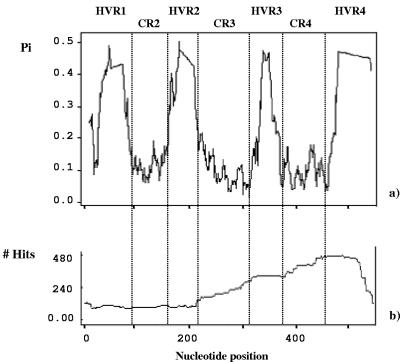
FIG. 1.
FIG. 1.
(a) Nucleotide divergence (Pi) of the alignment of 93 wsp sequences. Four peaks are identified, corresponding to the four HVRs. (b) Pattern of distribution of recombination events along the alignment of the 40 wsp nucleotide sequences, as detected by the MAXCHI program. The cumulative number of recombination events per site is given. Notably, all sites encompassing a single HVR experience similar numbers of events, suggesting that single HVRs are generally exchanged as unique tracts. HVR3 and -4 clearly appear to have undergone a proportionally higher number of recombination events than HVR1 and -2.
FIG. 2.
FIG. 2.
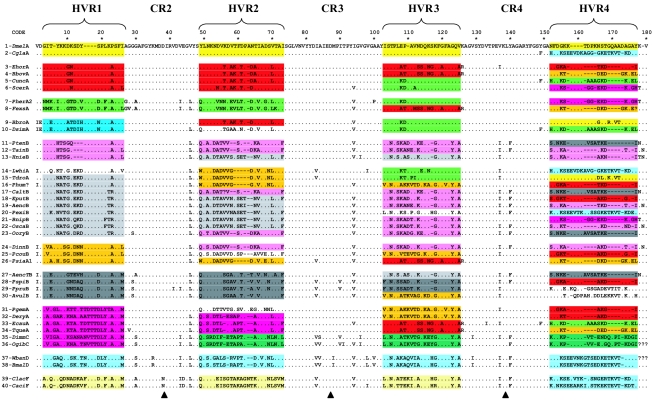
Amino acid alignment of 40 wsp sequences (180 amino acid in length). The reference sequence is 1-DmelA (from the host D. melanogaster). Amino acid motifs at the HVRs are color coded based on similarity of shared polymorphisms within each HVR. HVR1 is used as the initial reference region for sequence grouping. HVR motifs with uncertain groupings were left uncolored. Based on the pattern of colors along the gene, each of the first 34 arthropod sequences shows a unique combination of four HVR motifs and thus could be regarded as a distinct protein type. A clear shuffling of HVRs between sequences can be visualized. CR1 (about 145 bp) is not shown because the region was not completely sequenced for all of the strains. Arrowheads indicate the limits of the alignment sectors (HVR+) analyzed for phylogenetic reconstructions (see Fig. 4).
FIG. 3.
FIG. 3.
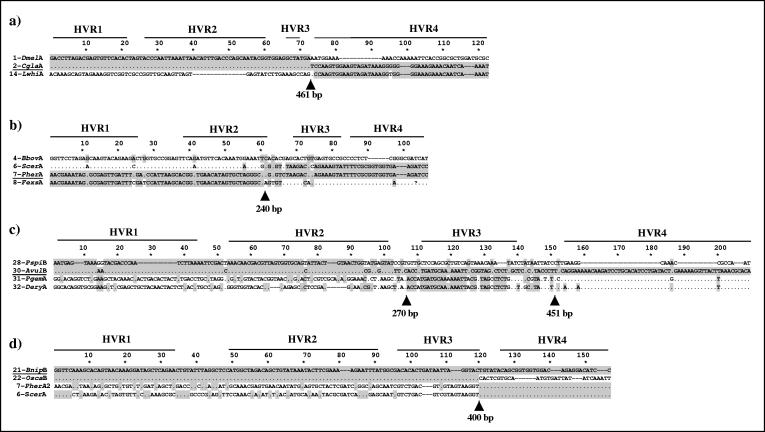
Examples of recombination breakpoints along wsp. For each alignment, only the polymorphic sites are shown. Also shown are the positions of the four HVRs. Polymorphisms shared with the underlined sequence are highlighted in gray. Arrows indicate significant breakpoints detected by MAXCHI and the approximate nucleotide position. In all cases, recombination breakpoints fall between HVRs.
FIG. 4.
FIG. 4.
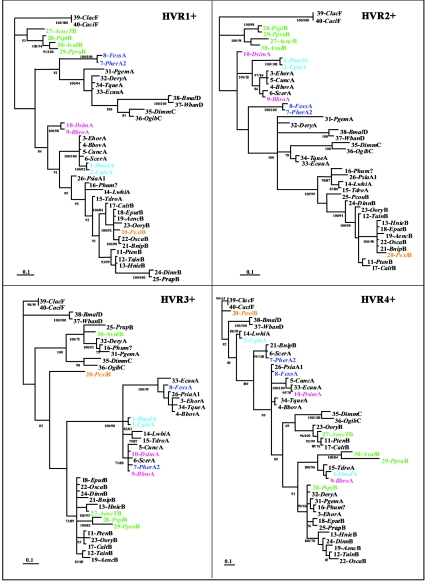
Phylogenetic trees of the four portions of wsp encompassing single HVR+s (135 bp each). The trees were generated by MrBayes (100,000 replicates, 50% majority rule) and are unrooted. Sequence identification corresponds to the description provided in Table 1. Colors highlight some of the examples discussed in the text (see Results) and show changes in phylogenetic association across HVR+s affecting all sequences shown. Sequences of supergroups A and B do not form separate groupings at any HVR. Posterior probability values higher than 70% are shown at the nodes. For nodes supported also by parsimonious analyses, the corresponding bootstrap value is shown under the posterior probabilities.

References

    1. Andrews, T. D., and T. Gojobori. 2004. Strong positive selection and recombination drive the antigenic variation of the PilE protein of the human pathogen Neisseria meningitidis. Genetics 166:25-32. - PMC - PubMed
    1. Baldo, L., J. D. Bartos, J. H. Werren, C. Bazzocchi, M. Casiraghi, and S. Panelli. 2002. Different rates of nucleotide substitutions in Wolbachia endosymbionts of arthropods and nematodes: arms race or host shifts? Parasitologia 44:179-187. - PubMed
    1. Bandi, C., C. G. Anderson, C. Genchi, and M. L. Blaxter. 1998. Phylogeny of Wolbachia in filarial nematodes. Proc. R. Soc. Lond. B Biol. Sci. 265:2407-2413. - PMC - PubMed
    1. Bandi, C., T. J. C. Anderson, C. Genchi, and M. Blaxter. 2001. The Wolbachia endosymbionts of filarial nematodes, p. 25-43. In M. W. Kennedy and W. Harnett (ed.), Parasitic nematodes. CAB International, Wallingford, Oxon, United Kingdom.
    1. Bandi, C., A. J. Trees, and N. W. Brattig. 2001. Wolbachia in filarial nematodes: evolutionary aspects and implications for the pathogenesis and treatment of filarial diseases. Vet. Parasitol. 98:215-238. - PubMed

Publication types

Substances