


Regulation of Mycobacterium tuberculosis cell envelope composition and virulence by intramembrane proteolysis
- PMID: 16034419
- PMCID: PMC1502149
- DOI: 10.1038/nature03713
Regulation of Mycobacterium tuberculosis cell envelope composition and virulence by intramembrane proteolysis
Abstract
Mycobacterium tuberculosis infection is a continuing global health crisis that kills 2 million people each year. Although the structurally diverse lipids of the M. tuberculosis cell envelope each have non-redundant roles in virulence or persistence, the molecular mechanisms regulating cell envelope composition in M. tuberculosis are undefined. In higher eukaryotes, membrane composition is controlled by site two protease (S2P)-mediated cleavage of sterol regulatory element binding proteins, membrane-bound transcription factors that control lipid biosynthesis. S2P is the founding member of a widely distributed family of membrane metalloproteases that cleave substrate proteins within transmembrane segments. Here we show that a previously uncharacterized M. tuberculosis S2P homologue (Rv2869c) regulates M. tuberculosis cell envelope composition, growth in vivo and persistence in vivo. These results establish that regulated intramembrane proteolysis is a conserved mechanism controlling membrane composition in prokaryotes and show that this proteolysis is a proximal regulator of cell envelope virulence determinants in M. tuberculosis.
Figures
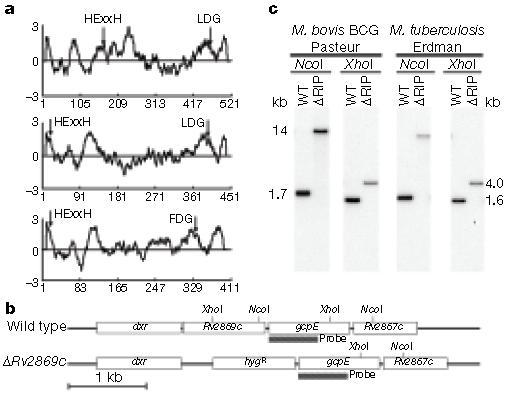
Hydropathy plots of human S2P, E. coli YaeL, and Mtb Rv2869c where positive numbers on the y axis indicate hydrophobic residues plotted against amino acid number on the x axis. Arrowheads indicate the conserved sequences (HExxH and F/LDG) within predicted transmembrane domains typical of intramembrane cleaving proteases.
Map of the Rv2869c genomic region in wild-type and the Rv2869c mutant. Restriction sites and probe location are indicated.
Southern blot of genomic DNA from indicated strains probed with the DNA fragment indicated in (b) showing allelic exchange at the Rv2869c locus in both M. tuberculosis and M. bovis BCG.
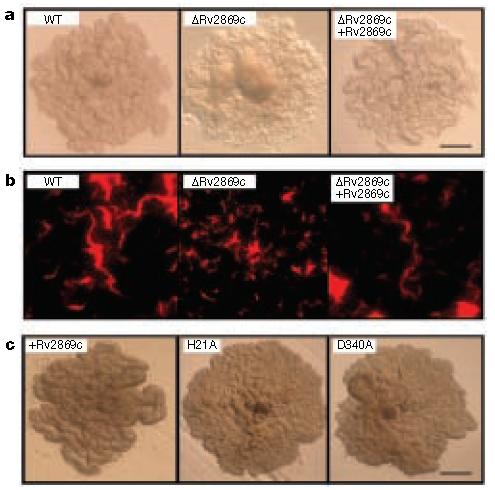
Single colonies of the indicated BCG strains at 5x magnification. Scale bar indicates 2 mm.
Auramine-Rhodamine stained smears of the indicated M. tuberculosis strains examined by fluorescence microscopy at 400 x magnification.
Conserved HExxH and FDG motifs of Rv2869c are required for complementation of the mutant cording phenotype. The M. bovis BCG Rv2869c null mutant was complemented either with the wild type Rv2869c, Rv2869c(H21A), or Rv2869c(D340A) and single colonies were assessed for return of wild type colony morphology.
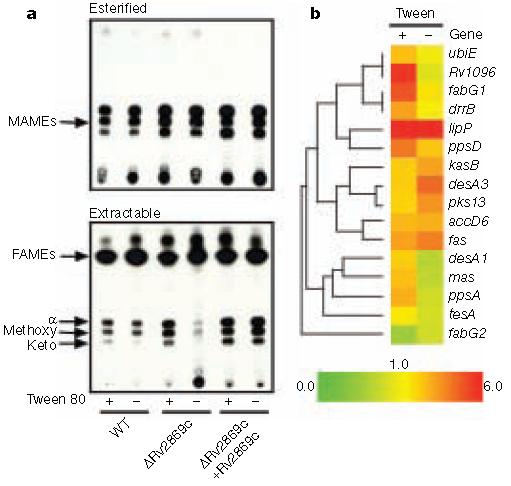
Radio thin layer chromatogram of mycolic acid methyl esters (MAME) and Fatty acid methyl esters (FAME) in the presence (+Tween80) or absence (−Tween80) of detergent. The top panel shows lipids covalently bound to the cell wall (esterified) while the bottom panel shows extractable lipids. The 3 major mycolic acid subtypes (alpha, methoxy, and ketomycolates) are labeled in the bottom panel.
Rv2869c controls cell envelope composition through positive and negative transcriptional control of lipid anabolic and catabolic genes. Lipid related genes significantly regulated in the Rv2869c mutant as determined by microarray analysis in detergent (+Tw) or short term detergent withdrawal (−Tw) conditions. Color bar depicts ratio of mutant/wt.
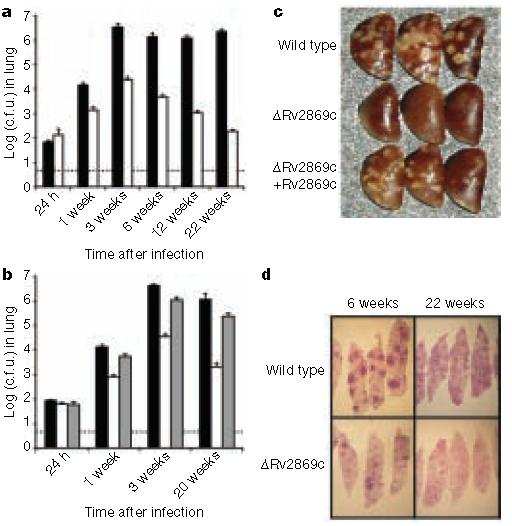
a and b. Lung bacterial loads plotted (log scale) from mice infected by aerosol with wild type Mtb (black bar), the ΔRv2869c strain (open bar), and the complemented mutant (gray bar) in two separate experiments. The horizontal line indicates the limit of detection of the assay and error bars are SD.
c. Gross pathology of infected lungs at 20 weeks from wild type (top), Rv2869c mutant (middle), or complemented mutant (bottom)
d. Hematoxylin and eosin-stained lung tissue from C57BL/6 mice infected with wild type (upper panels) and Rv2869c mutant (lower panels) at 6 (left panels) and 22 weeks (right panels) after infection.
References
-
- WHO . Global Tuberculosis Control: Surveillance, Planning, Financing. World Health Organization; Geneva, Switzerland: 2004.
-
- Glickman MS, Cox JS, Jacobs WR., Jr. A novel mycolic acid cyclopropane synthetase is required for cording, persistence, and virulence of Mycobacterium tuberculosis. Mol Cell. 2000;5:717–27. - PubMed
-
- Reed MB, et al. A glycolipid of hypervirulent tuberculosis strains that inhibits the innate immune response. Nature. 2004;431:84–7. - PubMed
-
- Cox JS, Chen B, McNeil M, Jacobs WR., Jr. Complex lipid determines tissue-specific replication of Mycobacterium tuberculosis in mice. Nature. 1999;402:79–83. - PubMed
-
- Gao LY, et al. Requirement for kasB in Mycobacterium mycolic acid biosynthesis, cell wall impermeability and intracellular survival: implications for therapy. Mol Microbiol. 2003;49:1547–63. - PubMed
Publication types
MeSH terms
Substances
Grants and funding
LinkOut - more resources
Full Text Sources
Other Literature Sources
Molecular Biology Databases
