


Repeated ethanol intoxication induces behavioral sensitization in the absence of a sensitized accumbens dopamine response in C57BL/6J and DBA/2J mice
- PMID: 16034441
- PMCID: PMC1405844
- DOI: 10.1038/sj.npp.1300833
Repeated ethanol intoxication induces behavioral sensitization in the absence of a sensitized accumbens dopamine response in C57BL/6J and DBA/2J mice
Abstract
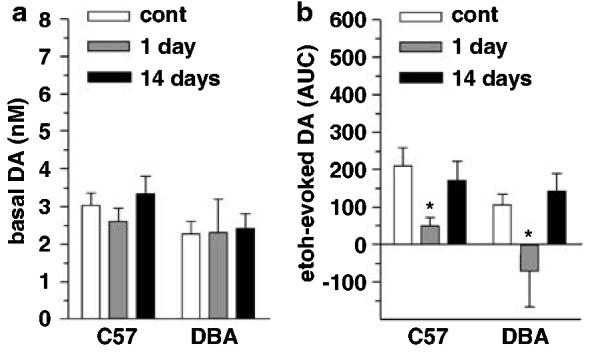
Repeated exposure to drugs of abuse results in an increased sensitivity to their behavioral effects, a phenomena referred to as behavioral sensitization. It has been suggested that the same neuroadaptations underlying behavioral sensitization contribute to the maintenance and reinstatement of addiction. Dysregulation of dopamine (DA) neurotransmission in the mesoaccumbens system is one neuroadaptation that is thought to lead to the compulsive drug-seeking that characterizes addiction. Evidence that sensitization to psychostimulants and opiates is associated with an enhancement of drug-evoked DA levels in the nucleus accumbens has also been obtained. Like other drugs of abuse, the acute administration of ethanol (ETOH) stimulates DA release in this brain region. Moreover, repeated ETOH experience results in an enhanced behavioral response to a subsequent ethanol challenge. Data regarding the influence of repeated ethanol intoxication and withdrawal upon mesoaccumbal DA neurotransmission is limited. Studies examining ETOH-evoked alterations in mesoaccumbal DA neurotransmission as a function of withdrawal duration are lacking. The present experiments quantified basal and ethanol-evoked DA levels 14 days and 24 h following the cessation of a repeated ETOH intoxication protocol, which results in sensitization to the locomotor activating effects of ethanol. Locomotor activity was assessed in parallel groups of animals. Studies were conducted in two mouse strains, C57BL/6J and DBA/2J, which differ in their behavioral responses to ETOH. The results indicate the development of transient tolerance to both ETOH-induced behavioral activation and evoked accumbens DA release at early withdrawal. Moreover, no enhanced DA response to a subsequent ETOH challenge could be demonstrated in ETOH experienced animals 2 weeks after withdrawal, in spite of the observation of clear behavioral sensitization at this time point. These results suggest that, at least in the case of ethanol, sensitization of the DA mesolimbic system may not be necessary for the development of behavioral sensitization.
Figures

References
-
- Becker HC. Positive relationship between the number of prior ethanol withdrawal episodes and the severity of subsequent withdrawal seizures. Psychopharmacology (Berlin) 1994;116:26–32. - PubMed
-
- Becker HC, Diaz-Granados JL, Weathersby RT. Repeated ethanol withdrawal experience increases the severity and duration of subsequent withdrawal seizures in mice. Alcohol. 1997;14:319–326. - PubMed
-
- Broadbent J, Grahame NJ, Cunningham CL. Haloperidol prevents ethanol-stimulated locomotor activity but fails to block sensitization. Psychopharmacology (Berlin) 1995;120:475–482. - PubMed
-
- Broadbent J, Kampmueller KM, Koonse SA. Expression of behavioral sensitization to ethanol by DBA/2J mice: the role of NMDA and non-NMDA glutamate receptors. Psychopharmacology (Berin) 2003;167:225–234. - PubMed
-
- Broadbent J, Weitemier AZ. Dizocilpine (MK-801) prevents the development of sensitization to ethanol in DBA/2J mice. Alcohol Alcohol. 1999;34:283–288. - PubMed
Publication types
MeSH terms
Substances
Grants and funding
LinkOut - more resources
Full Text Sources
