


A growth curve model of learning acquisition among cognitively normal older adults
- PMID: 16036723
- PMCID: PMC2908897
- DOI: 10.1080/03610730590948195
A growth curve model of learning acquisition among cognitively normal older adults
Abstract
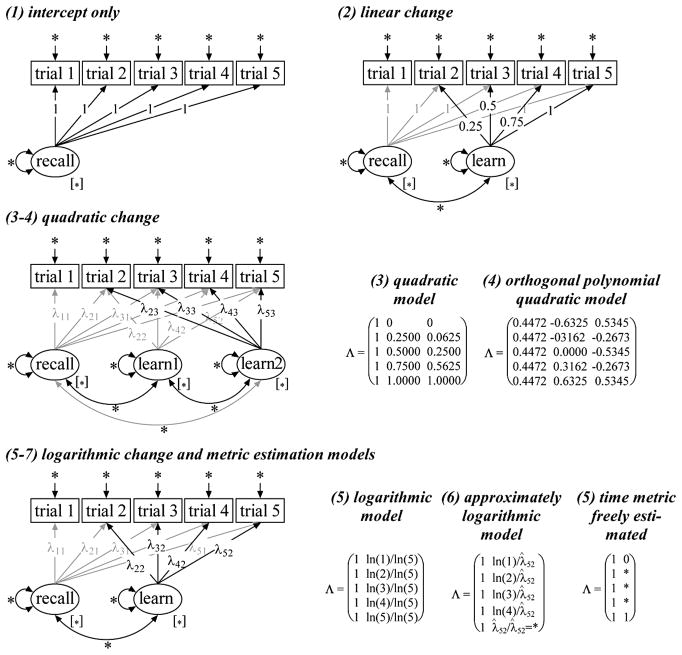
The objective of this study was to model recall and learning on the Auditory Verbal Learning Test using latent growth curve techniques. Participants were older adults recruited for the ACTIVE cognitive intervention pilot. A series of nested models revealed that an approximately logarithmic growth curve model provided optimal fit to the data. Although recall and learning factors were statistically uncorrelated, a fitted multivariate model suggested that initial recall was significantly associated with demographic characteristics but unrelated to health factors and cognitive abilities. Individual differences in learning were related to race/ethnicity, speed of processing, verbal knowledge, and global cognitive function level. These results suggest that failing to recognize initial recall and learning as distinct constructs clouds the interpretation of supraspan memory tasks.
Figures
References
-
- Akaike H. A new look at statistical model identification. IEEE Transactions on Automatic Control. 1974;AC-19:716–723.
-
- Anstey K, Christensen H. Education, activity, health, blood pressure and apolipoprotein E as predictors of cognitive change in old age: A review. Gerontology. 2000;46:163–177. - PubMed
-
- Bäckman L, Small B, Wahlin A, Larson M. Cognitive functioning in very old age. In: Craik F, Salthouse T, editors. The handbook of aging and cognition. Mahwah, NJ: Lawrence Erlbaum; 2000. pp. 499–558.
-
- Benedict RHB, Schretlen D, Groninger L, Brandt J. Hopkins Verbal Learning Test—Revised: Normative data and analysis of inter-form and test-retest reliability. The Clinical Neuropsychologist. 1998;12:43–55.
-
- Bentler PM. Comparative fit indexes in structural models. Psychological Bulletin. 1990;107:238–246. - PubMed
Publication types
MeSH terms
Grants and funding
- U01 NR004508/NR/NINR NIH HHS/United States
- U01 AG014282/AG/NIA NIH HHS/United States
- NR04508/NR/NINR NIH HHS/United States
- AG14282/AG/NIA NIH HHS/United States
- AG14276/AG/NIA NIH HHS/United States
- U01 AG014289/AG/NIA NIH HHS/United States
- AG14260/AG/NIA NIH HHS/United States
- U01 AG014260/AG/NIA NIH HHS/United States
- AG14263/AG/NIA NIH HHS/United States
- AG14289/AG/NIA NIH HHS/United States
- U01 AG014276/AG/NIA NIH HHS/United States
- U01 AG014263/AG/NIA NIH HHS/United States
- NR04507/NR/NINR NIH HHS/United States
- U01 NR004507/NR/NINR NIH HHS/United States
LinkOut - more resources
Full Text Sources
Medical
