. 2005 Aug;73(8):4972-81.
doi: 10.1128/IAI.73.8.4972-4981.2005.

Borrelia burgdorferi rel is responsible for generation of guanosine-3'-diphosphate-5'-triphosphate and growth control

Affiliations

Borrelia burgdorferi rel is responsible for generation of guanosine-3'-diphosphate-5'-triphosphate and growth control

Julia V Bugrysheva et al. Infect Immun. 2005 Aug.

Abstract

The global transcriptional regulator (p)ppGpp (guanosine-3'-diphosphate-5'-triphosphate and guanosine-3',5'-bisphosphate, collectively) produced by the relA and spoT genes in Escherichia coli allows bacteria to adapt to different environmental stresses. The genome of Borrelia burgdorferi encodes a single chromosomal rel gene (BB0198) (B. burgdorferi rel [rel(Bbu)]) homologous to relA and spoT of E. coli. Its role in (p)ppGpp synthesis, bacterial growth, and modulation of gene expression has not been studied in detail. We constructed a rel(Bbu) deletion mutant in an infectious B. burgdorferi 297 strain and isolated an extrachromosomally complemented derivative of this mutant. The mutant did not synthesize rel(Bbu) mRNA, Rel(Bbu) protein, or (p)ppGpp. This synthesis was restored in the complemented derivative, confirming that rel(Bbu) is necessary and sufficient for (p)ppGpp synthesis and degradation in B. burgdorferi. The rel(Bbu) mutant grew well during log phase in complete BSK-H but reached lower cell concentrations in the stationary phase than the wild-type parent, suggesting that (p)ppGpp may be an important factor in the ability of B. burgdorferi to adapt to stationary phase. Deletion of rel(Bbu) did not eliminate the temperature-elicited OspC shift, nor did it alter bmp gene expression or B. burgdorferi antibiotic susceptibility. Although deletion of rel(Bbu) eliminated B. burgdorferi virulence for mice, which was not restored by complementation, we suggest that rel(Bbu)-dependent accumulation of (p)ppGpp may be important for in vivo survival of this pathogen.


Figures
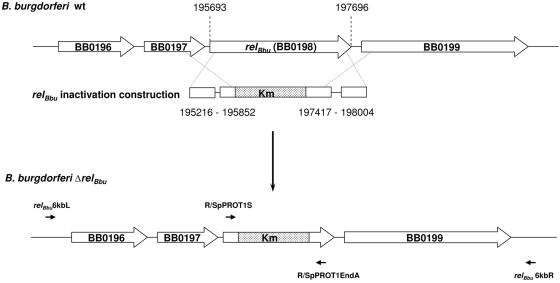
FIG. 1.
FIG. 1.
Production of the B. burgdorferi 297 relBbu deletion mutation by replacement of central region of relBbu with the kanamycin resistance gene aph(3′)-IIIa (Km) from Enterococcus faecalis (43). Numbers showing the positions of nucleotides on B. burgdorferi chromosome indicate the start and the end of relBbu gene and positions of flanking relBbu fragments used in inactivation construction. Primers used for analysis of relBbu deletion are shown by arrows. wt, wild type.
FIG. 2.
FIG. 2.
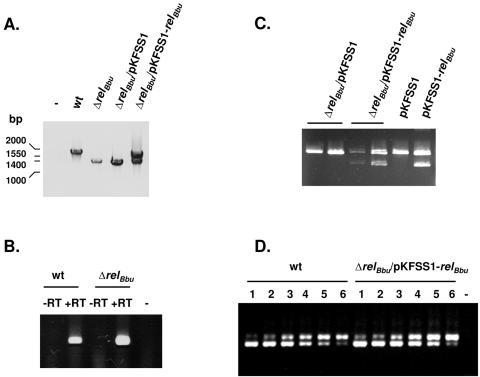
Confirmation of relBbu deletion and complementation in B. burgdorferi. (A) PCR analysis of the B. burgdorferi wild type (wt), relBbu mutant (ΔrelBbu), vector-transformed relBbu mutant (ΔrelBbu/pKFSS1), and complemented mutant (ΔrelBbu/pKFSS1-relBbu) with primers R/SpPROT1S and R/SpPROT1EndA (Fig. 1; Table 1). −, reaction with DNA omitted. (B) RT-PCR analysis of mRNA expression for BB0199 gene in the B. burgdorferi wild-type (wt) and relBbu mutant (ΔrelBbu). −, reaction with mRNA omitted; +RT, reaction with reverse transcriptase; −RT, reaction with reverse transcriptase omitted. (C) BamHI-PstI-digested plasmid DNA isolated from E. coli transformed with DNA from vector-transformed (ΔrelBbu/pKFSS1) or complemented (ΔrelBbu/pKFSS1-relBbu) relBbu mutant and BamHI-PstI-digested plasmids used for original transformation of B. burgdorferi (pKFSS1, pKFSS1-relBbu). (D) Competitive PCR analysis of relBbu gene copy number between B. burgdorferi wild-type (wt) and complemented relBbu mutant (ΔrelBbu/pKFSS1-relBbu). Reaction mixtures contained the same amount of total B. burgdorferi DNA and six serial twofold dilutions of competitor (lanes 1 to 6). Lane 4 shows equal signal intensities from target DNA (upper band) and competitor (lower band) for the wild type and the complemented relBbu mutant, indicating that they are present in equal concentrations in this reaction mixture. −, negative control.
FIG. 3.
FIG. 3.
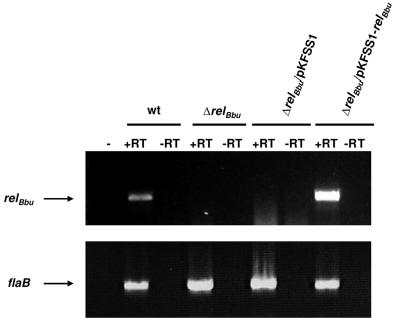
relBbu mRNA synthesis in the B. burgdorferi wild type (wt), relBbu mutant (ΔrelBbu), vector-transformed relBbu mutant (ΔrelBbu/pKFSS1), and complemented mutant (ΔrelBbu/pKFSS1-relBbu). RT-PCR for constitutively expressed flaB gene was used as a control to show the presence of RNA in a sample. −, RT-PCR in the absence of mRNA; +RT, reaction containing reverse transcriptase; −RT, reaction in the absence of reverse transcriptase. Arrows indicate PCR fragments corresponding to relBbu or flaB mRNA.
FIG. 4.
FIG. 4.
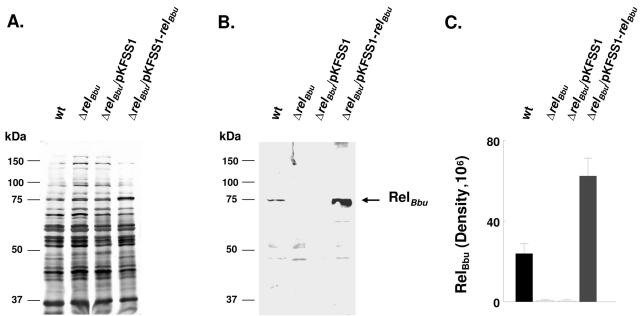
RelBbu protein synthesis in the B. burgdorferi wild type (wt), relBbu mutant (ΔrelBbu), vector-transformed relBbu mutant (ΔrelBbu/pKFSS1), and complemented mutant (ΔrelBbu/pKFSS1-relBbu). (A) Sodium dodecyl sulfate-polyacrylamide gel electrophoresis (silver stain) of total B. burgdorferi lysates shows that the load of total protein is similar for each lane. (B) Western blot analysis with anti-RelBbu antibodies. (C) Relative RelBbu band intensities estimated from six independent Western blots and presented as means ± standard deviations.
FIG. 5.
FIG. 5.
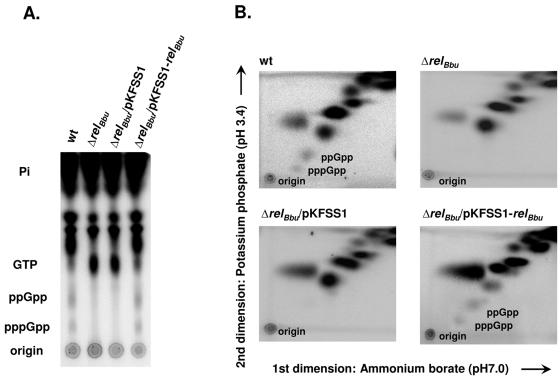
(p)ppGpp synthesis in the B. burgdorferi wild type (wt), relBbu mutant (ΔrelBbu), vector-transformed relBbu mutant (ΔrelBbu/pKFSS1), and complemented mutant (ΔrelBbu/pKFSS1-relBbu). (A) One-dimensional TLC; (B) two-dimensional TLC. The identities of B. burgdorferi pppGpp and ppGpp were determined by comigration on chromatograms with (p)ppGpp of E. coli (3). Pi, inorganic phosphate.
FIG. 6.
FIG. 6.
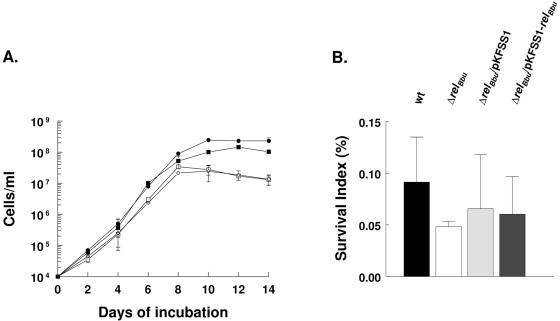
Growth of the B. burgdorferi wild type (wt), relBbu mutant (ΔrelBbu), vector-transformed relBbu mutant (ΔrelBbu/pKFSS1), and complemented mutant (ΔrelBbu/pKFSS1-relBbu) in BSK-H at 34°C. (A) Growth curves of the B. burgdorferi wild type (closed circles), relBbu mutant (open squares), vector-transformed relBbu mutant (open diamonds), and complemented mutant (closed squares). The numbers of cells/ml of culture were calculated from the results from two independent experiments in duplicate and presented as means ± standard deviations for the corresponding day of incubation. (B) Survival index (as a percentage) = viable cells/mlDay 30 (by limiting dilution)/total cells/mlday 14 (by microscopy) × 100. The survival index is presented as the mean ± standard deviation calculated from the results from two independent experiments in duplicate.
FIG. 7.
FIG. 7.
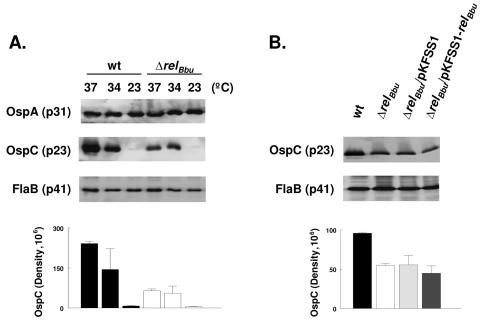
Temperature shift in the B. burgdorferi wild type (wt), relBbu mutant (ΔrelBbu), vector-transformed relBbu mutant (ΔrelBbu/pKFSS1), and complemented mutant (ΔrelBbu/pKFSS1-relBbu). (A) Western blots for FlaB, OspA, and OspC in B. burgdorferi wild-type and relBbu mutant mid-log-phase cultures in BSK-H at 23°C, 34°C, and 37°C. OspC levels in the B. burgdorferi wild type and relBbu mutant in mid-log-phase cultures in BSK-H at 23°C, 34°C, and 37°C were estimated from the results from four independent Western blots and presented as means ± standard deviations. (B) Western blots for FlaB and OspC in wild-type, relBbu mutant, and complemented B. burgdorferi from early-stationary-phase cultures grown in BSK-H at 37°C. OspC levels in wild-type, relBbu mutant, and complemented B. burgdorferi from early-stationary-phase cultures grown in BSK-H at 37°C were compared from four different Western blots and presented as means ± standard deviations. Similar intensities of FlaB bands in panels A and B show similar protein loads for each lane.

References

    1. Alverson, J., S. F. Bundle, C. D. Sohaskey, M. C. Lybecker, and D. S. Samuels. 2003. Transcriptional regulation of the ospAB and ospC promoters from Borrelia burgdorferi. Mol. Microbiol. 48:1665-1677. - PubMed
    1. Brown, L., D. Gentry, T. Elliott, and M. Cashel. 2002. DksA affects ppGpp induction of RpoS at a translational level. J. Bacteriol. 184:4455-4465. - PMC - PubMed
    1. Bugrysheva, J., E. Y. Dobrikova, H. P. Godfrey, M. L. Sartakova, and F. C. Cabello. 2002. Modulation of Borrelia burgdorferi stringent response and gene expression during extracellular growth with tick cells. Infect. Immun. 70:3061-3067. - PMC - PubMed
    1. Bugrysheva, J., E. Y. Dobrikova, M. L. Sartakova, M. J. Caimano, T. J. Daniels, J. D. Radolf, H. P. Godfrey, and F. C. Cabello. 2003. Characterization of the stringent response and relBbu expression in Borrelia burgdorferi. J. Bacteriol. 185:957-965. - PMC - PubMed
    1. Caimano, M. J., C. H. Eggers, K. R. Hazlett, and J. D. Radolf. 2004. RpoS is not central to the general stress response in Borrelia burgdorferi but does control expression of one or more essential virulence determinants. Infect. Immun. 72:6433-6445. - PMC - PubMed

Publication types

LinkOut - more resources