Controlled Clinical Trial
. 2005 Jul 22;6(1):80.
doi: 10.1186/1465-9921-6-80.

Expression profiles of hydrophobic surfactant proteins in children with diffuse chronic lung disease

Affiliations
Controlled Clinical Trial

Expression profiles of hydrophobic surfactant proteins in children with diffuse chronic lung disease

Matthias Griese et al. Respir Res. .

Abstract

Background: Abnormalities of the intracellular metabolism of the hydrophobic surfactant proteins SP-B and SP-C and their precursors may be causally linked to chronic childhood diffuse lung diseases. The profile of these proteins in the alveolar space is unknown in such subjects.

Methods: We analyzed bronchoalveolar lavage fluid by Western blotting for SP-B, SP-C and their proforms in children with pulmonary alveolar proteinosis (PAP, n = 15), children with no SP-B (n = 6), children with chronic respiratory distress of unknown cause (cRD, n = 7), in comparison to children without lung disease (n = 15) or chronic obstructive bronchitis (n = 19).

Results: Pro-SP-B of 25-26 kD was commonly abundant in all groups of subjects, suggesting that their presence is not of diagnostic value for processing defects. In contrast, pro-SP-B peptides cleaved off during intracellular processing of SP-B and smaller than 19-21 kD, were exclusively found in PAP and cRD. In 4 of 6 children with no SP-B, mutations of SFTPB or SPTPC genes were found. Pro-SP-C forms were identified at very low frequency. Their presence was clearly, but not exclusively associated with mutations of the SFTPB and SPTPC genes, impeding their usage as candidates for diagnostic screening.

Conclusion: Immuno-analysis of the hydrophobic surfactant proteins and their precursor forms in bronchoalveolar lavage is minimally invasive and can give valuable clues for the involvement of processing abnormalities in pediatric pulmonary disorders.


Figures
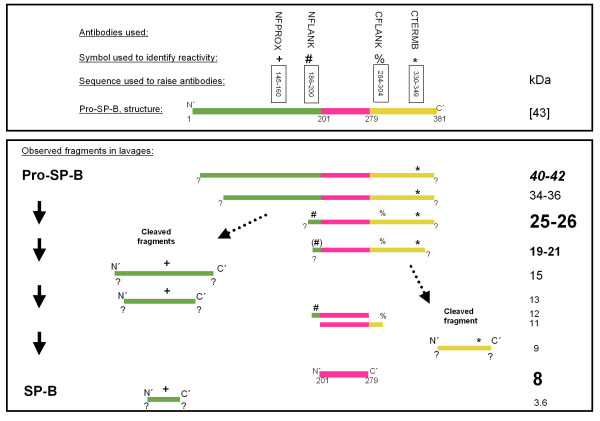
Figure 1
Figure 1
Schematic diagram of pro-SP-B and its processing to SP-B. Upper panel: Indicated are the antibodies used, the symbols for their identification, the amino acid stretches against which the antibodies were developed, and a diagram of the structure of pro-SP-B. Lower panel: The molecular weight and the reactivity of the antibodies (in the absence, but not in the presence of the competing peptides) during Western blotting is indicated. The sizing of the letters used for indication of the molecular weights is proportional to the frequency at which the bands were observed (biggest: common >75% of subjects, 2nd biggest: frequent, in <75 but >50% of the subjects, 3rd biggest: sporadic, in <50 but >25% of the subjects, smallest: rare, in <25% of the subjects). The sequence of SP-B within the pro-SP-B sequence is indicated in pink. All bands were analyzed under reducing conditions.
Figure 2
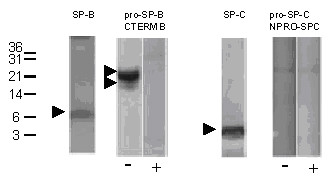
Figure 2
Children with chronic bronchitis. Representative Western blotting pattern of BAL from child with chronic bronchitis (patient control 03). After SDS-PAGE and transfer, the membranes were probed with different antibodies directed against SP-B, certain sequences of the pro-SP-B, in the absences (-) and presence (+) of excess of the peptides, used to raise the antibodies, SP-C and against pro-SP-C, in the absence (-) and presence (+) of excess of the N-terminal peptide, used to raise these antibodies. The numbers next to the lanes indicate the molecular weight in kDa. The arrow heads indicate bands of interest, as described in the text. All bands were analyzed under reducing conditions.
Figure 3
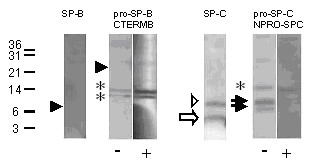
Figure 3
SP-B deficiency. Western blotting of a lavage from patient SP-B 06 homozygous for the 121ins2 SFTPB mutation. After SDS-PAGE and transfer, the membranes were probed with the antibodies indicated. The pro-forms were probed in the absence (-) and presence (+) of an excess of the peptide used to raise this antibody. Note that bands that are not displaced by the competing peptide were not considered as specific bands (marked by an asterisk). The numbers next to the lanes indicate the molecular weight in kDa. The closed arrowheads indicate the absence of SP-B and of proforms of SP-B. Arrows show the presence of SP-C (open arrow) and of abberant pro-SP-C (closed arrows). Some aberrant pro-SP-C can also be seen on the SP-C blot, above the SP-C band, which is indicated by an open arrowhead. All bands were analyzed under reducing conditions.
Figure 4
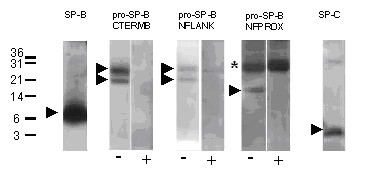
Figure 4
Children with pulmonary alveolar proteinosis. Western blotting of a lavage from patient PAP 12 (only NFPROX bands) and PAP 04 (all other bands) to demonstrate the most frequent abnormalities. After SDS-PAGE and transfer, the membranes were probed with the antibodies indicated. The pro-forms were probed in the absence (-) and presence (+) of an excess of the peptide used to raise this antibody. Note that bands that are not displaced by the competing peptide were not considered as specific bands and they are marked by an asterisk. The numbers next to the lanes indicate the molecular weights in kDa. The arrowheads indicate the abundance of SP-B, the bands at 19–21 and 25–26 kDa using CTERMB which also react with NFLANK, and some of the break-down fragments reacting with NFPROX which are more frequently seen in this condition and in cRD as compared to the other lung diseases (see figure 5). All bands were analyzed under reducing conditions.
Figure 5
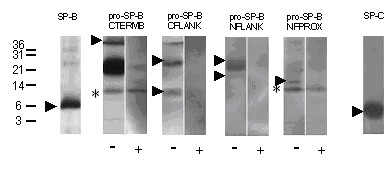
Figure 5
Children with chronic respiratory distress of unknown cause (cRD). Western blotting of a lavage from patient cRD 06 (NFLANK) and from patient cRD 07 (all other blots), performed as described in detail in the legend to figure 4. An asterisk marks non-specific bands, i.e. bands not displaced by the competing peptide. The arrowheads indicate the bands reacting with CTERMB at 40–42 kDa which are more frequently observed in these conditions than in the others. Similarly, with CFLANK, bands are seen at 40–42, 25–26, and 19–21 kDa. Cut off fragments likely generated during protein processing react with NFLANK or NFPROX. All bands were analyzed under reducing conditions.

References

    1. Griese M. Pulmonary surfactant in health and human lung diseases: state of the art. Eur Respir J. 1999;13:1455–1476. - PubMed
    1. Weaver TE, Conkright JJ. Functions of surfactant proteins B and C. Annu Rev Physiol. 2001;63:555–578. doi: 10.1146/annurev.physiol.63.1.555. - DOI - PubMed
    1. Weaver TE. Synthesis, processing and secretion of surfactant proteins B and C. Biochimica et Biophysica Acta-Molecular Basis of Disease. 1998;1408:173–179. doi: 10.1016/S0925-4439(98)00066-0. - DOI - PubMed
    1. Brasch F, Ochs M, Kahne T, Guttentag S, Schauer-Vukasinovic V, Derrick M, et al. Involvement of napsin A in the C- and N-terminal processing of surfactant protein B in type-II pneumocytes of the human lung. J Biol Chem. 2003;278:49006–49014. doi: 10.1074/jbc.M306844200. - DOI - PubMed
    1. Ueno T, Linder S, Na CL, Rice WR, Johansson J, Weaver TE. Processing of Pulmonary Surfactant Protein B by Napsin and Cathepsin H. J Biol Chem. 2004;279:16178–16184. doi: 10.1074/jbc.M312029200. - DOI - PubMed

Publication types

Substances