. 2005 Jul 26:6:103.
doi: 10.1186/1471-2164-6-103.

Conjugative plasmid pAW63 brings new insights into the genesis of the Bacillus anthracis virulence plasmid pXO2 and of the Bacillus thuringiensis plasmid pBT9727

Affiliations

Conjugative plasmid pAW63 brings new insights into the genesis of the Bacillus anthracis virulence plasmid pXO2 and of the Bacillus thuringiensis plasmid pBT9727

Géraldine A Van der Auwera et al. BMC Genomics. .

Abstract

Background: Bacillus cereus, Bacillus anthracis and Bacillus thuringiensis belong to the genetically close-knit Bacillus cereus sensu lato group, a family of rod-shaped Gram-positive bacteria. pAW63 is the first conjugative plasmid from the B. cereus group to be completely sequenced.

Results: The 71,777 bp nucleotide sequence of pAW63 reveals a modular structure, including a 42 kb tra region encoding homologs of the Type IV secretion systems components VirB11, VirB4 and VirD4, as well as homologs of Gram-positive conjugation genes from Enterococcus, Lactococcus, Listeria, Streptococcus and Staphylococcus species. It also firmly establishes the existence of a common backbone between pAW63, pXO2 from Bacillus anthracis and pBT9727 from the pathogenic Bacillus thuringiensis serovar konkukian strain 97-27. The alignment of these three plasmids highlights the presence of well conserved segments, in contrast to distinct regions of high sequence plasticity. The study of their specific differences has provided a three-point reference framework that can be exploited to formulate solid hypotheses concerning the functionalities and the molecular evolution of these three closely related plasmids. This has provided insight into the chronology of their divergence, and led to the discovery of two Type II introns on pAW63, matching copies of the mobile element IS231L in different loci of pXO2 and pBT9727, and the identification on pXO2 of a 37 kb pathogenicity island (PAI) containing the anthrax capsule genes.

Conclusion: The complete sequence determination of pAW63 has led to a functional map of the plasmid yielding insights into its conjugative apparatus, which includes T4SS-like components, as well as its resemblance to other large plasmids of Gram-positive bacteria. Of particular interest is the extensive homology shared between pAW63 and pXO2, the second virulence plasmid of B. anthracis, as well as pBT9727 from the pathogenic strain B. thuringiensis serovar konkukian strain 97-27.


Figures
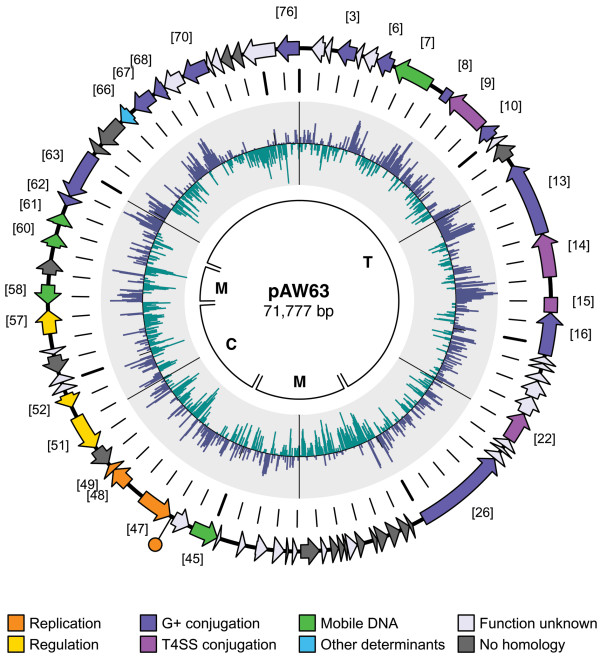
Figure 1
Figure 1
Circular map of pAW63. Coding Sequences (CDS) are represented by block arrows on the outer circle. Predicted functions/homologies are indicated by the color key featured below; numbers in brackets refer to main CDSs (see Table 1 for details). The first circle from the center delineates the functional modules identified on the plasmid; T indicates the transfer (tra) region, C indicates the control region (replication and regulation), and M indicates the two mobile DNA-associated flanking regions. The second circle from the center is a circular bar graph of the G+C composition percentage of the plasmid sequence, with the overall mean value (33.8%) as baseline; values above the line are G+C rich (max value 51% G+C) and values below the line are A+T rich (min value 16% G+C). The third circle from the center is a graduated size scale with small tick marks every 1 kb and large tick marks every 10 kb.
Figure 2
Figure 2
Linear alignment of pXO2, pAW63 and pBT9727. CDSs are represented by block arrows. Several CDS numbers (see Table 1) are indicated for reference on each plasmid, just above or below their representation. Predicted functions/homologies are indicated by the color key featured below. Well conserved segments of the plasmids are paired by shaded regions (>40% amino acid identity); percentages for specific CDS pairs can be found in Tables 1 and 2. The proposed PAI of pXO2 is raised above the rest of the sequence for clarity. Scale is indicated by the bar in the lower right-hand corner.
Figure 3
Figure 3
Relational diagram of the replicon region of the three plasmids. Comparison of the replicon region of each plasmid reveals a complex structure of palindromic and/or iterative elements serving as node points for recombination events. Sequence segments are represented by thick horizontal lines joined by solid diagonal lines. The background striping highlights 'shared' versus 'unique' sequence segments as indicated by the text legend on the left hand side. Horizontal dashes are spacers to indicate a shorter length or lack of corresponding segment. Node points putatively involved in recombination events are represented by green circles; iterative and/or palindromic sequence units by half arrows; CDSs by rectangles, above the sequence line to indicate clockwise orientation, or below to indicate counter- clockwise orientation.

References

    1. Helgason E, økstad OA, Caugant DA, Johansen HA, Fouet A, Mock M, Hegna I, Kolstø AB. Bacillus anthracis, Bacillus cereus, and Bacillus thuringiensis--one species on the basis of genetic evidence. Appl Environ Microbiol. 2000;66:2627–2630. doi: 10.1128/AEM.66.6.2627-2630.2000. - DOI - PMC - PubMed
    1. Schoeni JL, Wong AC. Bacillus cereus food poisoning and its toxins. J Food Prot. 2005;68:636–648. - PubMed
    1. David DB, Kirkby GR, Noble BA. Bacillus cereus endophthalmitis. Br J Ophthalmol. 1994;78:577–580. - PMC - PubMed
    1. Mock M, Fouet A. Anthrax. Annu Rev Microbiol. 2001;55:647–671. doi: 10.1146/annurev.micro.55.1.647. - DOI - PubMed
    1. Gill SS, Cowles EA, Pietrantonio PV. The mode of action of Bacillus thuringiensis endotoxins. Annu Rev Entomol. 1992;37:615–636. doi: 10.1146/annurev.en.37.010192.003151. - DOI - PubMed

Publication types

MeSH terms

LinkOut - more resources
