. 2005 Aug 2;102(31):10999-1004.
doi: 10.1073/pnas.0501444102. Epub 2005 Jul 25.

Endothelial nitric oxide synthase is critical for ischemic remodeling, mural cell recruitment, and blood flow reserve

Affiliations

Endothelial nitric oxide synthase is critical for ischemic remodeling, mural cell recruitment, and blood flow reserve

Jun Yu et al. Proc Natl Acad Sci U S A. .

Abstract

The genetic loss of endothelial-derived nitric oxide synthase (eNOS) in mice impairs vascular endothelial growth factor (VEGF) and ischemia-initiated blood flow recovery resulting in critical limb ischemia. This result may occur through impaired arteriogenesis, angiogenesis, or mobilization of stem and progenitor cells. Here, we show that after ischemic challenge, eNOS knockout mice [eNOS (-/-)] have defects in arteriogenesis and functional blood flow reserve after muscle stimulation and pericyte recruitment, but no impairment in endothelial progenitor cell recruitment. More importantly, the defects in blood flow recovery, clinical manifestations of ischemia, ischemic reserve capacity, and pericyte recruitment into the growing neovasculature can be rescued by local intramuscular delivery of an adenovirus encoding a constitutively active allele of eNOS, eNOS S1179D, but not a control virus. Collectively, our data suggest that endogenous eNOS-derived NO exerts direct effects in preserving blood flow, thereby promoting arteriogenesis, angiogenesis, and mural cell recruitment to immature angiogenic sprouts.


Figures
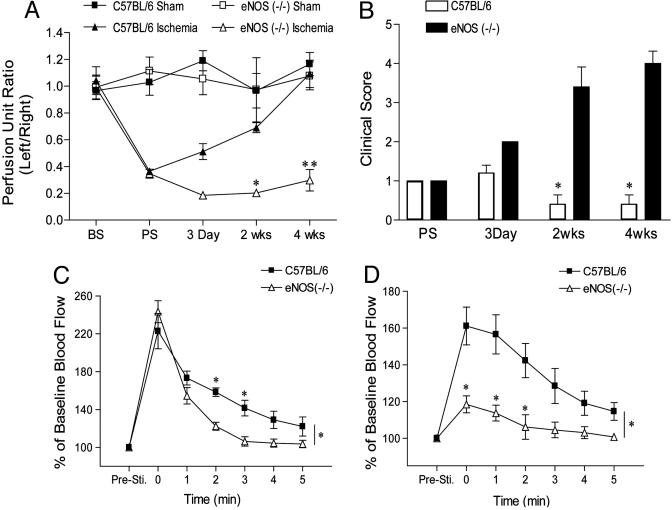
Fig. 1.
Fig. 1.
eNOS (-/-) mice are a model of critical limb ischemia with impaired hyperemia. (A and B) C57BL/6 or congenic eNOS (-/-) mice were exposed to sham surgery (squares) or surgical arteriectomy (triangles) and gastrocnemius blood flow (A) and clinical score (B) assessed over 4 weeks. (C) The adductor muscle groups of mice were electro-stimulated, and the increase in gastronemius blood flow was recorded. (D) The identical experiment was performed after 2 weeks of ischemia in C57BL/6 and eNOS (-/-) mice. Data represent mean ± SEM; n = 4 mice per group for sham surgery and n = 10 mice per strain for arteriectomy in A and B; n = 5 mice per strain in C and D; *, P < 0.05.
Fig. 2.
Fig. 2.
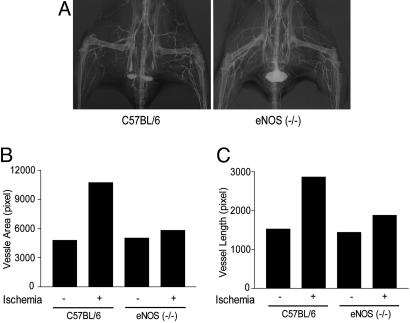
Angiographic evidence for impaired arteriogenesis in eNOS (-/-) mice. (A) Arterial phase angiograms from C57BL/6 (Left) and eNOS (-/-) (Right) mice after 4 weeks of left limb ischemia. (B and C) eNOS (-/-) mice show reduced quantification of vessel area (B) and total length (C) compared with C57BL/6 mice. Data are mean values from two angiograms.
Fig. 3.
Fig. 3.
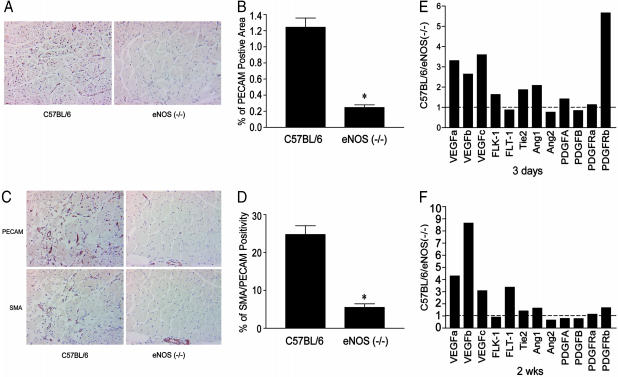
Impaired ischemia-induced angiogenesis, pericyte recruitment, and gene expression in eNOS (-/-) mice. Gastrocnemius muscles of ischemic mice were immunostained for PECAM-1 (an endothelial cell marker) only (A with quantification in B) or PECAM-1 and SMA (a smooth muscle/pericyte marker in C with quantification in D). Data represent mean ± SEM; n = 8 mice per strain in B and D; *, P < 0.05. The expression of angiogenic and remodeling genes were assessed by qPCR in the gastronemius after 3 days (E) and two weeks (F) after ischemia. Data represent the differences in gene expression in C57BL/6 compared with eNOS (-/-) mice. Data are average determinations of relative gene expression in ischemic/nonischemic limbs from RNA pooled from three mice per strain per time point.
Fig. 4.
Fig. 4.
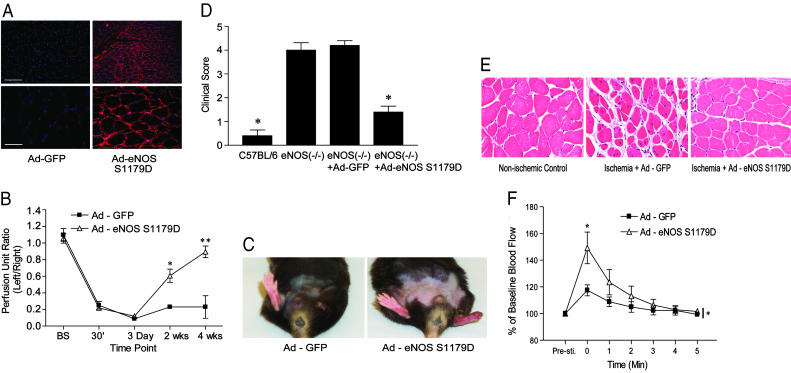
Intramuscular injection of Ad-eNOS S1179D, rescues ischemic defect in flow, clinical outcome, and hyperemia. (A) eNOS (-/-) mice were injected with Ad-GFP or Ad-eNOS S1179D and eNOS levels examined in the adductor muscle group by fluorescence microscopy after 4 days of infection. (Scale bars: Upper Left, 200 μm; Lower Left, 50 μm.) Ad-eNOS S1179D improved the time course of blood flow recovery (B) and clinical outcome (D). Images in C and E reflect improvement of limb appearance and muscle histology after Ad-eNOS S1179D infection. (F) Ad-eNOS S1179D gene transfer into eNOS (-/-) mice also improves postcontraction hyperemia. Data are mean ± SEM; n = 5 mice per group in B, D, and F; *, P < 0.05.
Fig. 5.
Fig. 5.
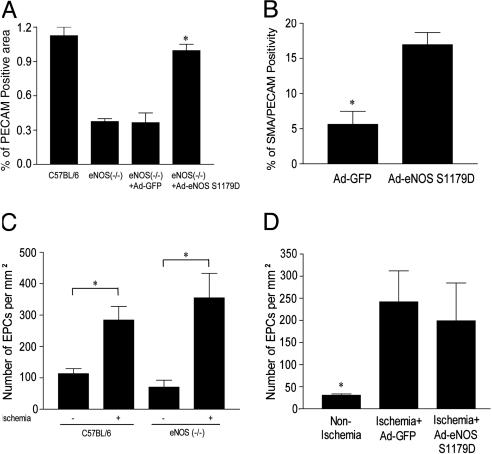
Ad-eNOS S1179D improves angiogenesis but does not influence EPC mobilization. Gastrocnemius muscles of ischemic C57BL/6, eNOS (-/-), and eNOS (-/-) mice injected with Ad-GFP or Ad-eNOS S1179D were immunostained for PECAM-1 (an endothelial cell marker) (A) or serial sections colabeled with PECAM-1 and SMA antibodies (a smooth muscle/pericyte marker) (B). Ischemia mediated increases in EPC mobilization into peripheral blood in C57BL/6 and eNOS (-/-) mice (C), and the beneficial effects of Ad-eNOS S1179D (D) are not different. Data are mean ± SEM; n = 5 mice per treatment in A, B, and D and 6 mice per group in C; *, P < 0.05.

References

    1. Heil, M. & Schaper, W. (2004) Circ. Res. 95, 449-458. - PubMed
    1. Carmeliet, P., Moons, L., Luttun, A., Vincenti, V., Compernolle, V., De Mol, M., Wu, Y., Bono, F., Devy, L., Beck, H., et al. (2001) Nat. Med. 7, 575-583. - PubMed
    1. Silvestre, J. S., Mallat, Z., Duriez, M., Tamarat, R., Bureau, M. F., Scherman, D., Duverger, N., Branellec, D., Tedgui, A. & Levy, B. I. (2000) Circ. Res. 87, 448-452. - PubMed
    1. Sasaki, K., Murohara, T., Ikeda, H., Sugaya, T., Shimada, T., Shintani, S. & Imaizumi, T. (2002) J. Clin. Invest. 109, 603-611. - PMC - PubMed
    1. Johnson, C., Sung, H. J., Lessner, S. M., Fini, M. E. & Galis, Z. S. (2004) Circ. Res. 94, 262-268. - PMC - PubMed

Publication types

MeSH terms

Substances

LinkOut - more resources