


Antimicrobial peptides in the oral environment: expression and function in health and disease
- PMID: 16053246
- PMCID: PMC1479858
- DOI: 10.1093/jac/dki103
Antimicrobial peptides in the oral environment: expression and function in health and disease
Abstract
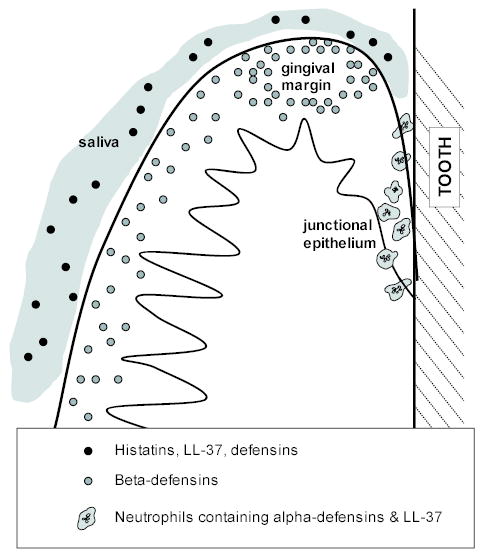
The oral cavity is a unique environment in which antimicrobial peptides play a key role in maintaining health and may have future therapeutic applications. Present evidence suggests that alpha-defensins, beta-defensins, LL-37, histatin, and other antimicrobial peptides and proteins have distinct but overlapping roles in maintaining oral health and preventing bacterial, fungal, and viral adherence and infection. The expression of the inducible hBD-2 in normal oral epithelium, in contrast to other epithelia, and the apparent differential signaling in response to commensal and pathogenic organisms, provides new insights into innate immunity in this body site. Commensal bacteria are excellent inducers of hBD-2 in oral epithelial cells, suggesting that the commensal bacterial community acts in a manner to benefit the overall innate immune readiness of oral epithelia. This may have major significance for understanding host defense in the complex oral environment.
Figures
References
-
- Abiko Y, Mitamura J, Nishimura M, Muramatsu T, Inoue T, Shimono M, Kaku T. Pattern of expression of beta-defensins in oral squamous cell carcinoma. Cancer Lett. 1999;143:37–43. - PubMed
-
- Allaker RP, Kapas S. Adrenomedullin and mucosal defence: interaction between host and microorganism. Regul Pept. 2003;112:147–152. - PubMed
-
- Banchereau J, Steinman RM. Dendritic cells and the control of immunity. Nature. 1998;392:245–252. - PubMed
-
- Becker MN, Diamond G, Verghese MW, Randell SH. CD14-dependent lipopolysaccharide-induced beta-defensin-2 expression in human tracheobronchial epithelium. J Biol Chem. 2000;275:29731–29736. - PubMed
-
- Befus AD, Mowat C, Gilchrist M, Hu J, Solomon S, Bateman A. Neutrophil defensins induce histamine secretion from mast cells: mechanisms of action. J Immunol. 1999;163:947–953. - PubMed
Publication types
MeSH terms
Substances
Grants and funding
- T32 DE007023/DE/NIDCR NIH HHS/United States
- T32 DE007023-26/DE/NIDCR NIH HHS/United States
- R01 DE013573-04/DE/NIDCR NIH HHS/United States
- P60 DE013061-020001/DE/NIDCR NIH HHS/United States
- T32 DE07023/DE/NIDCR NIH HHS/United States
- P60 DE013061-030001/DE/NIDCR NIH HHS/United States
- P60 DE013061-040001/DE/NIDCR NIH HHS/United States
- R01 DE013573-03/DE/NIDCR NIH HHS/United States
- P60 DE013061-010001/DE/NIDCR NIH HHS/United States
- T32 DE007023-27/DE/NIDCR NIH HHS/United States
- R01 DE 13573/DE/NIDCR NIH HHS/United States
- R01 DE013573-01A1/DE/NIDCR NIH HHS/United States
- P60 DE013061-01S10001/DE/NIDCR NIH HHS/United States
- R01 DE013573-02/DE/NIDCR NIH HHS/United States
- R01 DE013573/DE/NIDCR NIH HHS/United States
- DE P60 013061/DE/NIDCR NIH HHS/United States
LinkOut - more resources
Full Text Sources
Other Literature Sources
Medical
