. 2005 Aug;25(16):6857-68.
doi: 10.1128/MCB.25.16.6857-6868.2005.

Subunit contributions to histone methyltransferase activities of fly and worm polycomb group complexes

Affiliations

Subunit contributions to histone methyltransferase activities of fly and worm polycomb group complexes

Carrie S Ketel et al. Mol Cell Biol. 2005 Aug.

Abstract

The ESC-E(Z) complex of Drosophila melanogaster Polycomb group (PcG) repressors is a histone H3 methyltransferase (HMTase). This complex silences fly Hox genes, and related HMTases control germ line development in worms, flowering in plants, and X inactivation in mammals. The fly complex contains a catalytic SET domain subunit, E(Z), plus three noncatalytic subunits, SU(Z)12, ESC, and NURF-55. The four-subunit complex is >1,000-fold more active than E(Z) alone. Here we show that ESC and SU(Z)12 play key roles in potentiating E(Z) HMTase activity. We also show that loss of ESC disrupts global methylation of histone H3-lysine 27 in fly embryos. Subunit mutations identify domains required for catalytic activity and/or binding to specific partners. We describe missense mutations in surface loops of ESC, in the CXC domain of E(Z), and in the conserved VEFS domain of SU(Z)12, which each disrupt HMTase activity but preserve complex assembly. Thus, the E(Z) SET domain requires multiple partner inputs to produce active HMTase. We also find that a recombinant worm complex containing the E(Z) homolog, MES-2, has robust HMTase activity, which depends upon both MES-6, an ESC homolog, and MES-3, a pioneer protein. Thus, although the fly and mammalian PcG complexes absolutely require SU(Z)12, the worm complex generates HMTase activity from a distinct partner set.


Figures
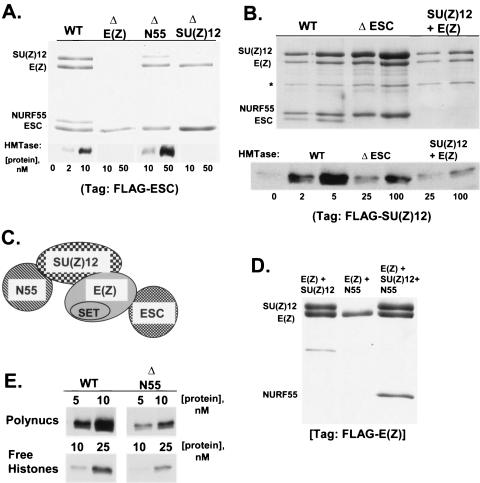
FIG. 1.
FIG. 1.
Assembly and activity of recombinant subcomplexes missing individual subunits of the ESC-E(Z) complex. (A) Subunit compositions (top) and HMTase activities (bottom) of subcomplexes obtained after omission of indicated subunits. Wild-type (WT) four-subunit complex (left lane) and subcomplexes were affinity purified using FLAG-ESC. (B) As in panel A, except complexes purified using FLAG-SU(Z)12. The second lane of each pair shows twice as much material loaded. The rightmost lanes show subcomplex obtained after coexpression of only SU(Z)12 plus E(Z). An asterisk here, and in subsequent figures, denotes hsp70, which often contaminates baculovirus-produced complexes (10, 34). (C) Model for the four-subunit complex deduced from stable interactions detected in panels A and B. The catalytic subunit, E(Z), occupies a central position and can bind stably and independently to ESC and SU(Z)12. (D) Subunit compositions of subcomplexes obtained after coexpression of the indicated subunits and purified using FLAG-E(Z). (E) HMTase activities of wild-type four-subunit complex versus trimeric complex lacking NURF-55. Activities were compared on polynucleosome (Polynucs; top) and free histone (bottom) substrates.
FIG. 2.
FIG. 2.
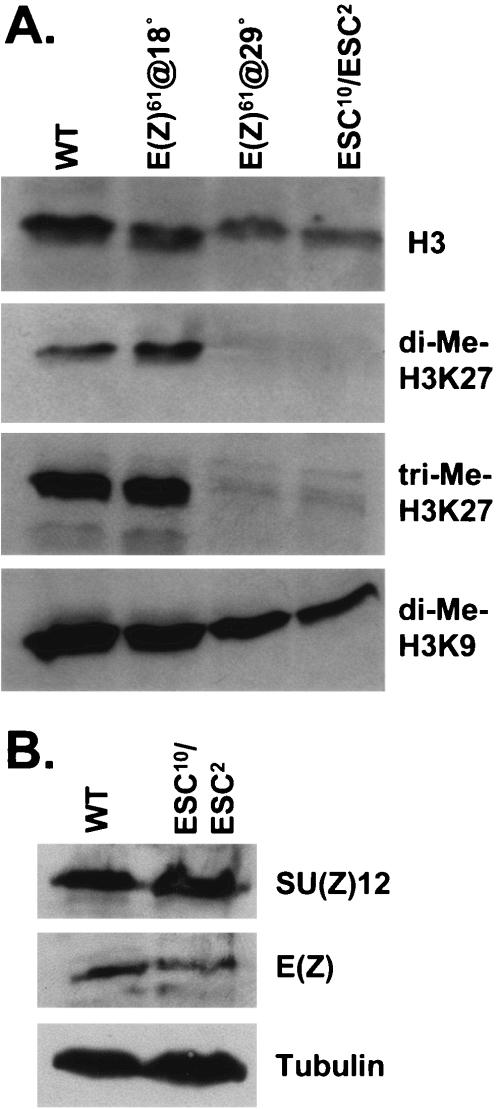
Levels of methylated histone H3 in fly embryos bearing an ESC or E(Z) loss-of-function mutation. (A) Western blots were performed on fly embryo extracts using antibodies that detect either unmodified histone H3 (top row) or the indicated forms of methylated H3 (bottom rows). Extracts were prepared from wild-type (WT) embryos (lane 1), E(z)61 embryos collected at permissive temperature (18°C, lane 2), E(z)61 embryos at restrictive temperature (29°C, lane 3), or embryos collected as progeny of esc10/esc2 parents (lane 4). (B) As in panel A, except blots were incubated with antibodies against SU(Z)12, E(Z), or tubulin (loading control) as indicated.
FIG. 3.
FIG. 3.
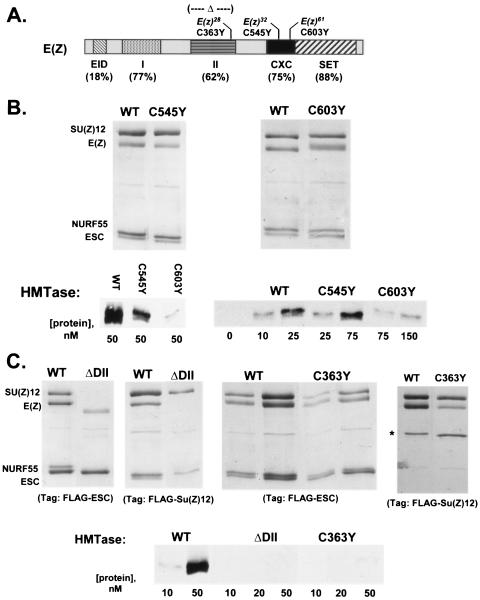
Effects of E(Z) mutations on assembly and HMTase activity of ESC-E(Z) complexes. (A) Domain organization of E(Z) as defined by comparison to mammalian homologs (19, 28). Percent identities between fly E(Z) and human EZH2 are shown for each domain. EID represents the ESC-interacting domain (18, 58). Mutations analyzed in this study are indicated. WT, wild type. (B) Assembly (top) and HMTase activities (bottom) of complexes containing E(Z) CXC domain mutations, purified using FLAG-SU(Z)12. (C) Assembly (top) and HMTase activities (bottom) of complexes containing E(Z) domain II mutations. For Δdomain II analysis (top left), subcomplexes obtained using FLAG-ESC or FLAG-SU(Z)12 are shown. For C363Y analysis (top right), either the four-subunit complex with FLAG-ESC or just pairwise binding to FLAG-SU(Z)12 is shown. The second lane of each pair shows twice as much material loaded. HMTase assays (bottom) were performed on subcomplexes obtained with FLAG-ESC.
FIG. 4.
FIG. 4.
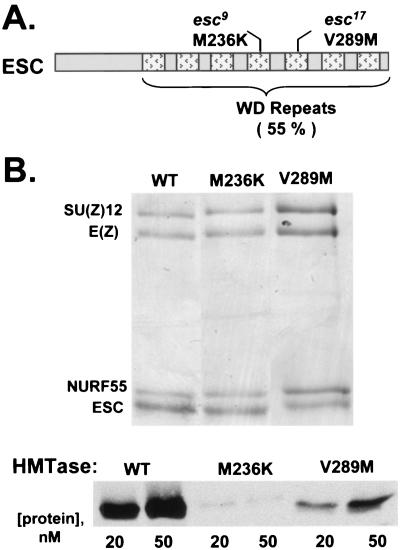
Effects of ESC mutations on assembly and HMTase activity of ESC-E(Z) complexes. (A) Domain organization of ESC (37, 58). Percent identity between fly ESC and human EED is shown for the WD repeat region. Mutations analyzed in this study are indicated. WT, wild type. (B) Assembly (top) and HMTase activities (bottom) of complexes containing indicated ESC mutations. Complexes were purified using FLAG-ESC bearing the mutations.
FIG. 5.
FIG. 5.
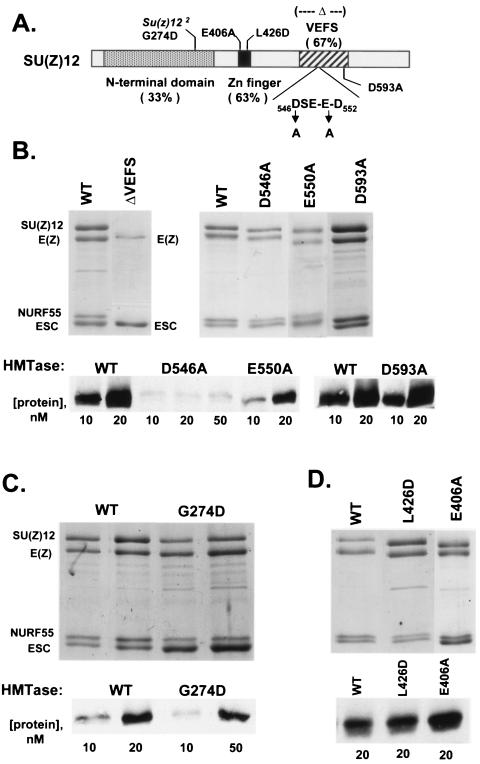
Effects of SU(Z)12 mutations on assembly and HMTase activity of ESC-E(Z) complexes. (A) Domain organization of SU(Z)12 as defined by comparison to its plant and mammalian homologs (2). Percent identities between fly and human SU(Z)12 are shown for each domain. Mutations analyzed in this study are indicated. (B) Assembly (top) and HMTase activities (bottom) of complexes containing SU(Z)12 VEFS domain mutations. WT, wild type. (C) Assembly (top) and HMTase activities (bottom) of complexes containing the SU(Z)12-G274D mutation. The second lane of each pair shows twice as much material loaded. (D) Assembly (top) and HMTase activities (bottom) of complexes containing SU(Z)12 zinc finger mutations. All complexes shown in this figure were purified via FLAG-ESC.
FIG. 6.
FIG. 6.
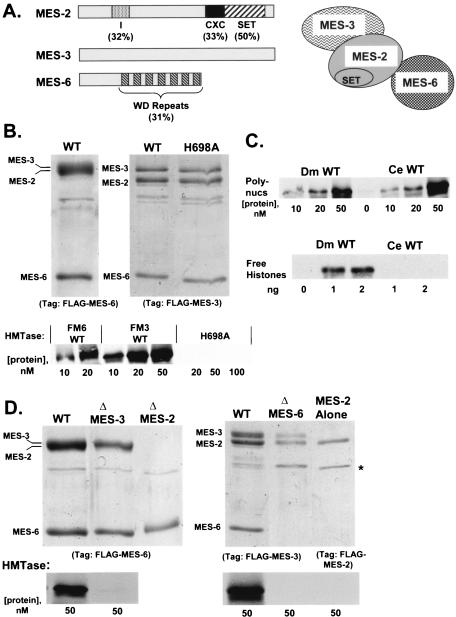
Properties and subunit contributions of recombinant worm MES complexes. (A) Domain organizations of the three worm MES proteins. Percent identities shown are between worm MES-2 and fly E(Z) or between worm MES-6 and fly ESC (17, 25). Boundaries of the CXC and SET domains are as defined (28), whereas domain I similarity spans residues 101 to 175 of fly E(Z). The illustration on the right shows a model of the MES complex based upon stable interactions detected in panels B and D below and in reference . (B) Assembly (top) and HMTase activities (bottom) of wild-type trimeric MES complexes or a trimeric complex bearing MES-2-H698A. Complexes were purified via FLAG-MES-6 (FM6) or FLAG-MES-3 (FM3) as indicated. (C) HMTase activities of wild-type four-subunit fly (D. melanogaster [Dm]) complex versus wild-type three-subunit worm (C. elegans [Ce]) complex. Activities were compared on polynucleosome (Polynucs; top) and free histone (bottom) substrates. Numbers in the top panel indicate concentrations of complexes (in nM), and numbers in the bottom panel denote free histone amounts (in ng) in reactions with the indicated complex at 50 nM. (D) Assembly and activity of recombinant subcomplexes missing individual subunits of the worm MES complex. Complexes on the left were purified via FLAG-MES-6, and complexes on the right were purified via FLAG-MES-3.

References

    1. Bender, L. B., R. Cao, Y. Zhang, and S. Strome. 2004. The MES-2/MES-3/MES-6 complex and regulation of histone H3 methylation in C. elegans. Curr. Biol. 14:1639-1643. - PubMed
    1. Birve, A., A. K. Sengupta, D. Beuchle, J. Larsson, J. A. Kennison, A. Rasmuson-Lestander, and J. Muller. 2001. Su(z)12, a novel Drosophila Polycomb group gene that is conserved in vertebrates and plants. Development 128:3371-3379. - PubMed
    1. Cao, R., L. Wang, H. Wang, L. Xia, H. Erdjument-Bromage, P. Tempst, R. S. Jones, and Y. Zhang. 2002. Role of histone H3 lysine 27 methylation in Polycomb-group silencing. Science 298:1039-1043. - PubMed
    1. Cao, R., and Y. Zhang. 2004. The functions of E(Z)/EZH2-mediated methylation of lysine 27 in histone H3. Curr. Opin. Genet. Dev. 14:155-164. - PubMed
    1. Cao, R., and Y. Zhang. 2004. SUZ12 is required for both the histone methyltransferase activity and the silencing function of the EED-EZH2 complex. Mol. Cell 15:57-67. - PubMed

Publication types

MeSH terms

Substances

LinkOut - more resources