


Reduced hyperpolarization in endothelial cells of rabbit aortic valve following chronic nitroglycerine administration
- PMID: 16056232
- PMCID: PMC1751179
- DOI: 10.1038/sj.bjp.0706363
Reduced hyperpolarization in endothelial cells of rabbit aortic valve following chronic nitroglycerine administration
Abstract
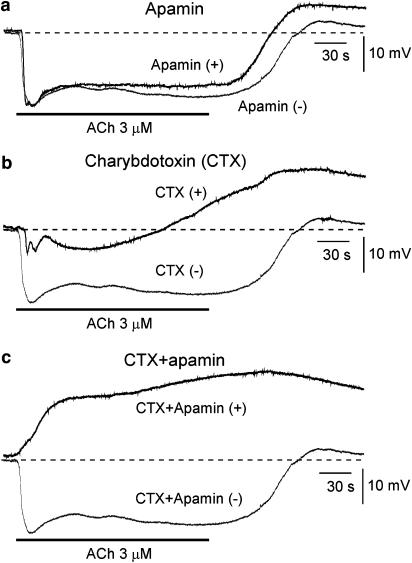
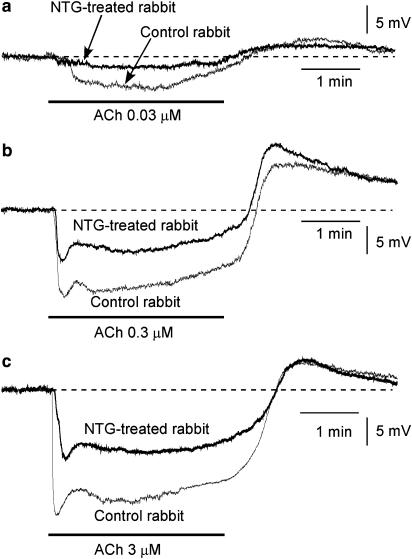
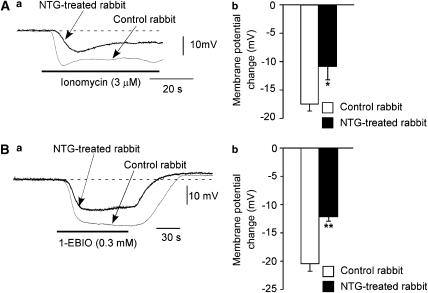
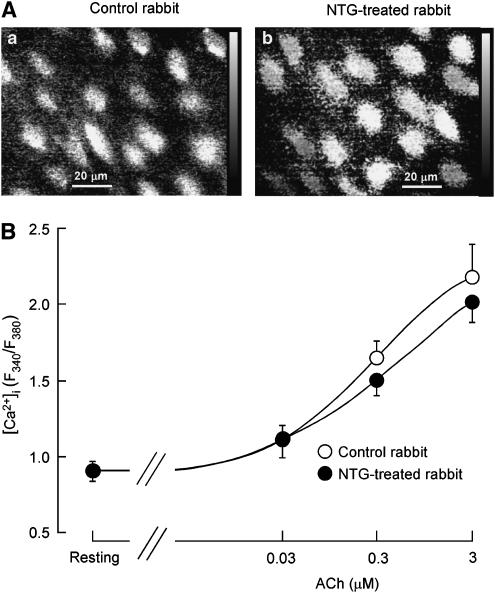
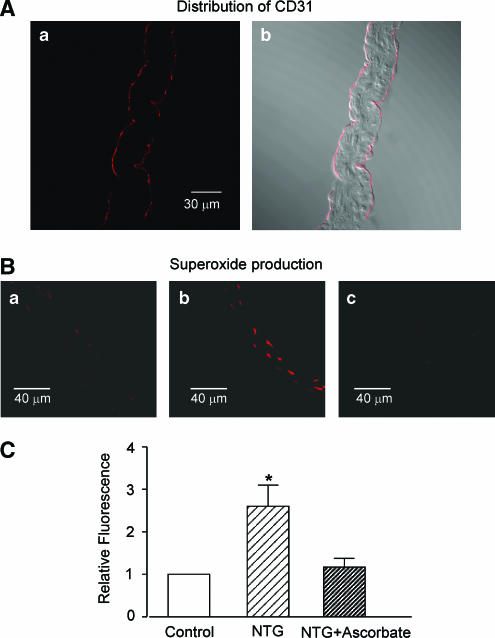
This study was undertaken to determine whether long-term in vivo administration of nitroglycerine (NTG) downregulates the hyperpolarization induced by acetylcholine (ACh) in aortic valve endothelial cells (AVECs) of the rabbit and, if so, whether antioxidant agents can normalize this downregulated hyperpolarization. ACh (0.03-3 microM) induced a hyperpolarization through activations of both apamin- and charybdotoxin-sensitive Ca2+-activated K+ channels (K(Ca)) in rabbit AVECs. The intermediate-conductance K(Ca) channel (IK(Ca)) activator 1-ethyl-2-benzimidazolinone (1-EBIO, 0.3 mM) induced a hyperpolarization of the same magnitude as ACh (3 microM). The ACh-induced hyperpolarization was significantly weaker, although the ACh-induced [Ca2+]i increase was unchanged, in NTG-treated rabbits (versus NTG-untreated control rabbits). The hyperpolarization induced by 1-EBIO was also weaker in NTG-treated rabbits. The reduced ACh-induced hyperpolarization seen in NTG-treated rabbits was not modified by in vitro application of the superoxide scavengers Mn-TBAP, tiron or ascorbate, but it was normalized when ascorbate was coadministered with NTG in vivo. Superoxide production within the endothelial cell (estimated by ethidium fluorescence) was increased in NTG-treated rabbits and this increased production was normalized by in vivo coadministration of ascorbate with the NTG. It is suggested that long-term in vivo administration of NTG downregulates the ACh-induced hyperpolarization in rabbit AVECs, possibly through chronic actions mediated by superoxide.
Figures
Comment in
-
Reduced vascular reactivity after chronic nitroglycerine administration: EDHF mechanism is also downregulated.Br J Pharmacol. 2005 Oct;146(4):479-80. doi: 10.1038/sj.bjp.0706364. Br J Pharmacol. 2005. PMID: 16056231 Free PMC article. No abstract available.
References
-
- BÉNY J. Electrical coupling between smooth muscle cells and endothelial cells in pig coronary arteries. Pflügers Arch. 1997;433:364–367. - PubMed
-
- BÉNY J., PACICCA C. Bidirectional electrical communication between smooth muscle and endothelial cells in the pig coronary artery. Am. J. Physiol. 1994;266:H1465–H1472. - PubMed
-
- BERKENBOOM G., FONTAINE D., UNGER P., BALDASSARRE S., PREUMONT N., FONTAINE J. Absence of nitrate tolerance after long-term treatment with ramipril: an endothelium-dependent mechanism. J. Cardiovasc. Pharmacol. 1999;34:547–553. - PubMed
-
- BRAKEMEIER S., EICHLER I., KNORR A., FASSHEBER T., KOHLER R., HOYER J. Modulation of Ca2+-activated K+ channel in renal artery endothelium in situ by nitric oxide and reactive oxygen species. Kidney Int. 2003;64:199–207. - PubMed
-
- BRUNET P., BÉNY J. Substance P and bradykinin hyperpolarize pig coronary artery endothelial cells in primary culture. Blood Vessels. 1989;26:228–234. - PubMed
Publication types
MeSH terms
Substances
LinkOut - more resources
Full Text Sources
Miscellaneous
