


Review
doi: 10.1084/jem.20050221.
Balancing diversity and tolerance: lessons from patients with systemic lupus erythematosus
Affiliations
- PMID: 16061723
- PMCID: PMC2213089
- DOI: 10.1084/jem.20050221
Item in Clipboard
Review
Balancing diversity and tolerance: lessons from patients with systemic lupus erythematosus
J Exp Med.
.
Abstract
The autoimmune disease systemic lupus erythematosus (SLE) is caused by a failure of B cell tolerance. Recent studies in mouse models of SLE have identified several distinct tolerance checkpoints that must each function appropriately to protect against disease. However, studies of B cell repertoire selection in humans are essential to understand which checkpoints are defective in human autoimmune diseases.
Figures
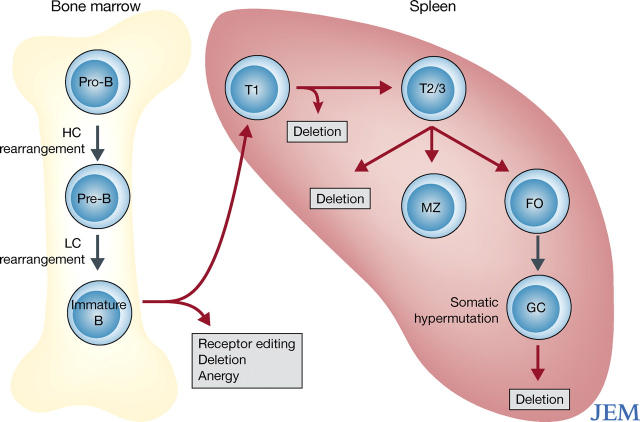
Negative selection checkpoints in B cell development. There are two points of BCR diversification—initial receptor rearrangement in the bone marrow and somatic hypermutation during the germinal center reaction. Each is followed by negative selection of autoreactive cells. Negative selection, receptor editing, anergy, or deletion occur in immature and transitional B cells after BCR engagement. The mechanisms for negative selection of autoreactive cells in GCs are not known. HC, heavy chain; LC, light chain.
Comment on
-
Defective B cell tolerance checkpoints in systemic lupus erythematosus.J Exp Med. 2005 Mar 7;201(5):703-11. doi: 10.1084/jem.20042251. Epub 2005 Feb 28. J Exp Med. 2005. PMID: 15738055 Free PMC article.
References
-
- Grimaldi, C.M., D.J. Michael, and B. Diamond. 2001. Cutting edge: expansion and activation of a population of autoreactive marginal zone B cells in a model of estrogen-induced lupus. J. Immunol. 167:1886–1890. - PubMed
-
- Thien, M., T.G. Phan, S. Gardam, M. Amesbury, A. Basten, F. Mackay, and R. Brink. 2004. Excess BAFF rescues self-reactive B cells from peripheral deletion and allows them to enter forbidden follicular and marginal zone niches. Immunity. 20:785–798. - PubMed
Publication types
MeSH terms
LinkOut - more resources
Full Text Sources
Medical
