


A three-dimensional model of myxobacterial aggregation by contact-mediated interactions
- PMID: 16061806
- PMCID: PMC1183571
- DOI: 10.1073/pnas.0504259102
A three-dimensional model of myxobacterial aggregation by contact-mediated interactions
Abstract
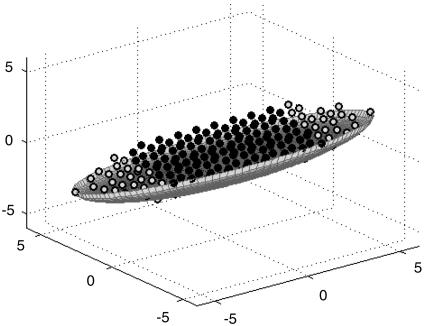
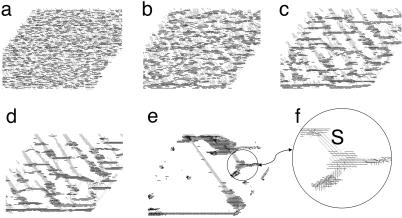
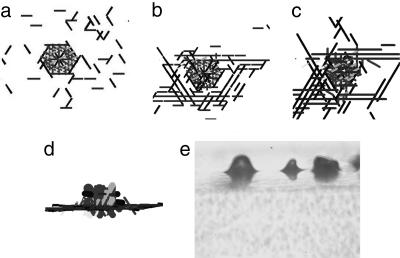
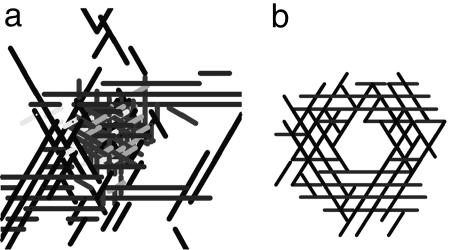
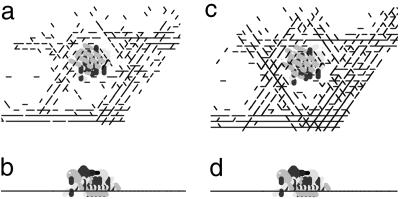
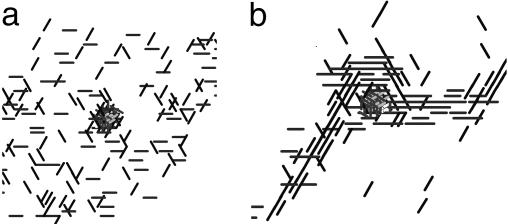
Myxobacteria provide one of the simplest models of cell-cell interaction and organized cell movement leading to cellular differentiation. When starved, tens of thousands of cells change their movement pattern from outward spreading to inward concentration; they form aggregates that become fruiting bodies. Cells inside fruiting bodies differentiate into round, nonmotile, environmentally resistant spores. Traditionally, cell aggregation has been considered to imply chemotaxis; a long-range cell interaction. However, myxobacterial aggregation is the consequence of direct cell-contact interactions, not chemotaxis. We present here a 3D stochastic lattice-gas cellular automata model of cell aggregation based on local cell-cell contact, and no chemotaxis. We demonstrate that a 3D discrete stochastic model can simulate two stages of cell aggregation. First, a "traffic jam" forms embedded in a field of motile cells. The jam then becomes an aggregation center that accumulates more cells. We show that, at high cell density, cells stream around the traffic jam, generating a 3D hemispherical mound. Later, when the nuclear traffic jam dissolves, the aggregation center becomes a 3D ring of streaming cells.
Figures

References
-
- Zhang, R., Pappas, T., Brace, J. L., Miller, P. C., Oulmassov, T., Molyneaux, J. M., Anderson, J. C., Bashkin, J. K., Winans, S. C. & Joachimiak, A. (2002) Nature 417, 971–974. - PubMed
-
- Igoshin, O. A., Kaiser, D. & Oster, G. (2004) Curr. Biol. 14, R459–R462. - PubMed
-
- Sproer, C., Reichenbach, H. & Stackebrandt, E. (1999) Int. J. Syst. Bacteriol. 49, 1255–1262. - PubMed
-
- Tsimring, L. & Levine, H. (1995) Phys. Rev. Lett. 75, 1859–1862. - PubMed
Publication types
MeSH terms
Grants and funding
LinkOut - more resources
Full Text Sources
