Comparative Study
. 2005 Aug;187(16):5568-77.
doi: 10.1128/JB.187.16.5568-5577.2005.

Swine and poultry pathogens: the complete genome sequences of two strains of Mycoplasma hyopneumoniae and a strain of Mycoplasma synoviae

Ana Tereza R Vasconcelos  1 Henrique B FerreiraCristiano V BizarroSandro L BonattoMarcos O CarvalhoPaulo M PintoDarcy F AlmeidaLuiz G P AlmeidaRosana AlmeidaLeonardo Alves-FilhoEnedina N AssunçãoVasco A C AzevedoMaurício R BogoMarcelo M BrigidoMarcelo BrocchiHelio A BurityAnamaria A CamargoSandro S CamargoMarta S CarepoDirce M CarraroJúlio C de Mattos CascardoLuiza A CastroGisele CavalcantiGustavo ChemaleRosane G CollevattiCristina W CunhaBruno DallagiovannaBibiana P DambrósOdir A DellagostinClarissa FalcãoFabiana Fantinatti-GarbogginiMaria S S FelipeLaurimar FiorentinGloria R FrancoNara S A FreitasDiego FríasThalles B GrangeiroEdmundo C GrisardClaudia T GuimarãesMariangela HungriaSílvia N JardimMarco A KriegerJomar P LaurinoLucymara F A LimaMaryellen I LopesElgion L S LoretoHumberto M F MadeiraGilson P ManfioAndrea Q MaranhãoChristyanne T MartinkovicsSílvia R B MedeirosMiguel A M MoreiraMárcia NeivaCicero E Ramalho-NetoMarisa F NicolásSergio C OliveiraRoger F C PaixãoFábio O PedrosaSérgio D J PenaMaristela PereiraLilian Pereira-FerrariItamar PifferLuciano S PintoDeise P PotrichAnna C M SalimFabrício R SantosRenata SchmittMaria P C SchneiderAugusto SchrankIrene S SchrankAdriana F SchuckHector N SeuanezDenise W SilvaRosane SilvaSérgio C SilvaCélia M A SoaresKelly R L SouzaRangel C SouzaCharley C StaatsMaria B R SteffensSantuza M R TeixeiraTuran P UrmenyiMarilene H VainsteinLuciana W ZuccheratoAndrew J G SimpsonArnaldo Zaha
Affiliations
Comparative Study

Swine and poultry pathogens: the complete genome sequences of two strains of Mycoplasma hyopneumoniae and a strain of Mycoplasma synoviae

Ana Tereza R Vasconcelos et al. J Bacteriol. 2005 Aug.

Abstract

This work reports the results of analyses of three complete mycoplasma genomes, a pathogenic (7448) and a nonpathogenic (J) strain of the swine pathogen Mycoplasma hyopneumoniae and a strain of the avian pathogen Mycoplasma synoviae; the genome sizes of the three strains were 920,079 bp, 897,405 bp, and 799,476 bp, respectively. These genomes were compared with other sequenced mycoplasma genomes reported in the literature to examine several aspects of mycoplasma evolution. Strain-specific regions, including integrative and conjugal elements, and genome rearrangements and alterations in adhesin sequences were observed in the M. hyopneumoniae strains, and all of these were potentially related to pathogenicity. Genomic comparisons revealed that reduction in genome size implied loss of redundant metabolic pathways, with maintenance of alternative routes in different species. Horizontal gene transfer was consistently observed between M. synoviae and Mycoplasma gallisepticum. Our analyses indicated a likely transfer event of hemagglutinin-coding DNA sequences from M. gallisepticum to M. synoviae.


Figures

FIG. 1.
FIG. 1.
Comparison of the genomes of M. hyopneumoniae strains J, 7448, and 232. Genome-specific regions (ICEH and R-M/T) and rearranged regions (regions 1 to 5) are indicated; CDSs located in these regions are described in Tables S1 to S3 in the supplemental material). CDSs that are not identical in two genomes or that have undergone rearrangements are represented by small black arrows. Mhy-J, M. hyopneumoniae strain J; Mhy-P, M. hyopneumoniae strain 7448; Mhy-232, M. hyopneumoniae strain 232. The axes show the scales, in kilobases.
FIG. 2.
FIG. 2.
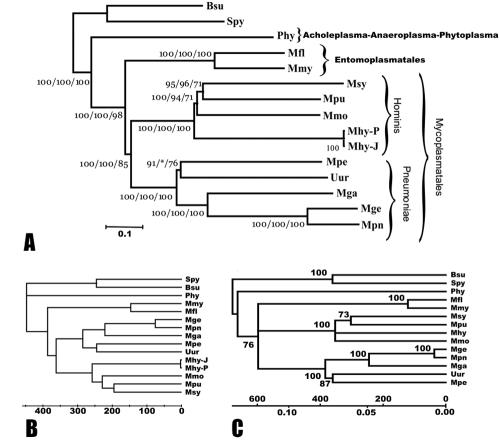
Phylogenetic analysis of Mollicutes. (A) Phylogenetic tree of the Mollicutes based on the concatenated alignment of deduced amino acid sequences of 146 CDSs. Bootstrap support values (based on 100 replicates) are indicated near each node for neighbor joining with JTT distance, maximum parsimony, and TREE-PUZZLE maximum likelihood, respectively (the asterisk indicates an unconfirmed node). The main taxonomic groups within Mollicutes are shown on the right. The Mollicutes phytoplasma (“Candidatus Phytoplasma asteris” OY strain, AP006628) (Phy) from the Acholeplasma-Anaeroplasma-Phytoplasma clade, Mesoplasma florum (NC_006055) (Mfl) from the Entomoplasmatales, as well as Bacillus subtilis (NC000964) (Bsu) and Streptococcus pyogenes (NC002737) (Spy) were included as outgroups. (B) Phylogenetic tree with branch lengths proportional to divergence times based on a 146-CDS data set estimated with the r8s program. (C) Linearized tree based on 16S rRNA sequences estimated by NJ with Kimura's two-parameter distance estimate and 100 bootstrap replicates. Divergence times were estimated assuming a divergence rate of 1% per 50 million years. Differences between estimates were due to the different calibration methods. The abbreviations of the mycoplasma species are explained in Table 2, footnote b.
FIG. 3.
FIG. 3.
Similarity relationships between 12 Mollicute genomes. Connecting lines inside the circle denote BLAST matches between nodes, with each node representing a protein sequence. Connected nodes are shown in green. The color of the connecting line indicates the degree of similarity between nodes as follows: red, a score between 0.9 and 1.0; yellow, a score between 0.8 and 0.9; blue, a score between 0.7 to 0.8; and light gray, a score of <0.7 (PhyloGrapher software). The order of nodes, or protein sequences, in the graph was arranged according to the topology (shown outside the circle) grouping the 12 mollicute genomes. The abbreviations of the mycoplasma species are explained in Table 2, footnote b. Phy, Phytoplasma.
FIG. 4.
FIG. 4.
Schematic representation of C1-THF metabolism in mycoplasmas. FolA, dihydrofolate reductase; FolD, methylenetetrahydrofolate dehydrogenase (NADP+); Fmt, methionyl-tRNA formyltransferase; FthS, formate-dihydrofolate ligase; GlyA, glycine hydroxymethyltransferase; ThyA, thymidylate synthase; ThyX, thymidylate synthase (FAD).

References

    1. Allen, J. L., A. H. Noormohammadi, and G. F. Browning. 2005. The vlhA loci of Mycoplasma synoviae are confined to a restricted region of the genome. Microbiology 151:935-940. - PubMed
    1. Almeida, L. G., R. Paixao, R. C. Souza, G. C. Costa, F. J. Barrientos, M. T. Santos, D. F. Almeida, and A. T. Vasconcelos. 2004. A System for Automated Bacterial (genome) Integrated Annotation—SABIA. Bioinformatics 20:2832-2833. - PubMed
    1. Andersson, S. G., and C. G. Kurland. 1998. Reductive evolution of resident genomes. Trends Microbiol. 6:263-268. - PubMed
    1. Battistuzzi, F. U., A. Feijao, and S. B. Hedges. 9November2004, posting date. A genomic timescale of prokaryote evolution: insights into the origin of methanogenesis, phototrophy, and the colonization of land. BMC Evol. Biol. 4:44. [Online.] http://www.biomedcentral.com/1471-2148/4/44. - PMC - PubMed
    1. Bencina, D., M. Drobnic-Valic, S. Horvat, M. Narat, S. H. Kleven, and P. Dovc. 2001. Molecular basis of the length variation in the N-terminal part of Mycoplasma synoviae hemagglutinin. FEMS Microbiol. Lett. 203:115-123. - PubMed

Publication types

Associated data

LinkOut - more resources