


The lipopolysaccharide of Brucella abortus BvrS/BvrR mutants contains lipid A modifications and has higher affinity for bactericidal cationic peptides
- PMID: 16077108
- PMCID: PMC1196083
- DOI: 10.1128/JB.187.16.5631-5639.2005
The lipopolysaccharide of Brucella abortus BvrS/BvrR mutants contains lipid A modifications and has higher affinity for bactericidal cationic peptides
Abstract
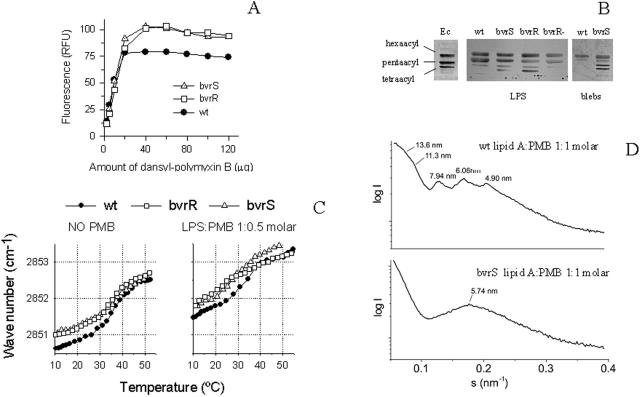
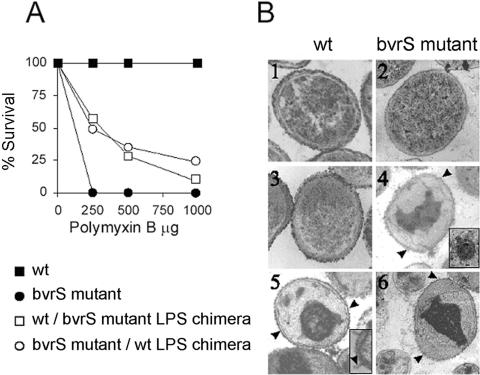
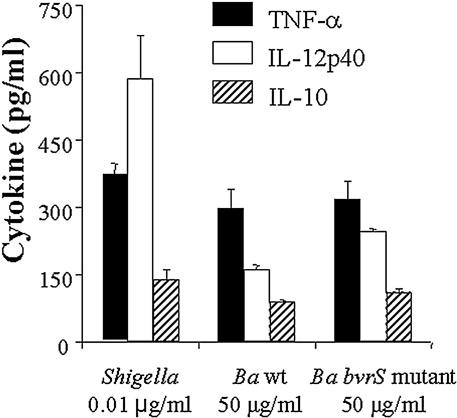
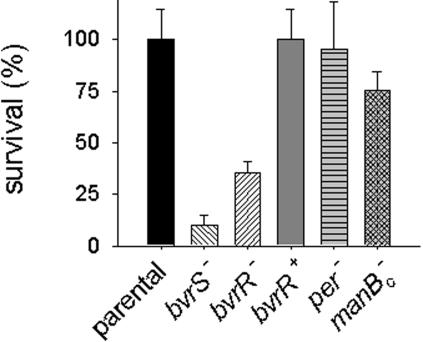
The two-component BvrS/BvrR system is essential for Brucella abortus virulence. It was shown previously that its dysfunction abrogates expression of some major outer membrane proteins and increases bactericidal peptide sensitivity. Here, we report that BvrS/BvrR mutants have increased surface hydrophobicity and susceptibility to killing by nonimmune serum. The bvrS and bvrR mutant lipopolysaccharides (LPSs) bound more polymyxin B, chimeras constructed with bvrS mutant cells and parental LPS showed augmented polymyxin B resistance, and, conversely, parental cells and bvrS mutant LPS chimeras were more sensitive and displayed polymyxin B-characteristic outer membrane lesions, implicating LPS as being responsible for the phenotype of the BvrS/BvrR mutants. No qualitative or quantitative changes were detected in other envelope and outer membrane components examined: periplasmic beta(1-2) glucans, native hapten polysaccharide, and phospholipids. The LPS of the mutants was similar to parental LPS in O-polysaccharide polymerization and fine structure but showed both increased underacylated lipid A species and higher acyl-chain fluidity that correlated with polymyxin B binding. These lipid A changes did not alter LPS cytokine induction, showing that in contrast to other gram-negative pathogens, recognition by innate immune receptors is not decreased by these changes in LPS structure. Transcription of Brucella genes required for incorporating long acyl chains into lipid A (acpXL and lpxXL) or implicated in lipid A acylation control (bacA) was not affected. We propose that in Brucella the outer membrane homeostasis depends on the functioning of BvrS/BvrR. Accordingly, disruption of BvrS/BvrR damages the outer membrane, thus contributing to the severe attenuation manifested by bvrS and bvrR mutants.
Figures
References
-
- Bengoechea, J. A., K. Brandenburg, M. D. Arraiza, U. Seydel, M. Skurnik, and I. Moriyón. 2003. Pathogenic Yersinia enterocolitica strains increase the outer membrane permeability in response to environmental stimuli by modulating lipopolysaccharide fluidity and lipid A structure. Infect. Immun. 71:2014-2021. - PMC - PubMed
-
- Bengoechea, J. A., K. Brandenburg, U. Seydel, R. Díaz, and I. Moriyón. 1998. Yersinia pseudotuberculosis and Yersinia pestis show increased outer membrane permeability to hydrophobic agents which correlates with lipopolysaccharide acyl-chain fluidity. Microbiology 144:1517-1526. - PubMed
-
- Bligh, E. G., and W. J. Dyer. 1959. A rapid method of total lipid extraction and purification. Can. J. Biochem. Physiol. 37:911-917. - PubMed
Publication types
MeSH terms
Substances
LinkOut - more resources
Full Text Sources
Molecular Biology Databases
