. 2005 Aug;187(16):5751-60.
doi: 10.1128/JB.187.16.5751-5760.2005.

Deletion of the Mycobacterium tuberculosis pknH gene confers a higher bacillary load during the chronic phase of infection in BALB/c mice

Affiliations

Deletion of the Mycobacterium tuberculosis pknH gene confers a higher bacillary load during the chronic phase of infection in BALB/c mice

K G Papavinasasundaram et al. J Bacteriol. 2005 Aug.

Abstract

The role of the serine/threonine kinase PknH in the physiology and virulence of Mycobacterium tuberculosis was assessed by the construction of a pknH deletion mutant. Deletion of the pknH gene did not affect sensitivity to the antimycobacterial drug ethambutol, although it was previously thought to be involved in regulating expression of emb genes encoding arabinosyl transferases, the targets of ethambutol. Nevertheless, transcription analyses revealed that genes associated with mycobacterial cell wall component synthesis, such as emb and ini operons, are downstream substrates of the PknH signaling cascade. In vitro survival studies revealed that a mutant with a deletion of the pknH gene displayed increased resistance to acidified nitrite stress, suggesting that nitric oxide is one of the potential environmental triggers for PknH activation. The effect of pknH deletion on mycobacterial virulence was investigated in BALB/c mice. In this model, the DeltapknH mutant was found to survive and replicate to a higher bacillary load in mouse organs than its parental strain and the pknH-complemented strain. In contrast, another closely related kinase mutant, the DeltapknE mutant, obtained from the same parental strain, was not affected in its virulence phenotype. Infection of THP-1 cells or in vitro growth studies in 7H9 medium did not reveal a significant in vitro growth advantage phenotype for the DeltapknH mutant. In conclusion, we propose that the serine/threonine kinase PknH plays a role in regulating bacillary load in mouse organs to facilitate adaptation to the host environment, possibly by enabling a regulated chronic infection by M. tuberculosis.


Figures
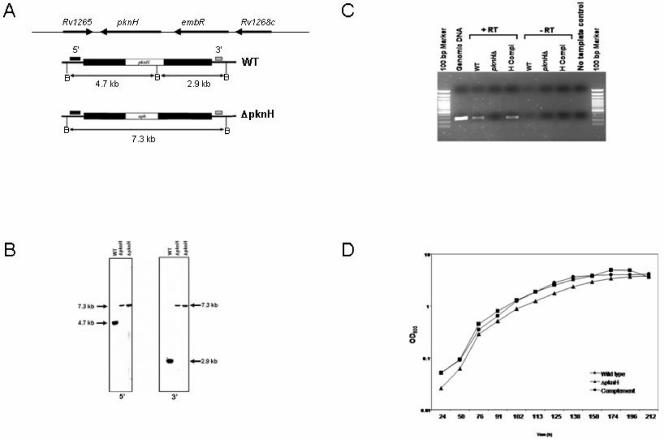
FIG. 1.
FIG. 1.
Genotype and in vitro phenotype of the M. tuberculosis ΔpknH mutant strain. (A) Structure of the M. tuberculosis pknH locus. Black bars correspond to the pknH-flanking regions that were cloned into a nonreplicating vector to make the knockout construct. Allelic exchange resulted in the replacement of pknH with a kanamycin resistance gene in the ΔpknH mutant strain. Locations of the hybridizing probes (small solid bars) and the expected sizes of the hybridizing fragments of BamHI (B) digests for each of the 5′ and 3′ Southern blots are indicated. (B) Southern blot analysis. Blots of BamHI-digested genomic DNAs from the wild type and two ΔpknH mutant isolates were hybridized to 5′ and 3′ DNA probes. The sizes of the hybridizing fragments determined from the migration distances of the molecular size markers confirmed the genomic context expected for the ΔpknH strain. (C) RT-PCR analysis. A 278-bp PCR product corresponding to an internal fragment of the pknH gene was amplified by PCR from the cDNAs of the parental wild-type strain (WT) and the complemented strain (H comp) but not from the ΔpknH mutant and the negative control reactions. Expression of the housekeeping gene sigA was found in all three strains, indicating that the lack of pknH expression in the ΔpknH strain was not due to degradation of the isolated RNA sample (data not shown). (D) pknH deletion did not affect in vitro growth of M. tuberculosis. Growth of the wild type (•), the ΔpknH mutant (▴), and the complemented strain (▪) was monitored in Dubos broth cultures. Similar growth patterns were observed during incubation in 7H9 with OADC and Proskauer and Beck medium supplemented with 0.05% Tween 80 (not shown).
FIG. 2.
FIG. 2.
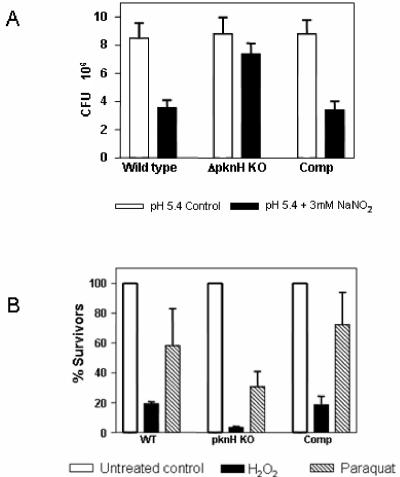
Deletion of M. tuberculosis pknH increases resistance to acidified nitrite stress. (A) Survival (CFU) of the pknH strains following exposure to 3 mM NaNO2 in acidified medium (pH 5.4) for 48 h was determined and compared with the CFU obtained from pH 5.4 medium lacking NaNO2. Error bars represent standard deviations obtained for triplicate cultures of each strain. The values obtained for the ΔpknH mutant strain are significantly different (P < 0.0001) from those for the wild type and the complement. (B) Effect of oxidizing stresses on viability of the pknH strains. Bacteria were grown in 7H9-Tween-ADS medium, exposed to different stressing reagents (10 mM H2O2 or 50 mM paraquat) for 48 h, and plated to determine viability. The bars represent mean percent survival (% CFU treated/untreated) for each treatment, and the error bars indicate standard deviations obtained from triplicate cultures.
FIG. 3.
FIG. 3.
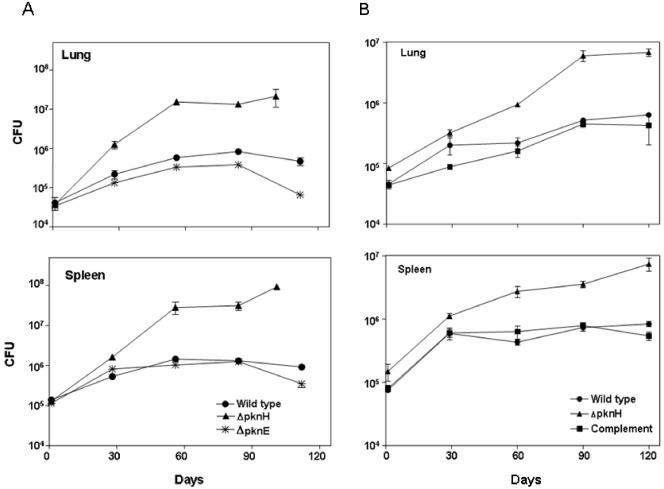
Deletion of the pknH gene leads to increased bacillary load in BALB/c mice. Following intravenous route of infection, the bacillary load in the lungs and spleen was determined in two experiments (A and B), and the mean CFU counts for the wild-type (•), ΔpknH mutant (▴), ΔpknE mutant (✻), and pknH-complemented (▪) strains were plotted. The error bars indicate standard deviation. The CFU means obtained for the ΔpknH mutant strain after day 30 are significantly greater than those of the wild type as measured by the two-tailed Student t test analysis for groups of unequal variance (P < 0.01).
FIG. 4.
FIG. 4.
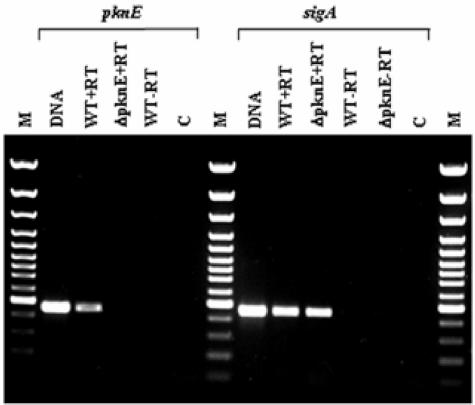
RT-PCR analysis for the expression of the M. tuberculosis pknE gene. A 447-bp PCR product corresponding to the internal DNA fragment located between positions 1188 and 1634 bp of the pknE coding sequence was amplified by PCR from the cDNAs of the wild type (WT) but not from the ΔpknE mutant and the negative control reactions. Expression of a 451-bp sigA-specific PCR product, corresponding to the 542- to 992-bp region of the sigA gene, was amplified from the RNA of both the ΔpknE mutant and its parental strain.
FIG. 5.
FIG. 5.
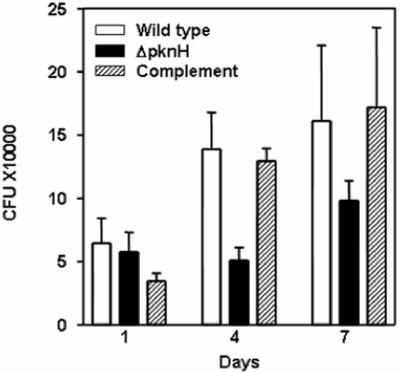
Intracellular growth of the pknH strains in THP-1 cells. Monolayers of differentiated THP-1 cells were infected with the pknH strains for 20 h, and CFU of intracellular bacteria were determined on the indicated days postinfection. The bars represent CFU means and standard deviations obtained from triplicate infections. The mean CFU differences between the ΔpknH mutant and its parental wild-type strain for days 4 and 7 are statistically significant (P < 0.05).

References

    1. Alland, D., I. Kramnik, T. R. Weisbrod, L. Otsubo, R. Cerny, L. P. Miller, W. R. Jacobs, Jr., and B. R. Bloom. 1998. Identification of differentially expressed mRNA in prokaryotic organisms by customized amplification libraries (DECAL): the effect of isoniazid on gene expression in Mycobacterium tuberculosis. Proc. Natl. Acad. Sci. USA 95:13227-13232. - PMC - PubMed
    1. Alland, D., A. J. Steyn, T. Weisbrod, K. Aldrich, and W. R. Jacobs, Jr. 2000. Characterization of the Mycobacterium tuberculosis iniBAC promoter, a promoter that responds to cell wall biosynthesis inhibition. J. Bacteriol. 182:1802-1811. - PMC - PubMed
    1. Av-Gay, Y., and M. Everett. 2000. The eukaryotic-like Ser/Thr protein kinases of Mycobacterium tuberculosis. Trends Microbiol. 8:238-244. - PubMed
    1. Av-Gay, Y., S. Jamil, and S. J. Drews. 1999. Expression and characterization of the Mycobacterium tuberculosis serine/threonine protein kinase PknB. Infect. Immun. 67:5676-5682. - PMC - PubMed
    1. Bakal, C. J., and J. E. Davies. 2000. No longer an exclusive club: eukaryotic signalling domains in bacteria. Trends Cell Biol. 10:32-38. - PubMed

Publication types

MeSH terms

LinkOut - more resources