Comparative Study
. 2005 Dec;171(4):1463-75.
doi: 10.1534/genetics.105.046458. Epub 2005 Aug 3.

Genetic and genomic analysis of the AT-rich centromere DNA element II of Saccharomyces cerevisiae

Affiliations
Comparative Study

Genetic and genomic analysis of the AT-rich centromere DNA element II of Saccharomyces cerevisiae

Richard E Baker et al. Genetics. 2005 Dec.

Abstract

Centromere DNA element II (CDEII) of budding yeast centromeres is an AT-rich sequence essential for centromere (CEN) function. Sequence analysis of Saccharomyces cerevisiae CDEIIs revealed that A(5-7)/T(5-7) tracts are statistically overrepresented at the expense of AA/TT and alternating AT. To test the hypothesis that this nonrandom sequence organization is functionally important, a CEN library in which the CDEII sequences were randomized was generated. The library was screened for functional and nonfunctional members following centromere replacement in vivo. Functional CENs contained CDEIIs with the highly biased A(n)/T(n) run distribution of native centromeres, while nonfunctional CDEIIs resembled those picked from the library at random. Run content, defined as the fraction of residues present in runs of four or more nucleotides, of the functional and nonfunctional CDEII populations differed significantly (P < 0.001). Computer searches of the genome for regions with an A + T content comparable to CDEIIs revealed that such loci are not unique to centromeres, but for 14 of the 16 chromosomes the AT-rich locus with the highest A(n > or =4) + T(n > or =4) run content was the centromere. Thus, the distinctive and nonrandom sequence organization of CDEII is important for centromere function and possesses informational content that could contribute to the determination of centromere identity.


Figures
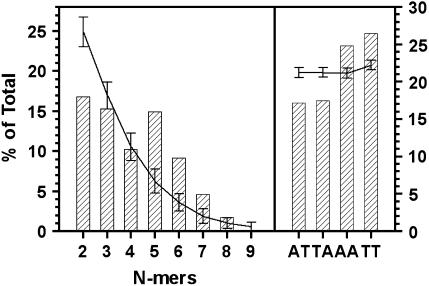
Figure 1.
Figure 1.
An/Tn run and dinucleotide content of S. cerevisiae CDEII sequences. CDEII is defined as shown in Figure 2. Results are shown only for AT, TA, AA, and TT dinucleotides (right). All results are expressed as the percentage of total nucleotides. Curves show the means of randomization trials with error bars showing the standard deviation of 100 trials.
Figure 2.
Figure 2.
Design of replacement CENs containing randomized CDEII. The middle line shows the consensus sequence of the 16 endogenous S. cerevisiae centromeres where the height of each letter is proportional to its frequency of occurrence at that position (Schneider and Stephens 1990). The sequence logos were generated by WebLogo (Crooks et al. 2004). Below the consensus sequence is shown the DNA sequence of the replacement centromeres generated by ligation of the randomized CDEII segments into the pRB507 vector (see materials and methods).
Figure 3.
Figure 3.
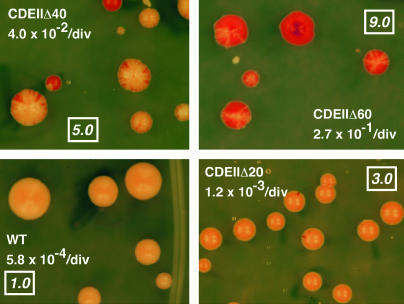
Visual assay of chromosome loss rate. A wild-type and three CDEII deletion CENs were used to replace CEN3 in diploid strain R99 as described in materials and methods. The CDEII deletions had a common endpoint at the CDEII-CDEIII junction. The sectoring phenotype and the mitotic loss rate of the marked chromosome determined by fluctuation analysis are shown. The boxed numbers are the numerical scores assigned to that phenotype.
Figure 4.
Figure 4.
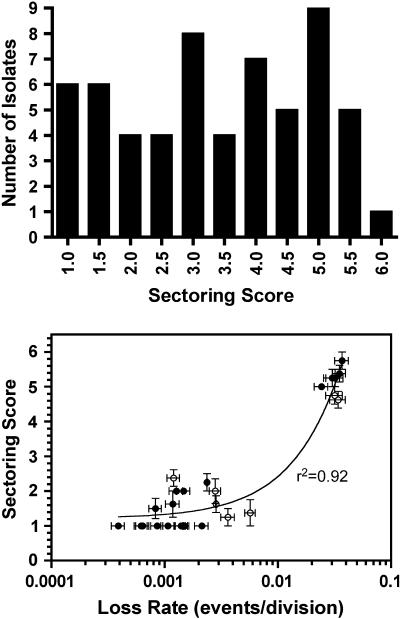
Histogram of sectoring scores determined for randomly picked transformants carrying replacement centromeres from the randomized CDEII CEN library (top) and correlation between sectoring score and loss rate determined by fluctuation test (bottom). The curve (bottom) represents the least-squares linear regression fit of the data. Open circles indicate strains omitted from further analysis.
Figure 5.
Figure 5.
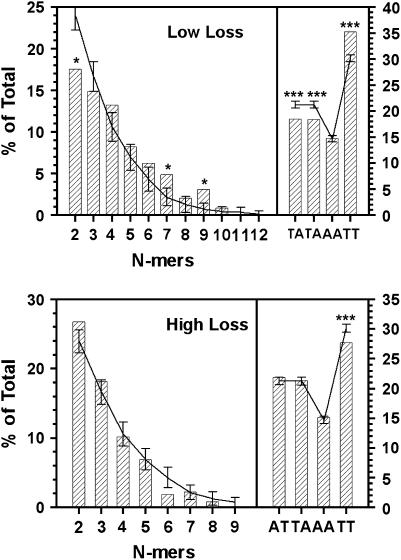
An/Tn run and dinucleotide content of low- and high-loss CDEIIs. The NdeI site common to all sequences and technically part of CDEII (see Figure 2) was not included in the analysis. Results are shown only for AT, TA, AA, and TT dinucleotides (right). All results are expressed as the percentage of total nucleotides. Curves show the means of randomization trials with error bars showing the standard deviation of 100 trials. *, P < 0.05; ***, P < 0.001.
Figure 6.
Figure 6.
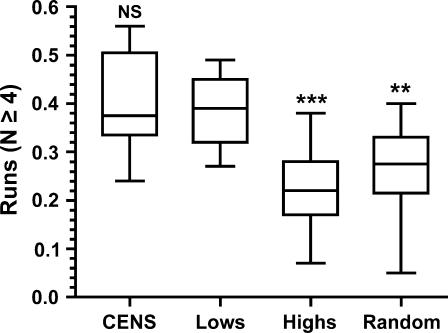
Box plots of homopolymer run content of CDEII sequences. Horizontal lines indicate the median, with the box showing the 25th and 75th percentile bounds; error bars show the extremes. The results of Bonferroni's multiple comparison test comparing the “Lows” group with all other groups are shown above the plots. CENS, endogenous CDEIIs; Lows, low-loss CDEII population; Highs, high-loss CDEII population; Random, 16 random CDEII clones; NS, not significant; **, P < 0.01; ***, P < 0.001.
Figure 7.
Figure 7.
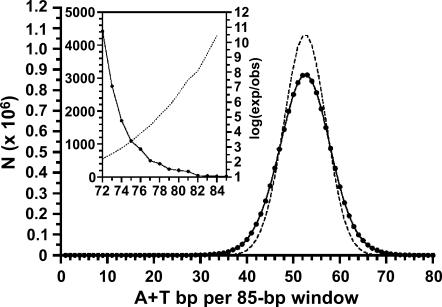
Genomic distribution of A + T content. Solid symbols indicate the number of 85-bp windows in the yeast genome containing the number of A + T residues given on the x-axis. Dotted line shows the result expected at random. The inset shows the right-hand extreme of the distribution. The dotted line of the inset shows the likelihood of occurrence, plotted as the log10 of the ratio of expected to observed occurrences (values are negative).
Figure 8.
Figure 8.
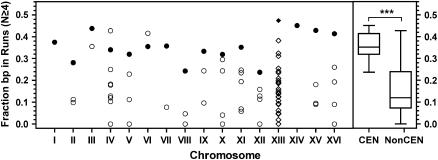
Run content of AT-rich chromosomal loci. Each circle represents a locus having a local A + T content of ≥90.6%. Chromosome XIII loci (diamonds) have an A + T content of ≥85.9% (see text). Solid symbols designate the centromere loci. Box plots of the run content of centromere and noncentromere loci (as in Figure 6) are shown on the right. ***, P < 0.001 (two-tailed t-test).

References

    1. Anselmi, C., G. Bocchinfuso, P. De Santis, M. Savino and A. Scipioni, 2000. A theoretical model for the prediction of sequence-dependent nucleosome thermodynamic stability. Biophys. J. 79: 601–613. - PMC - PubMed
    1. Baker, R. E., K. Harris and K. Zhang, 1998. Mutations synthetically lethal with cep1 target Saccharomyces cerevisiae kinetochore components. Genetics 149: 73–85. - PMC - PubMed
    1. Baker, R. E., and D. C. Masison, 1990. Isolation of the gene encoding the Saccharomyces cerevisiae centromere-binding protein CP1. Mol. Cell. Biol. 10: 2458–2467. - PMC - PubMed
    1. Brown, M. T., 1995. Sequence similarities between the yeast chromosome segregation protein Mif2 and the mammalian centromere protein CENP-C. Gene 160: 111–116. - PubMed
    1. Carbon, J., and L. Clarke, 1984. Structural and functional analysis of a yeast centromere (CEN3). J. Cell Sci. Suppl. 1: 43–58. - PubMed

Publication types