


Diverse DNA transposons in rotifers of the class Bdelloidea
- PMID: 16081532
- PMCID: PMC1188004
- DOI: 10.1073/pnas.0505333102
Diverse DNA transposons in rotifers of the class Bdelloidea
Abstract
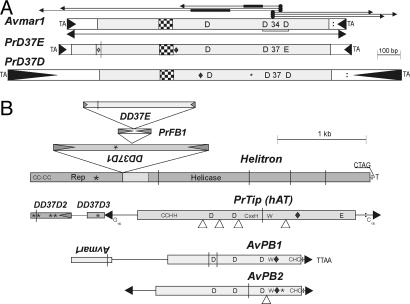
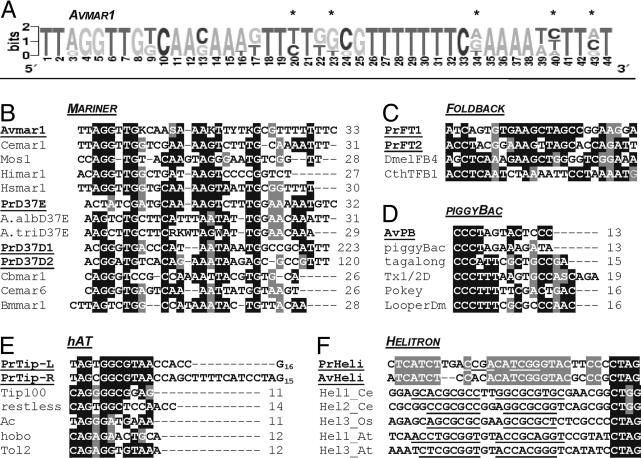
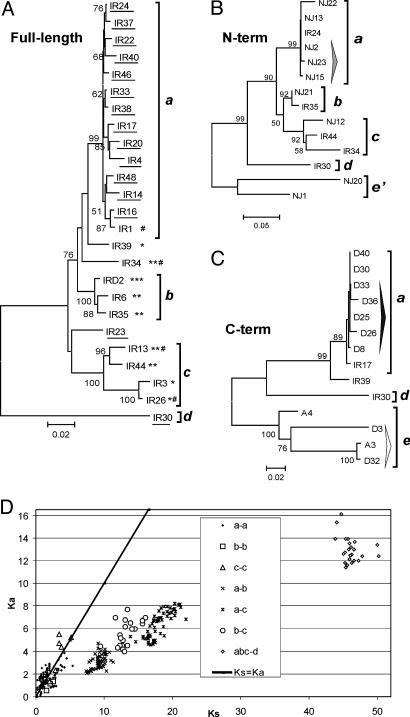
We surveyed the diversity, structural organization, and patterns of evolution of DNA transposons in rotifers of the class Bdelloidea, a group of basal triploblast animals that appears to have evolved for millions of years without sexual reproduction. Representatives of five superfamilies were identified: ITm (IS630/Tc/mariner), hAT, piggyBac, helitron, and foldback. Except for mariners, no fully intact copies were found. Mariners, both intact and decayed, are present in high copy number, and those described here may be grouped in several closely related lineages. Comparisons across lineages show strong evidence of purifying selection, whereas there is little or no evidence of such selection within lineages. This pattern could have resulted from repeated horizontal transfers from an exogenous source, followed by limited intragenomic proliferation, or, less plausibly, from within-host formation of new lineages under host- or element-based selection for function, in either case followed by eventual inactivation and decay. Unexpectedly, the flanking sequences surrounding the majority of mariners are very similar, indicating either insertion specificity or proliferation as part of larger DNA segments. Members of all superfamilies are present near chromosome ends, associated with the apparently domesticated retroelement Athena, in large clusters composed of diverse DNA transposons, often inserted into each other, whereas the examined gene-rich regions are nearly transposon-free.
Figures
References
-
- Mayr, E. (1963) Animal Species and Evolution (Harvard Univ. Press, Cambridge, MA).
-
- Mark Welch, D. & Meselson, M. (2000) Science 288, 1211-1215. - PubMed
-
- Normark, B. B., Judson, O. & Moran, N. (2003) Biol. J. Linn. Soc. 79, 69-84.
-
- Curcio, M. J. & Derbyshire, K. M. (2003) Nat. Rev. Mol. Cell. Biol. 4, 865-877. - PubMed
-
- Kazazian, H. H., Jr. (2004) Science 303, 1626-1632. - PubMed
Publication types
MeSH terms
Substances
Associated data
- Actions
- Actions
- Actions
- Actions
- Actions
- Actions
- Actions
- Actions
- Actions
- Actions
- Actions
- Actions
- Actions
- Actions
- Actions
- Actions
- Actions
- Actions
- Actions
- Actions
- Actions
- Actions
- Actions
- Actions
- Actions
- Actions
- Actions
- Actions
- Actions
- Actions
- Actions
- Actions
- Actions
- Actions
- Actions
- Actions
- Actions
- Actions
- Actions
- Actions
- Actions
- Actions
- Actions
- Actions
- Actions
- Actions
- Actions
- Actions
- Actions
- Actions
- Actions
LinkOut - more resources
Full Text Sources
Other Literature Sources
