


Tailored education may reduce health literacy disparities in asthma self-management
- PMID: 16081544
- PMCID: PMC2718412
- DOI: 10.1164/rccm.200409-1291OC
Tailored education may reduce health literacy disparities in asthma self-management
Abstract
Rationale: Although inadequate health literacy has been associated with lower asthma medication knowledge and worse metered-dose inhaler (MDI) technique, the relationship between health literacy and the capacity to learn asthma self-management skills is unknown.
Objectives: In this prospective cohort study of adults hospitalized for severe asthma exacerbations at two inner-city hospitals, we examined the relationship between inadequate health literacy and difficulties learning and retaining instructions about discharge medications and appropriate MDI technique.
Methods: At hospital discharge, participants received one-on-one, 30-min, guideline-based, written and oral instruction about their asthma discharge regimen as well as appropriate MDI technique.
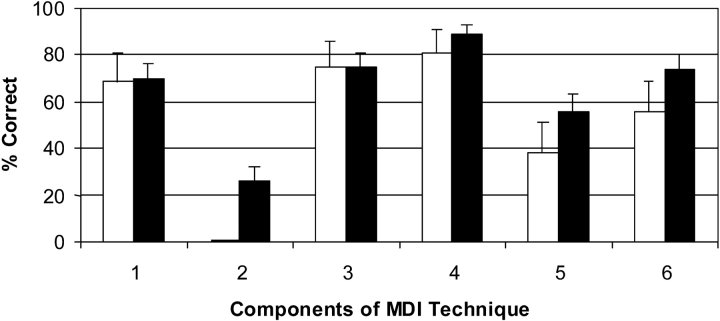
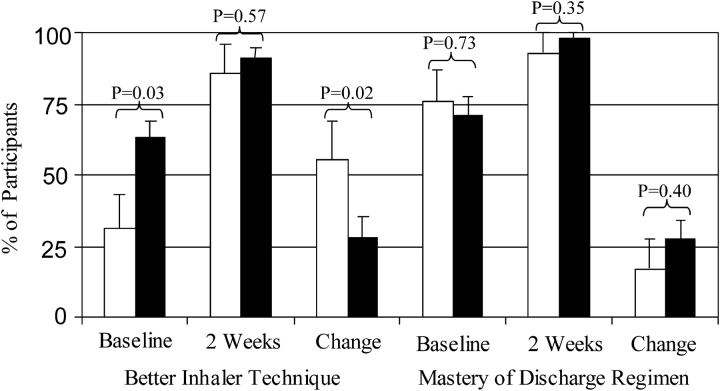
Measurements and main results: Seventy-three patients were enrolled. Inadequate health literacy was identified in 16 (22%) participants. Before instruction, inadequate health literacy was associated with lower asthma medication knowledge (5.2/10 vs. 7.2/10, p < 0.001) and worse MDI technique (3.2/6 vs. 3.9/6, p = 0.03). However, inadequate health literacy was not associated with difficulty learning (p = 0.33) or retaining (p = 0.35) instructions about the discharge regimen. Similarly, inadequate health literacy was not associated with difficulty learning (p = 0.26) or retaining (p = 0.97) appropriate MDI technique. Results were similar in multivariable models adjusted for demographic characteristics and asthma severity indicators.
Conclusions: These findings suggest that inadequate health literacy is a surmountable barrier to learning and remembering key asthma self-management skills.
Figures
References
-
- Adams K, Corrigan JM. Institute of Medicine. Priority areas for national action: transforming health care quality. Committee on Identifying Priority Areas for Quality Improvement. Washington, DC: National Academies Press; 2003. - PubMed
-
- Carmona RH. Surgeon General of the United States: health literacy in America: the role of health care professionals. Prepared remarks given at the American Medical Association House of Delegates Meeting, June 14th, 2003. Available from: http://www.surgeongeneral.gov/news/speeches/ama061403.htm (accessed February 19, 2004).
-
- Ratzan SC, Parker RM. Introduction. In: Selden CR, Zorn M, Ratzan SC, Parker RM, editors. National Library of Medicine current bibliographies in medicine: health literacy. Vol. NLM. Bethesda, MD: National Institutes of Health, U.S. Department of Health and Human Services; 2000. Publication No. CBM 2000-1. Available from: http://www.nlm.nih.gov/pubs/cbm/hliteracy.html (accessed January 15, 2004).
-
- Nielsen-Bohlman LT, Panzer AM, Hamlin B, Kindig DA. Institute of Medicine. Health literacy: a prescription to end confusion. Committee on Health Literacy, Board on Neuroscience and Behavioral Health. Washington, DC: National Academies Press; 2004. - PubMed
Publication types
MeSH terms
Grants and funding
LinkOut - more resources
Full Text Sources
Other Literature Sources
Medical
